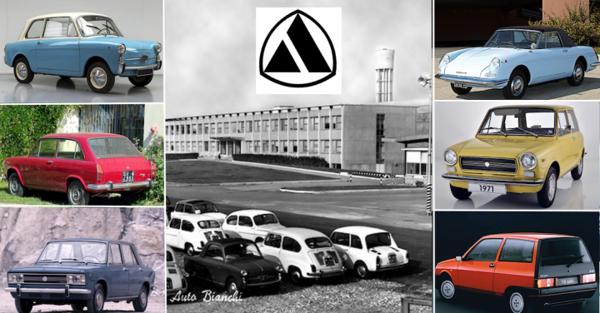
Autobianchi, the brand of legendary cars such as the Primula, Bianchina and A112
The brand was born from an agreement between Bianchi, Fiat and Pirelli equal partners with the aim of launching a range of cars with original features

4' min read
Key points
4' min read
The Autobianchi brand was born on 11 January 1955, from an idea of Bianchi's general manager, Ferruccio Quintavalle, to involve Fiat and Pirelli in a commercial operation that would give rise, with the capital of the three equal partners, to a new car production. Pirelli thus enlarged its market in the supply of its own tyres, Fiat took the opportunity to manufacture an auxiliary model to its own, but for customers motivated by a desire for distinction and also to guarantee itself a test-bed for alternative solutions, without having negative repercussions on its own brand, while Bianchi, sharing with the other partners an economic effort that it could not sustain, re-entered the car market at the end of the war.
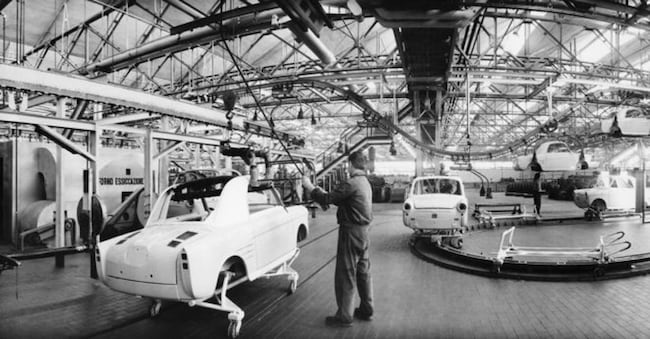
Production at the Bianchi factory in Desio
.The factory would remain in Desio, where Bianchi already had a suitable 140,000 square metre facility. The factory, after being improved and innovated, with a fully automated system of paint booths that was extremely modern for the time, began production of 200 cars a day. Autobianchi, however, did not take ownership of the factory until 1958, when the company that had been owned by Edoardo Bianchi sold its shares to the other two partners and Giuseppe Bianchi resigned from his position as president, which was taken over by Ferruccio Quintavalle on 28 June 1958.
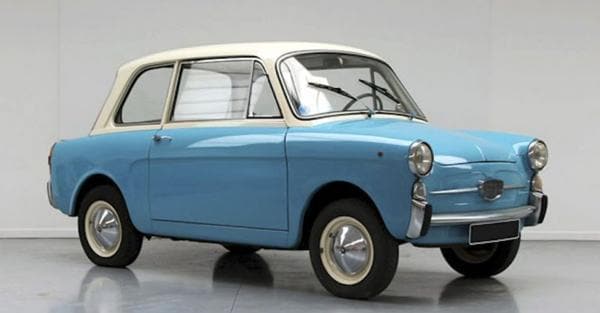
Bianchina the Fiat 500's close cousin
.The first car resulting from this union was derived from the assembly of an original body and a mechanical base of another model produced by the Turin-based company, namely the Fiat 500. The engine, behind the cockpit, was an in-line 2-cylinder with 15 hp. This new car, marked 110 B, was given the name Bianchina, in memory of the first car designed by Edoardo Bianchi. It was presented on 16 September 1957 at the Science and Technology Museum in Milan. It was a convertible saloon with a sunroof, more refined than the 500 and aimed at a more discerning public: two-tone bodywork, chrome on the sides and underneath the door and wheel covers. Pirelli whitewall tyres and defroster fitted as standard. Price 565,000 lire.
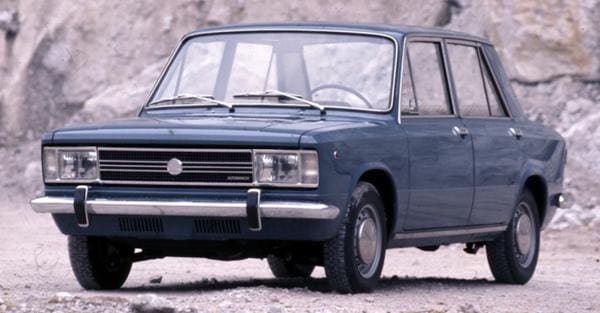
11,000 units produced in one year
.In 1958, the first year of distribution, as many as 11,000 Bianchine were produced. Success led to a diversification of models, with the Trasformabile Special, Cabriolet, Panoramica, 4-seater normal and Special saloon and Furgoncino being born over the years. The Trasformabile Special featured a 500 Sport engine boosted to 21 hp, a top speed of over 105 km/h compared to 85 km/k and bright red bodywork and grey roof. The Cabriolet unveiled in April 1960, was a refined open-top version. The Panoramica was the first family version with a new rear design and a rear window roof for maximum interior utilisation. Finally, the 4-seater normal and special saloon, in production since 1962, allowed a family of four to use the car comfortably. For commercial transport, in the city area, the furgonata was produced with sheet metal in place of the rear windows and offered a raised roof to increase capacity.
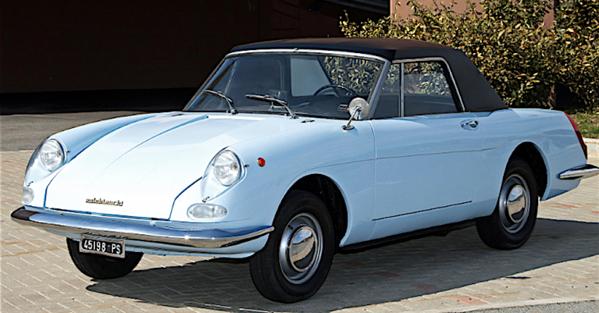
The Spider Stellina in polyester resin
.Autobianchi's experimental vocation found particular expression in June 1963 with the entry into production of the Spider Stellina, previewed at the Turin Motor Show that year. The Stellina was the first Italian car with a body in polyester resin and glass fabric, a combination that offered mechanical and physical characteristics of technical and commercial interest to the automotive industry. The essential features were high resistance to traction, compression, bending and above all impact, extreme lightness, the ability to dampen vibrations and consequent quietness, resistance to both chemical agents and above all corrosion, as well as low levels of thermal and even electrical conductivity.