
Magical autumn in the forests and villages of the Ambroz Valley
In the Extremadura region, austere nature is the setting for Roman ruins, abbeys, fortresses and villages where different peoples have met for centuries and which preserve history and sacredness
3' min read
Key points
3' min read
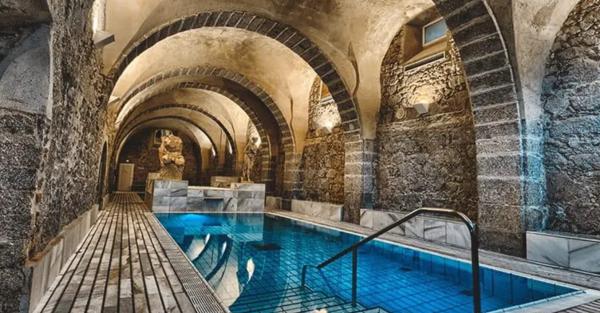
In the Valle del Ambroz, in that Extremadura where the Celtic culture and the ancient Romans, especially in the town of Caparra, have left indelible traces, autumn is cloaked in magic. One is surrounded by mountains that exceed 2,000 metres, such as the Pinajarro, covered with forests of wise and centuries-old chestnut trees. Your mouth is tantalised by the prized chilli peppers that grow luxuriantly in Aldeanueva del Camino, on the banks of the Rio Ambroz. And it is irresistible the temptation to at least stick one's feet into the natural pools of Casas del Monte and Abadía or to let oneself be reached by the splash of the waterfall of La Chorrera, until plunging one's whole body into the warm waters of the Roman thermal baths in Baños de Montemayor, used since the 2nd century for their mineral and medicinal properties.
Freedom Routes
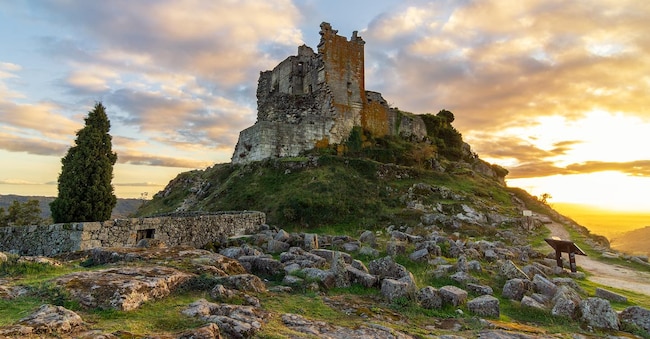
.On the road or backpacking, we set off for the Renaissance palace of Sotofermoso: the former fortress inhabited by the Templars a short distance from the Convento de la Bien Parada and the medieval bridge of Abadía, later transformed into an abbey entrusted to the Cistercian monks, presents a highly original architecture, with its undulating roof and cloister surrounded by colonnaded porticoes. Granadilla, with its circular perimeter enclosed by walls, also has great charm, also due to its foundation by the Arabs when they were lords of Granada.
In Hervas, on the other hand, Jewish traditions have never waned and are renewed in the many celebrations that take place in the heart of its network of narrow streets, with unbaked bricks and roofs resting on chestnut beams, covered with tiles of Arab origin: the 18th-century Dávila building is certainly the most emblematic building for discovering the history of this town, which still boasts leather craftsmen's workshops and 14th-century hermitages such as those of San Andrés and San Antón. In the small mountain community of Segura de Toro, on the other hand, the symbol is the Celtic stone bull dating back to the 4th century B.C. that stands in the centre of the square, witness to the pre-Roman Vetoni civilisation, dedicated to cattle breeding. Almost all the houses are made of ashlar stone, bearing flowers on their wooden balconies overlooking the valley that slopes down from the mountainous massif of Tras la Sierra carpeted with oak forests. The entire village rests on a ridge of this high ground, to which what remains of a Templar castle is also attached, while the interior of the Renaissance church of San Juan, also originally a fortress, as evidenced by its tower, is all carved in chestnut wood.
Verso La Garganta
Even if the first sprinkling of snow is delayed, climbing on foot or driving to La Garganta offers a romantic route through the landscape at the foot of the Sierra de Candelario, a naturalistic setting for the highest village in the entire Ambroz Valley: when the Covatilla slope opens, skiing will be possible in the Sierra de Bejar, but in the meantime these are the ideal weeks for senderismo, hiking along the paths that penetrate birch and holly forests, up and down spectacular gorges, keeping the telescope always within eye reach to admire the birds. In addition to the neviera used until a few decades ago, there are some stone stalls here where animals were kept during the transhumance. And while the church of the Assumption venerates the Virgen del Castañar, patron saint of the village, the hermitage of San Gregorio is the destination of many pilgrimages. A trip to the Valle del Ambroz cannot, however, be separated from Cáceres, where one enters almost escorted by the storks that fly here in every season. The streets are all cobbled, Renaissance palaces encircle Plaza Mayor. Entering through the 18th-century Arco de la Estrella, one perceives how time seems to have stood still under its arcades, over which towers the Torre de Bujaco, named after the Caliph Abú-Ya'qub, who conquered the city in 1173. The Golfines de Abajo, Carvajal and Toledo-Moctezuma palaces, together with the Casa de Las Veletas (in which works by Picasso and Miró are exhibited and the second largest cistern in the world is located), immediately make the city intimate, which can also be admired from the top of the bell tower of the Santa María Co-cathedral. It would be a shame, finally, not to give in to the temptations of gluttony: the Torta del Casar cheese and the migas with stale bread and bacon, with a glass of Ribera del Guadiana, will celebrate winter.

