
Axitea, artificial intelligence to enhance private security services
In the security ecosystem created by Axitea, a 92 million turnover company, artificial intelligence and robotics also find practical applications

3' min read
3' min read
'Building security is a constantly evolving process and we believe in an ongoing dialogue between the future and a sustainable ethical vision'. Marco Bavazzano has been the ceo of Axitea since 2014, taking over a company with a loss of 75 million. With him at the helm, a path of growth and renewal was set in motion, which over the years has enabled the company to enrich its offer with innovative services and solutions, while preserving that pioneering spirit (the business began in 1914, ndr.) that has distinguished its approach to security. After the creation of Sicurglobal, through the unification of 22 Italian private security companies, and the acquisition in 2008 by the English fund Stirling Square Capital Partners, the group integrated its offer with control systems and alarm systems, becoming Axitea in 2011, which today has 26 operating branches in Italy and 1,100 employees, 95% of whom have permanent contracts.
"Although physical security is widespread, future growth is linked to the ability to innovate and integrate," says Bavazzano. "In fact, it is no longer enough to protect only the perimeter: Italian companies are looking for complete and interconnected solutions for more effective management. Thus, in the security ecosystem created by Axitea, artificial intelligence and robotics also find practical applications, strategic development levers for both large companies and SMEs, presented through info-training days for entrepreneurs, opened by a group selected by Confapi Industria Ancona.
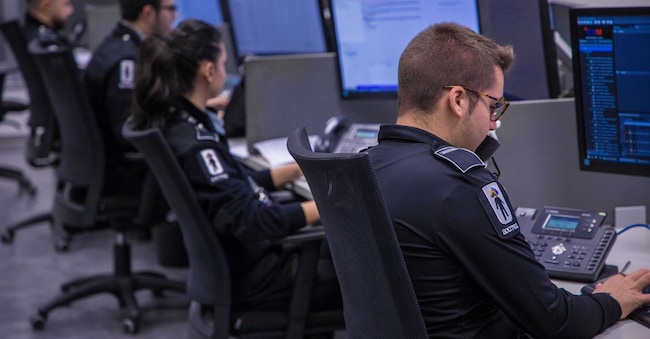
'Artificial intelligence plays a key role in the early identification of intrusions, thanks to advanced video surveillance algorithms,' explains the CEO. 'More than six thousand video streams have been analysed to date by AI, which provides crucial support to the analysts in our Security Operation Centre in detecting dangerous situations.
A use that is also determined in the detection of computer incidents and in the programming of customised software and programmes, such as the monitoring of boats in the protected area of the Isola dei Ciclopi, in Sicily, where a system of GPS sensors tracks, in real time and in anonymised mode, the movements of boats; the start-up phase saw an initial experimentation involving a dozen boats and small fishing boats operating in the area to monitor their routes and stopping points for fishing, defined by the areas where the speed of navigation is between 0 and 15 km/h, and the data collected are cross-referenced with those, recorded at the port on return, of the quantity and quality of fish actually caught, to create a very realistic picture of the situation of the fish resources in the area.
"This is the first time that satellite technology has been applied in such a granular way to a project that is preparatory to any possible initiative aimed at safeguarding fish stocks and optimising fishing activities, both in terms of yield and environmental impact," Bavazzano points out. Alongside AI is robotics, which can support humans in carrying out inspections in inaccessible places or over great distances, making surveillance and security operations more effective and safer.

