
Balenciaga: couture as the theatre of life
In his debut collection, Pierpaolo Piccioli focuses on sculptural forms and showcases his extraordinary sense of colour once again. Decadence and moderation as interpreted by Viktor & Rolf; distorted and ironic shapes by Gaultier

The cycle of fashion is relentless: when trends change, everything else seems outdated, but far from being a curse, this situation is a stimulating creative challenge.
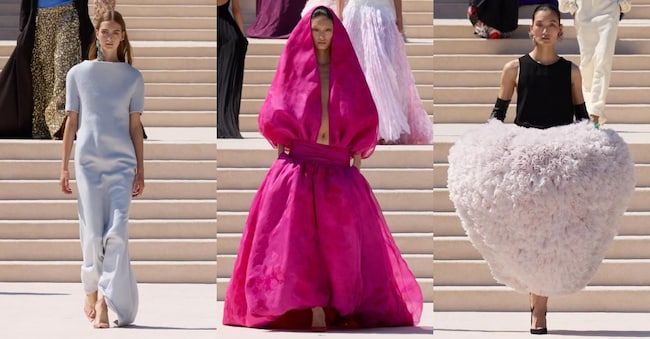
Pierpaolo Piccioli’s debut haute couture show for Balenciaga – the fiftieth for the Kering Group’s fashion house – is a magnificent display of pure sartorial theatrics, featuring sculptural silhouettes and fluid, gestural volumes enhanced by a truly unique colour palette. Yet, despite the splendour, what is truly striking is the sense that Piccioli has picked up exactly where he left off with his final couture show for Valentino: from the soundtrack to the staging of the show, right through to the final catwalk appearance alongside the entire atelier team, it all feels like déjà vu.
Of course, Piccioli was hired precisely to do what he is doing, not to mention the numerous tributes paid to Cristóbal Balenciaga himself over the years. In other words, he is the right person in the right place. And yet, despite the pursuit of lightness and the attempt – albeit a subtle one – to convey a sense of ease, the collection feels a little heavy, lacking a vision that truly anchors Balenciaga in the present.
Robert Wun lives in a bubble of his own: a fantastical, edgy world populated by otherworldly characters, whose identities are constructed through costumes of meticulous precision. Costumes, not clothes: that is what Wun’s creations are, which also explains his success amongst the crème de la crème of ultra-narcissists. Whether you like it or not, however, the standard of craftsmanship is always high and refined. This latest collection is particularly successful and light-hearted: it really does seem as though everything has been created by a child, despite the rigidity of the shapes.
Conceptual to the core, with an innate talent for effortless theatricality, Viktor & Rolf offer an incisive and highly timely commentary on the contradictions of the present, taking the form of a play starring Moderation and Decadence: two identical women wearing identical outfits, the former in sackcloth, the latter in sequins and gold. As the two dress and undress on a revolving platform, the message emerges clearly: Decadence and Moderation are opposite sides of the same coin, identical expressions of excess, one through subtraction, the other through addition. Which means: balance is what is truly lacking today.

