Paris Fashion Shows/6

Balenciaga restarts with Piccioli's signature light austerity

The designer brings his vision, convincingly, to the Kering group's maison. For Hermès ride in the Camargue, return to his roots for Glenn Martens on his debut at Maison Margiela

by Angelo Flaccavento

Balenciaga PE 2026

4' min read

Translated by AI
Versione italiana

4' min read

Translated by AI
Versione italiana

Reducing: an ever valid perspective, invigorating at any moment in history, helping to tame abundance or accept hard times, or simply reminding us how much beauty there is in subtraction. The sixth day of the Paris fashion shows sees the reductionists come out into the open.
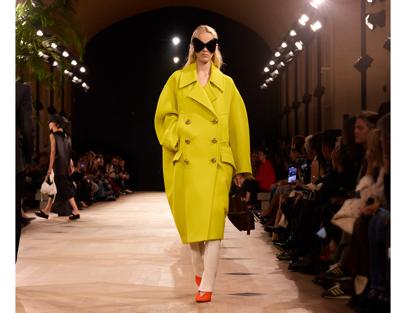
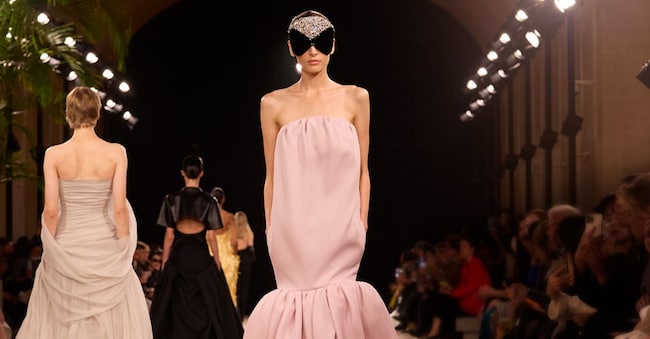
Pierpaolo Piccioli is a lyrical purist, whose entry, announced in May, into the Balenciaga maison, temple of austere and architectural fashion - with recent highly successful expressionist deviations by Demna - immediately seemed like a fateful event: the right person in the right place. The debut show confirms the initial impression even though there is much to put right, not for lack of ability, but because the vision does not appear clear and the message is evidently fragmented in multiple, discordant directions. At first glance, the saturated colours, the taste for verticality and the sense of inapparent virtuosity immediately recall Piccioli's Valentino, almost as if this might be the day after.

Loading...

It is a substantial part of what is seen on the catwalk, which smacks of what has already been seen, but which is mixed with an attempt at something harder, tighter, black - very interesting - something more suitable for the street - bomber jackets, chinos: to be fine-tuned - and more flourescent lightnesses and sack dresses. Finding a key to interpretation - given Balenciaga's successes and the current type of audience - is certainly not straightforward, but the desire to get there by going down many roads is evident, and confusing.
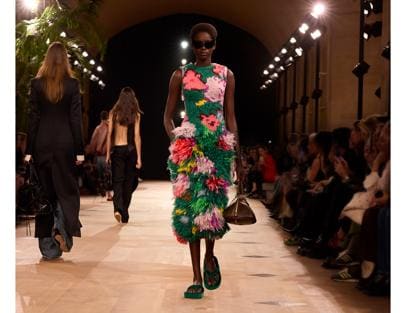
This is a character that is being seen in many collections at the moment: the choice of doing not everything but everything, chasing the philosopher's stone of transversal success. A theory understandable in shops, less so on the catwalk. If there is a designer capable of using a collection in a declarative and concise manner, it is Piccioli, and Balenciaga is the place to do it.

Glenn Martens makes his debut at Maison Margiela, leaving the last theatre behind to immerse himself in the everyday, which was then what Martin Margiela did. With resoluteness and observance, he makes a decisive return to the founding code, kept alive until now only by MM6 - the sister line with which conflicts could henceforth arise - and focuses on a severe and vertical silhouette, sober and subdued, which becomes exploration territory for virtuosities and experiments both archival and new, from the fusion of scotch and dress to shadow effects with linings coming out, to the integration of plastrons and evening scarves in the garments.

The fashion show is accompanied by the live performance of very young musicians from Romilly-sur-Seine who perform classical pieces in the ramshackle manner that is typical for children. It's a tender note, which on the one hand recalls the fanfares des beaux arts so often used by the Maison, but on the other induces a reflection on patience, because arriving at the right chords requires many rehearsals, just like arriving at the harmony of an orchestra. The flavour of this debut is at once confident and fearful: it resets to start again, but at the moment it all smacks of a task performed with zeal.

There are few traces of Martens' sardonic verve: just the four dots on the label turned into a diabolical mouth-blocking machine showing teeth.

Also working in reduction is Pieter Mulier, who at Alaïa explores the sculptural cleanliness of the line in a seductive and statuesque key. There is no decoration - except for the long fringes swaying from the Parisian stockings - only form, volume, colour. It is a proposal with a strong visual impact, undermined, however, by a hesitant limitation: the bodies that Mulier glorifies, but often punishes almost for the mere sake of the master's touch, are idealised bodies of models and it is difficult to imagine his creations on the limbs of real women in moments of real life. The result is somehow cold, misogynistic and distant from actual use and it is a pity because in Azzedine Alaïa's work, the ability to redesign any body and make clothes to wear was central and was the reason for his enormous success.

Hermès, la collezione per la PE 2026

Photogallery21 foto

Sensuality is decisive at Hermès, where Nadège Vanhee confirms herself in a state of creative grace. Thinking of the Camargue, she interprets the equestrian roots of the maison in a freer and wilder key, but also more connected to the sea, playing with the dialogue between the naked skin of the body and the skin of the clothes, opening up glimpses and revealing then using scarves, another staple, as covers and connections. The counterpoint works, so that the composed world of Hermès is charged with desire, but does not lose authenticity.

Rei Kawakubo of Comme des Garçons has for some years now become the abbess of bulbous forms, of distorting abstractions, of overpowering, gripping drama. This season the bulbs are still there, but the spirit is paradoxically light: it is conveyed by raw materials such as sack jute and lined cotton from old sheets, and spontaneous forms, like those created when playing as a child. All this, with a country aroma, of reconnection to the rhythm of nature, and something earthy that makes one think of Sardinian mamutones.

Junya Watanabe, on the other hand, plays with the most incongruous objects, from hangers to forks, which she accumulates on the silhouette creating otherwise impossible shapes. At Ann Demeulemeester, finally, Stefano Gallici imagines a collision between romantic rebellion and basketball that, however droll on paper, works on the catwalk. Ann's fanatics will perhaps invoke anathema, and indeed Antwerp is increasingly distant, even as a horizon of meaning, but Gallici is true to the spirit: viscerality of feeling.

Copyright reserved ©
Loading...

Brand connect

Loading...

Newsletter

Notizie e approfondimenti sugli avvenimenti politici, economici e finanziari.

Iscriviti