
Ballots, open polls: who has the upper hand and alliances
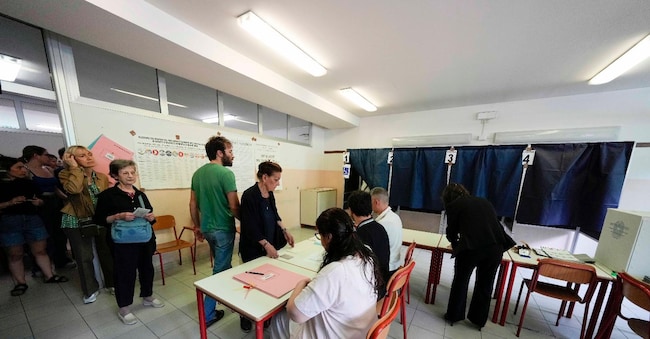
Voting will take place, in just over 100 municipalities, from 7 a.m. to 11 p.m. on Sunday 23 June and from 7 a.m. to 3 p.m. on Monday 24. All eyes are on the five regional capitals: Florence, Bari, Perugia, Potenza and Campobasso.

7' min read
Key points
- When voting
- Bari Leccese reunites wide field, Romito back
- Florence challenge between wide field and centre-right, turnout rebus
- In Perugia candidates divided by a handful of votes
- Campobasso on the ballot, De Benedittis-Forte challenge
- In Potenza, open challenge, Fanelli (centre-right) starts from 40%
- In Caltanissetta, no wide field for the ballot
7' min read
Polling stations open from 7am in a hundred or so municipalities. Back to the polls for the second round of local elections in five regional capitals (Florence, Bari, Perugia, Potenza and Campobasso) and nine provincial capitals (Lecce, Avellino, Cremona, Urbino, Caltanissetta, Vibo Valentia, Rovigo, Verbania, Vercelli). The scales will be tipped not only by the alignments and agreements reached after the vote on 8 and 9 June, but also by the turnout, which in the first round recorded 62.6% of those eligible. A figure down from 67.6% in the previous local elections in 2019, but still higher than the percentage of voters in the European elections, which stood at 49.66.
When you vote
.Voting will take place, in just over 100 municipalities,from 7 a.m. to 11 p.m. on Sunday 23 June and from 7 a.m. to 3 p.m. on Monday 24. All eyes are on the five regional capitals in particular.
At Bari Leccese reunites wide field, Romito back
In Bari, Vito Leccese, former chief of staff of the outgoing mayor Antonio Decaro and candidate of the centre-left, who obtained 48% in the first round, will have the support of M5S candidate Michele Laforgia (21.7%), to strengthen the centre-left line-up against Fabio Romito, the centre-right candidate who a fortnight ago obtained 29.1%. After coming close to victory in the first round, Leccese, therefore, will be able to count on Romito's united centre-left in Bari at the ballot. There won't be an official apportionment, but Pd, Greens, M5s and Sinistra italiana will be on the same team after the split sanctioned with the candidature of lawyer Michele Laforgia. On the other side there is a centre-right that did not go beyond 29% in the first round but which is fierce and hopes for a 'remuntada' by betting on the regional councillor. Last Wednesday, Leccese, chosen by the PD, and Laforgia, supported by the M5s and SI but defeated at the polls, signed a pact: on 23 and 24 June they will appear united, without an alliance, after having signed a protocol on legality. If victory should come and Leccese should, therefore, be proclaimed mayor, the commitment is to also give representation in the council to the coalition led by Laforgia and which has just over 20% of the preferences. "We will share," they announced, "a common programme that can represent the entire coalition, consistent with the proposals we put forward when presenting the lists and during the election campaign for a fairer, more inclusive, more sustainable and greener city. On the other front, Romito already had the entire centre-right on his side, but in the last week he will also be able to count on the direct support and arrival in Bari of no less than seven ministers of the Meloni government. It is not excluded that even the premier may be in town for the final rush. Discontinuity is the watchword of Romito's election campaign, which aims to convince the undecided and disgruntled, even in the centre-left camp.
Florence challenge between wide field and centre-right, turnout rebus
It is a challenge between the wide field and the united centre-right in Florence for the runoff between the centre-left candidate Sara Funaro, who obtained 43.2% of the vote in the first round, and Eike Schmidt, candidate of the centre-right, who came in at 32.86%. Having closed the game of appearances, Schmidt, former director of the Uffizi and now head, on leave, of the Capodimonte Museum in Naples, announced his alliance with RiBella Firenze, a civic list that obtained 0.57% of the votes supporting the candidature of Francesca Marrazza. For him also the support of the 'reconstituted' DC of Florence and Tuscany. There is no formal alliance on the other front with the secretary of the Tuscan PD, Emiliano Fossi, who in recent days has ruled out agreements with other forces, but Sara Funaro has the support of the Florentine 5-Star Movement and of the candidate Lorenzo Masi, who at the first round of the race, in a solo race, has arrived at 3.35% of the consensus. For Funaro endorsement also came from the mayoral candidate Iv, and vice-president of the Region of Tuscany, Stefania Saccardi who obtained 7.3% in the first round, while the rest of Italia viva invited all Florentines to go and vote in the run-off but leaving voters and party leaders free to make their own evaluations. The unknown remains as to how the voters of Cecilia Del Re of Firenze Democratica, a former Pd councillor who arrived at 6.2% in the first round, will orient themselves. Pd secretary Elly Schlein returned to Florence on Friday evening to pull the sprint for Funaro, while the previous day it was the turn of Stefano Bonaccini, Antonio Decaro, Giorgio Gori and Dario Nardella. At the moment, no party or government bigwigs for Schmidt, who even in the campaign for the first round tried to mark a civic candidacy. On the outcome of the vote weighs the unknown participation, a factor 'aggravated' by the fact that Monday 24 June is the feast of St. John the Baptist, the patron saint of Florence: the risk is that many Florentines will take advantage of the long weekend to go out of town, perhaps deserting the polls.
In Perugia, candidates divided by a handful of votes
.It will be a challenge between the centre-left (with the M5s inside), in a slight advantage after the first round, and the centre-right, the one for the leadership of the Municipality of Perugia. Two mayoral candidates are vying, Vittoria Ferdinandi and Margherita Scoccia, who, however things go, will be the first woman to lead Palazzo dei Priori. Ferdinandi and Scoccia both came close to 50 per cent of the vote. In the first round they were the protagonists of a head-to-head battle that lasted the entire day of the count. The count ended in the middle of the night. The final figure gave Vittoria Ferdinandi, centre-left and civics, 40,922 votes, 49.01 per cent of the total, and Margherita Scoccia, centre-right and civics, 40,324, or 48.29 per cent. That is a difference of 598 votes. The municipality of Perugia was led for two terms by Andrea Romizi, Forza Italia, who had won what was until his election the stronghold of the left. Ballots will also be held in four other Umbrian municipalities that will return to the polls: Foligno, Orvieto, Gubbio and Bastia Umbra.


