
Banca Generali launches a 500 million ETF to provide liquidity to SMEs on the Milan Stock Exchange
The Pmi2Change project aims to build a tangible bridge between Italian private savings and the talent of small listed companies in our country. The new instrument aims to replicate a basket of one hundred companies on the Milan stock exchange.

Key points
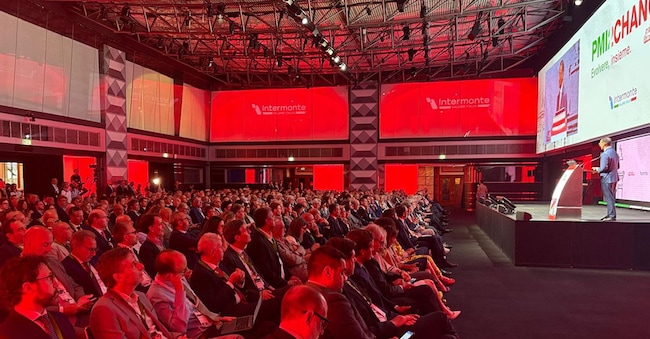
One hundred million euros for the time being, but with the clear aim of reaching 500 million in the medium term. This is the scale of Pmi2Change, the initiative presented yesterday in Milan at Palazzo Mezzanotte, through which Banca Generali aims to build a concrete bridge between Italia’s substantial private savings and the talent of small and medium-sized enterprises listed in the country. The occasion was marked by the traditional bell-ringing ceremony to celebrate the debut on the Piazza Affari of Investlinx Intermonte Valore Italia Active Pir Ucits, the first actively managed Pir-compliant ETF dedicated to the finest examples of Made in Italia.
Untapped potential
The new instrument aims to replicate a basket of one hundred companies listed on the Italian Stock Exchange, with a set of characteristics that, according to the chief executive of Banca Generali, Gian Maria Mossa, represents “the true backbone of our productive system and which, now more than ever, needs to feel that the country’s economic system is standing by its side”: a market capitalisation of less than one billion euros; a free float of at least 30 per cent and a minimum of five million shares; the presence of at least one independent director on the board of directors and research coverage over the last 18 months; a ratio of net debt to EBITDA of less than five.
The idea stems from the simple observation – highlighted by Mossa himself – that Italia is the country with the highest proportion of unlisted companies, often due to the constraints imposed by a capital market that has not developed sufficiently to cater for smaller businesses. The direct consequence noted by Guglielmo Manetti, CEO of Intermonte, is that ‘the value of companies listed on the stock exchange, despite the frenzied rise in indices in recent years, accounts for barely 40 per cent of the total value of domestic companies. This figure is far lower than that seen in France (65 per cent), Germany (70 per cent) and even in Spain (57 per cent), whose economy is less developed than ours’.
Wita, long live Italia
Hence the need to create a fund with the evocative ticker Wita, ‘Viva l’Italia’, which combines the tax benefits of PIRs – such as exemption from tax on capital gains and inheritance tax after five years – with a competitive cost structure (0.85% per annum) and the usual flexibility, transparency and liquidity of a listed ETF. Broadening the discussion to Pmi2Change, a project whose Il Sole 24 Ore had outlined the main features a month ago, this represents a natural evolution for Banca Generali in its role of providing comprehensive support to entrepreneurs: ‘not just a financial partner, but an active part of a wider system supporting the development of Italia’s productive fabric,’ Mossa clarified, highlighting one of the pillars of the new business plan due to be unveiled in November.
A system-wide initiative
An appeal was inevitably also directed at institutional bodies, with Mossa expecting “support from pension funds, which are the most natural investors”. This appeal already seems to be gaining traction among some of the country’s leading institutions: speaking at the conference held afterwards at Piazza Affari, the Undersecretary at the Ministry of Economy and Finance, Federico Freni, described it as essential to “enhance the value of the Italian economy without being afraid of a financial approach”.


