The vote

Bangladesh, election triumph of Bnp nationalists

Two-thirds majority passed. Tarique Rahman towards the premiership. Jamaat-e-Islami first acknowledges the result, then casts doubts on the vote

from our correspondent Marco Masciaga
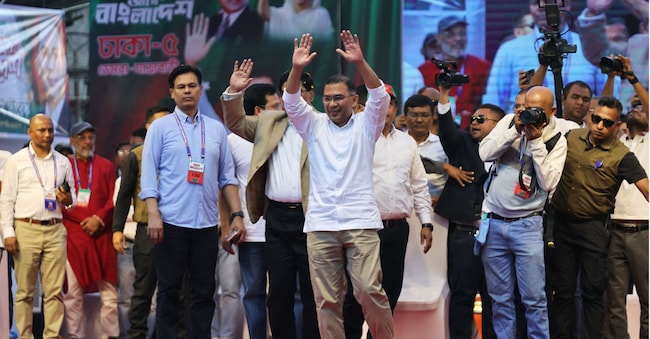
Il leader del Bangladesh Nationalist Party (Bnp) Tarique Rahman sarà il prossimo primo ministro del Paese asiatico

4' min read

Translated by AI
Versione italiana

4' min read

Translated by AI
Versione italiana

DHAKA - The Bangladesh Nationalist Party (Bnp) announced on Friday morning that it had won the first general election following the revolution of 2024 and had the numbers to form a one-party government, creating the conditions for the populous Asian country to potentially enter a phase of relative political stability. Although the Bangladesh Election Commission has not yet published the official final results, the party with the lead in the provisional count has already collected congratulations from India, Pakistan and the United States.

According to local media reports, the BNP won 212 of the 299 seats up for grabs, narrowly edging out Jamaat-e-Islami, the Islamist party that, after being kept on the fringes of the political scene for years, had appeared to rapidly increase its support over the past year. The Jamaat-led coalition won in 70 constituencies. The Bangladesh Election Commission now awards 181 seats to the BNP.

Loading...

On the night of Thursday-Friday, the leader of Jamaat-e-Islami Shafiqur Rahman acknowledged the election defeat in a gesture considered indispensable to ensure stability in a country where elections are often contested and the squares can become an element of pressure that is difficult to control. Then, in the morning, the Jamaat leadership questioned the regularity of the vote.

"We are not satisfied with the process that led to the results," Jamaat said in a note denouncing "repeated inconsistencies or manipulations in the announcement of provisional data" that "raise serious doubts about the integrity" of the electoral process. During the night, the National Citizen Party (Ncp), the movement born out of the 2024 student uprisings that allied with Jamaat, also denounced discrepancies in the results.

A clear result, such as the one obtained by the Bnp, was considered another requirement to avert the risk of incidents. A danger that had seemed real during the afternoon, after Jamaat activists had started to denounce fraud. In an encouraging sign of détente, the Bnp leadership announced that no street demonstrations were planned to celebrate the victory and invited voters to go to their places of worship to pray.

The next prime minister of Bangladesh will therefore be Tarique Rahman, the 60-year-old son of the recently deceased former premier Khaleda Zia, from whom he inherited the leadership of the party, and of former president Ziaur Rahman, who was assassinated in 1981 by a group of officers from his own army.

Political dynasties are a distinctive feature of Bangladesh and South Asian countries in general. Sheikh Hasina, the leader deposed in 2024, is the daughter of Sheikh Mujibur Rahman, the father of the country, president and prime minister assassinated in a coup in 1975.

Rahman, or rather Tarique as he is called to distinguish him from his many near-homonyms including the leader of Jamaat, returned to the country last December after almost 18 years living in London to escape the judicial persecution that was one of the hallmarks of the long years of power of former premier Sheikh Hasina, her mother Khaleda Zia's historical rival. From India, where she fled after the summer 2024 street demonstrations, Hasina called Thursday's vote 'a farce'.

The next premier faces complex challenges, on the economic front, public finance and relations with India. Relations between New Delhi and the interim government of Nobel Peace Prize laureate Muhammad Yunus that steered Bangladesh towards Thursday's vote have been frosty. According to several analysts, the installation of a new executive should provide an opportunity for a reset of relations under the banner of pragmatism and coexistence.

According to local media reports, approximately 60% of the eligible voters voted on Thursday, up sharply from the paltry 42% in the piloted elections of 2024. The vote took place without major incidents, thanks in part to an unprecedented deployment of security forces, with dozens of soldiers and paramilitaries deployed at the entrance to each polling station.

Bangladesh's single-chamber system elects 350 legislators: 300 by a uninominal system and 50 women by a proportional mechanism that takes into account the seats won by each party. On Thursday, 299 seats were allocated because in one constituency the polling was postponed due to the sudden disappearance of the Jamaat candidate.

In the two days leading up to the vote, train and bus stations in the capital Dhaka were invaded by millions of people from the country's rural regions returning to their towns and villages to vote in what was the first election since back in 2008 in which the name of the winning party was not already known before the poll.

"I hope that the priorities of the next government are anti-corruption, justice, stability and more job opportunities for young people," explains Habibur Rahman Jeshan, a 25-year-old young man who, after taking part in the July 2024 demonstrations that brought down Sheikh Hasina's regime, was voting for the first time on Thursday. "I don't think the right path is the Islamisation of society. Jamaat-e-Islami would like to encourage women not to work. I do not agree with this. Their safety must be ensured in another way'.

Parallel to the elections, a referendum was held on a series of constitutional reforms, including the establishment of a neutral interim government during election periods, the restructuring of parliament into a bicameral system, increasing the representation of women, strengthening the independence of the judiciary and introducing a two-term limit for the prime minister.

The leading local English-language newspaper, the Daily Star, reported that just over 65% of the votes cast were for 'Yes'.

Copyright reserved ©
Loading...

Brand connect

Loading...

Newsletter

Notizie e approfondimenti sugli avvenimenti politici, economici e finanziari.

Iscriviti