
Bank of Italy: Lazio's economy grows more than Italy. Industry in recovery
Pnrr, higher than average share of non-started worksites

3' min read
3' min read
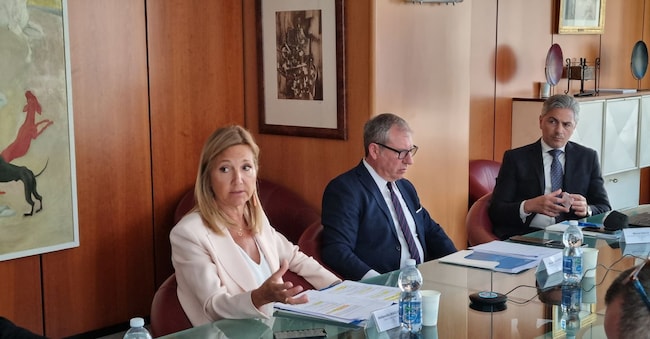
The growth of economic activity in Lazio continued in 2024: the Bank of Italy's quarterly indicator of the regional economy (ITER) shows an increase in real terms of 0.9 per cent, a rate higher than that recorded in the previous year (0.5) and slightly above the change in output at a national level (0.7). Foreign demand for goods and services and public spending supported activity levels, while consumption and investment were weaker. The figure emerges from the Report on Lazio's economy presented by the Bank of Italy's Rome office, in the presence of Antonella Magliocco, director of the Bank of Italy's Rome office, Marco Gallo, head of the Analysis and Territorial Economic Research Division, and Massimiliano Bolis, deputy head of the same Division
Jubilee drives investment growth
.The total primary expenditure of the territorial authorities of Lazio increased by 11.2 per cent, a significantly higher rate than that of the regions with ordinary statutes (RSO; 6.2 per cent). For the current part, this was affected by the accounting in 2024 of the costs for healthcare mobility incurred in the previous year. On the capital side, spending on gross fixed capital formation expanded strongly, by about 37 per cent, almost double the Italian average. It was mainly driven by the municipalities and is largely related to the public works planned for the Jubilee 2025 and the PNRR.
Pnrr, construction node not started
By the end of May 2025, EUR 13.3 billion had been allocated to public and private entities for interventions in Lazio, 9.3 per cent of the national total. Over 5 billion were tendered for the supply of goods and services and for public works. With regard to the latter, just over four-fifths of the value of the tenders had been awarded by the end of last December; however, half of the construction sites were still not started, a higher percentage than the national average.
Industry on the upswing
After the previous year's decline, industry showed a slight expansion (0.4 growth in added value), compared to stagnation at national level (-0.1). The sector's performance benefited from the impetus provided by exports of goods (8.5 per cent in nominal terms), especially pharmaceuticals; overall, sales abroad fell slightly (-0.4).
Constructions supported by the NRP
In construction, the growth in added value was 0.7 per cent (1.2 in Italy). The activity slowed down compared to the previous year, affected by the downsizing of the Superbonus interventions. Deductible investments decreased by approximately two-thirds. However, the sector was buoyed by expenditure on public works, particularly that related to the implementation of the National Recovery and Resilience Plan (NRP).


