
Bankers, Uilca confirms Furlan: 'Now congruous increases'
For the union, the objective is the renewal of the Abi contract and the maintenance of employment while the second half of the banking resiko is underway. Next week meeting in Abi on the climate survey. Changes to declarations stalled
Key points
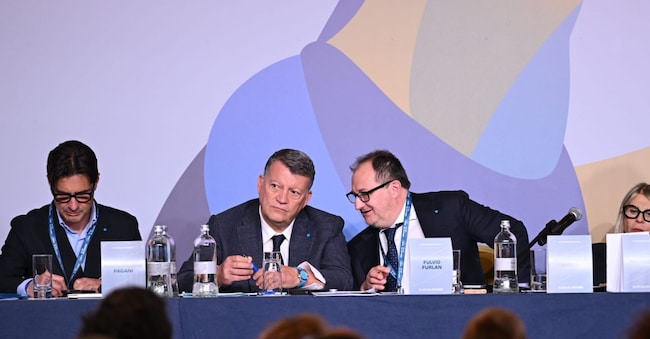
If very positive responses are coming from the bankers' assemblies to the trade union platform for the renewal of the ABI contract, which contains, among other things, the request for an average increase of 518 euro and a further reduction of working hours to 35 hours, the first test among bankers and shareholders sees them lukewarm, cautious and focused more on talking about the banking risk than on workers' demands. The catwalk of the 8th national congress of the Uilca, at Giudecca, Venice, where the general secretary Fulvio Furlan was reconfirmed at the helm, saw someone, like the ceo of Mps Luigi Lovaglio or the president of Unipol, Carlo Cimbri, arrive and leave by motorboat in order to be physically present at an appointment that seemed almost like a roadshow on the future challenges of credit in front of the 500 delegates of Uilca, and someone else, like the CEO of Bper, Gianni Franco Papa and the ceo of Bnl and head of Bnp Paribas in Italia take advantage of technology and connect remotely. Saying 'all roads lead to Siena', Lovaglio reopened the rose of hypotheses around the third pole, on which, however, even Papa clearly said 'never say never', while explaining that Bper is focused on integration, coming from a long series of operations: 'In 2019 we took over Unipol banca, in 2021 600 branches of Ubi, in 2022 we took over Carige, in 2025 the Popolare di Sondrio. We have a lot of meat on the fire and we must focus on consolidating what we have done'. He then added, 'we are in the market and we are looking around'. Moreover, Cimbri himself, chairman of Unipol, Bper's shareholder, let loose a sibylline 'Bper, let's leave them alone poor things, they already have Sondrio to integrate'. The game is complex and the sites are all still open.
Congruous increases
For the union, even in a strongly changing situation, one thing must be certain, however: 'In the next renewal of the bankers' contract, increases are needed that are congruent with the fact that the situation of the banks has improved'. Fulvio Furlan says that the workers' assemblies on the platform for the renewal of the bankers' labour contract (which expired on 31 March this year) are confirming the unity of purpose that characterises the bankers' unions: 'We may have different visions on how to reach the goal, but not on the goal, on which we are united. After the recent renewals of the Riscossione contract and the Ania contract, on which Cimbri thinks 'well for the speed with which the agreement was reached and for the significant response it gives on the recovery of purchasing power', for the category unions the start of the Abi bankers' negotiations is approaching. This round the target is 518 euro increase for the average reference level, therefore still higher than the 435 euro of 2023. After all, Furlan recalls, "from 2020 to 2025 net profits were over 140 billion and the industrial plans presented alone announce total profits of over 100 billion over the next three or four years. These are just a few figures to show that the banks' situation is not only positive in terms of profitability and capitalisation, but has further improved in recent years, those after the signing of the previous National Contract'. On this Cimbri pointed out that 'the credit sector today is living a happy season. It is good first of all to be able to work in it and then to have prospects for economic improvement'. More cautious was Bnl Bnp Paribas CEO Elena Goitini, who reminded the congress of the stalemate in negotiations on the results bonus in the group, which will present its new industrial plan in November. The banking sector in Italia 'is solid and capitalised, with good profitability', even if this is 'a starting point and not a point of arrival', which allows the system to 'face the transformations' underway and the turbulence on the energy front, inflation and geopolitical crises. Banking solidity is also an element to be considered in the upcoming renewal of the labour contract, where Goitini hoped that 'a constructive spirit will prevail'. At the end of the assembly process, which should be completed by mid-July, the platform will reach ABI to start negotiations.
The climate survey among bankers
The salary issue, while being the most important one on the table, cannot be separated from the many others facing the sector where in recent years 'people's sense of disaffection has increased. Even among new recruits, where those who resign within 18 months are increasing. This is why it is urgent to start the climate survey with Abi'. On this issue, a meeting is planned for 4 June in the context of the Cabina di regia on digital to understand how to listen to the category for which the increase is important, but so are the working conditions: flexibility, smart working, commercial pressures, overcoming the gender pay gap that in the sector is in double figures according to Uilca's estimate (between 18 and 32% depending on the institutions), the fight against gender violence on which a protocol was recently signed in Abi that has now entered into all second-level agreements, but above all the employment issue that is closely intertwined with that of the banking risk and technological innovation. In this regard Furlan claims 'the centrality of the Solidarity Fund to guarantee voluntary exits, but also of the practice whereby for every exit there is a recruitment. New technologies and AI cannot be substitutes for bank employees but only a support'.
Digital AI and the digital control room
On the subject of AI, Cimbri explained that 'we must accept this challenge and devote more time to knowledge in order to dominate machines and not let them dominate us. Innovation, technological evolution, we must try to ride it and know it: this applies to those who administer a company and those who administer a country'. For Furlan, the hope is that there can be progress in the negotiations within the Cabina di regia on digital technology, which will have the task of 'proceeding swiftly to discuss, with regard to organisational impacts, the declarations relating to new professional figures and those already existing, in consideration of the fact that the effects of new technologies invest every area of the bank. We note the reluctance of companies within the ABI delegation, due to the competitive dynamics that characterise them and which they never fail to emphasise. But there is a need for clear direction in the sector'.
Desertification and lawlessness
Technological innovation was a topic addressed at various times during the Uilca congress. Goitini also spoke about it, for whom it is necessary to think about the role of bank branches by including them in an ecosystem and in a scenario of 'hybridisation between digital and physical'. Papa explained that Bper 'has 20% of the branches, so we are talking about 400 branches, in municipalities where we are the only bank present. So here is the importance for us to be physically present in the territories where we operate'. Lovaglio recalled that the Mps group's plan includes investments in innovation, but 'we have something that other fintech operators do not have, and that is the relationship with customers' and a 'very strong' network, which has been central to the bank's revival during the worst of the crisis. Certainly, for Lovaglio, 'when you close branches it is a loss, but it is clear that I cannot have one every 20 metres, but having them and showing that you are there is nice'. Beyond the declarations of the importance of branches, the numbers compiled by Uilca speak of a continuous retreat of presence in the territories, an issue that is intertwined not only with access to credit even by the elderly and frail, but also with legality. According to Uilca research, almost 8 out of 10 respondents believe that the closure of branches and counters can contribute to the spread of illegality in a major way, generating concern among people. 67.9 per cent said they were alarmed by the progress of the phenomenon, and for 83.5 per cent the loss of institutional references and essential services, such as branches, could further open up spaces for illegality and usury. For Furlan, "4we need to set up a joint regional observatory of banks, trade unions and local institutions to monitor the phenomenon. The absence of a proximity bank contributes to the depopulation of territories and the weakening of local economies, making the daily lives of families, the elderly and small businesses more difficult. In this context, the risk of resorting to illegal credit channels, through unregulated entities, is growing. The problem does not only concern the financial system, but also the country's social and territorial cohesion'.

