
Baraclit celebrates its 80th anniversary with 200 million orders and green investments

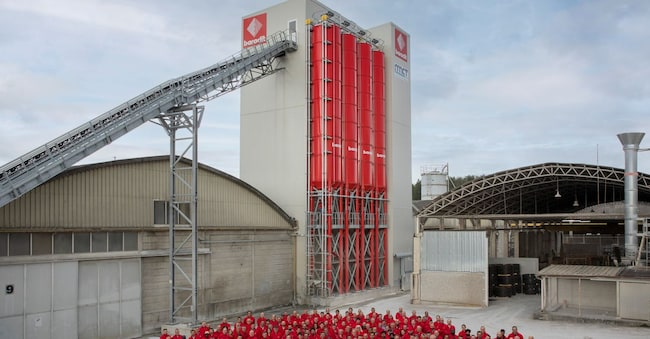
Baraclit, based in Bibbiena (Arezzo) – one of Italy’s leading manufacturers of prefabricated industrial concrete structures – is celebrating its 80th anniversary with the best financial results in its history and a bonus of over one thousand euros for each of its 350 employees. The Bernardini family-owned company closed 2025 with a production value of over 131 million euros – an 11 per cent increase on the previous year – and an EBITDA of around 11 million. This year, the profitability bonus provided for in the supplementary collective agreement will be supplemented by a special payment to mark the 80th anniversary – a reward, paid partly in cash and partly in the form of welfare benefits – which has also been extended to employees of the group’s companies, Prefabbricati 2000 in Brescia and Omat in Arezzo (around seventy in total).
Baraclit is a name synonymous with prefabricated structures for industrial, logistics, commercial and office buildings throughout Italia. Among its most significant projects are the new Bianchi Biciclette headquarters (22,000 square metres) in Treviglio; the Fass Shopping Centre (70,000 square metres) at Cagliari Airport; and two organic waste treatment plants near Rome (15,000 square metres each).
Founded in Bibbiena, in the Casentino region, in 1946 by the five Baracchi brothers (the daughter of one of the founders married Franco Bernardini, father of the current chief executive Luca), Baraclit has evolved from a small artisan business into an industrial group that also includes a division specialising in the production of prefabricated electrical substations and solutions for the energy sector – one of the sectors that has driven the group’s growth in recent years.
Over the two-year period 2025–2026, Baraclit invested 10 million euros, half of which went towards acquiring a 100 per cent stake in Prefabbricati 2000 and expanding production capacity, whilst thethe other half in the new tower-mix concrete plant at the Bibbiena site and in a floating photovoltaic system on an 8,000-square-metre reservoir (60–70 per cent of the surface area is covered by floating panels mounted on recycled plastic structures): the plant, with a capacity of 1 megawatt – of which 600 kilowatts are on the lake and 400 kilowatts on land – not only produces renewable energy but also reduces water evaporation, thereby maximising efficiency. “This is the final stage of a long-standing commitment to sustainability,” explains CEO Luca Bernardini. “Today, we have installed 5.2 megawatts at the plant, along with a storage system that allows us to use 50 per cent of the energy we generate ourselves; the rest we feed into the grid and, thanks to an agreement with our energy trader, we are guaranteed a 100 per cent supply of energy from renewable sources.”
Today, Baraclit’s order book has reached 200 million euros, a level that will enable the company to navigate a 2026 marked by uncertainties in the construction market. “The problem stems from the sharp rise in raw material costs – from diesel to steel, from cement to plastics, insulation and bitumen,” explains Bernardini, “because it is not easy to pass these increases on to customers, who sometimes slow down their investments. The order book is substantial, but it will be more difficult to translate this into profit margins.”

