Manager

Barbara Agogliati guides two thousand drivers and four thousand trucks with an app

A nuclear engineer, he is the innovation manager of Autosped G, the leading haulage company that introduced the telematics revolution

by Lello Naso
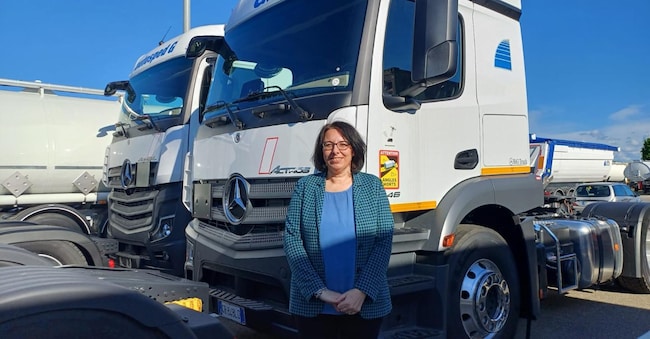
Barbara Agogliati, 52 anni, ingegnere nucleare, è fleet manager di Autosped G

4' min read

Key points

  • The trade inherited from his father who ran the family business
  • A satellite to monitor the entire fleet in real time and in detail (braking, acceleration, fuel consumption, phenomena...)
  • A programme to improve driving that has halved accidents

4' min read

If it were a film, or rather a Korean television series, the favourite of Barbara Agogliati, 52, a nuclear engineer, fleet manager of Autosped G (Gavio group), four thousand lorries and two thousand drivers, Italy's leading haulage company, it would have a script with black and white flashbacks.

First scene. A spartan office in Castelnuovo Scrivia, in the province of Alessandria, a stone's throw from Milan-Genoa. The sky outside the windows is grey, the day gloomy. Black bob hair, blue eyes and glasses, laptop in hand. With a series of apps Barbara Agogliati manages the fleet data that arrive in real time. She monitors trucks and drivers, journeys, routes. She knows everything about every single vehicle. How many braking, how many accelerator strokes. The weight, the consumption. How long the truck has been in neutral.
Loading...

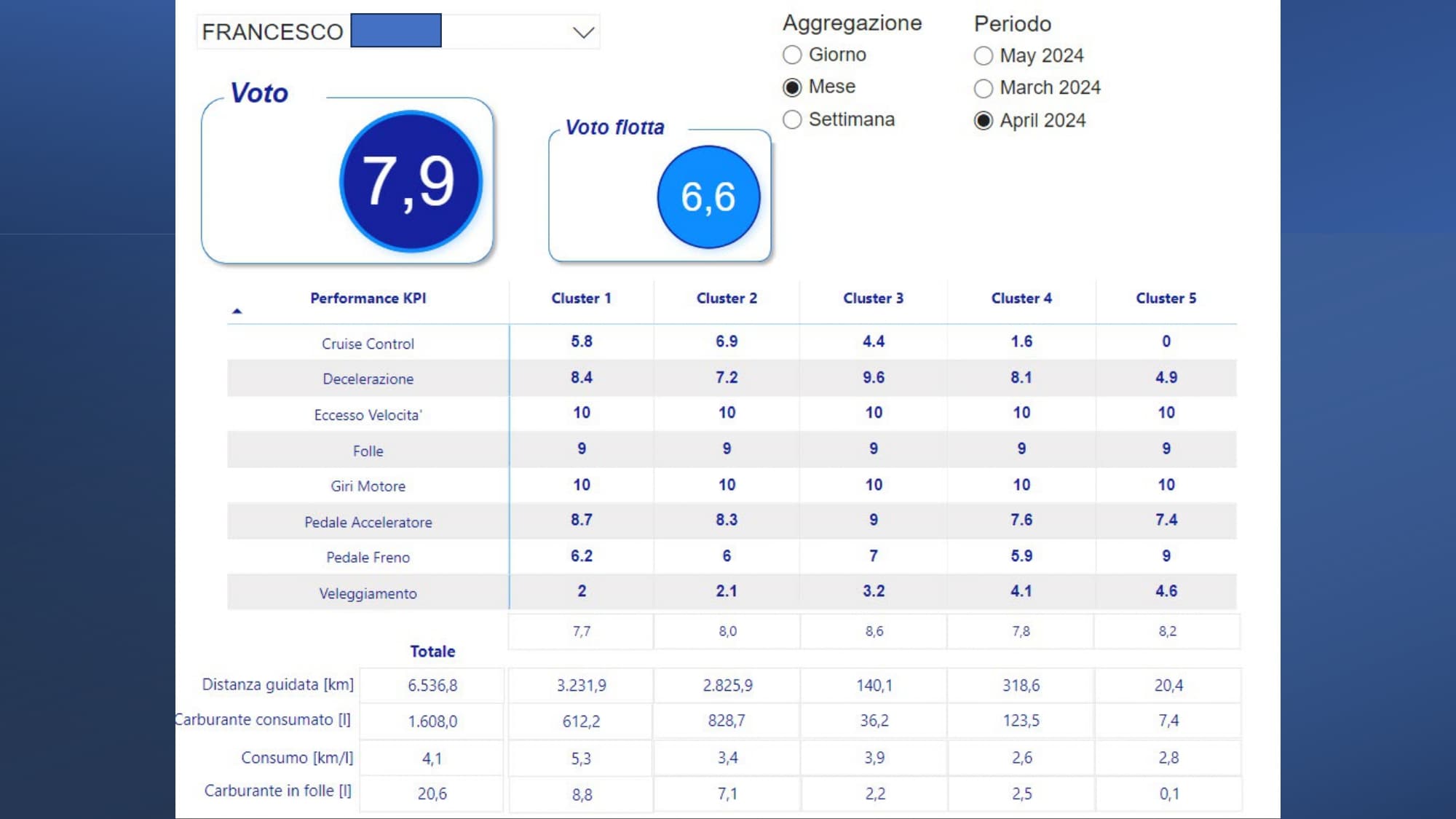
La pagella di un autista

Le performance del mese di aprile 2024

Nella schermata della app gli indicatori di un driver

Second scene. Black and white flashback. Early 1980s. In the house in Rozzano, on the outskirts of Milan, the Agogliati family is at the table. Pietro, Barbara's father, has a special place with double space. He keeps a large sheet of paper beside him on which are marked the routes, the drivers, the trucks of Agogliati Giuseppe and Bernardo, the family business. Next to the sheet, a telephone of the kind with a disc that rings continuously. A driver has delivered. Pietro takes notes and makes the arrangements for the next trip. Loading, departure, arrival, times. Barbara observes. Another ring, another delivery. Tomorrow it will be the turn of another family member, Giovanni, Mario, Romeo.

Agogliati Giuseppe and Bernardo, the family transport company was founded at the end of the Second World War in the Piacenza area by Pietro's father, Barbara's grandfather, and cousin Mario, father of Romeo, the current managing director. Grandfather used to deliver wood with mules. Then it became a modern transport company, with the first trucks on the first paved roads. In the 1960s, Giuseppe and Bernardo moved to Rozzano, next to the ring road of the Milan of the economic boom. Growth continued until the 2000s, when the Agogliati family and the Gavio family decided to merge their petroleum products transport activities into a single company. Fifty-five per cent of G&A is now held by Autosped G of the Gavio group, chaired by Luca Giorgi, a colossus with EUR 835 million in revenues and eighteen subsidiaries.

A mix between mechanic and manager

"My father," says Barbara, "stayed with the company and continued to manage the fleet. He retired in 2020, not that many years have passed, but from the point of view of management and technological transformation it is a geological era. My father, in the beginning, was in charge of trip planning, vehicles, maintenance. He was a mix between mechanic and manager. Even today he still recognises a truck breakdown from the sound of the engine. Another world'.
Today, telematics is in charge. Barbara joined the company in her father's place by taking a long ride. Degree in nuclear engineering from Milan Polytechnic, specialisation in optics. Research work at Pirelli, then manager in two companies in the Milan area, Csi and Matrix, which produced CDs and floppy disks. In between there was also a move into politics, as mayor of Rozzano, a legacy of his mother's social commitment, a historic headmaster in the town in the Milanese hinterland.

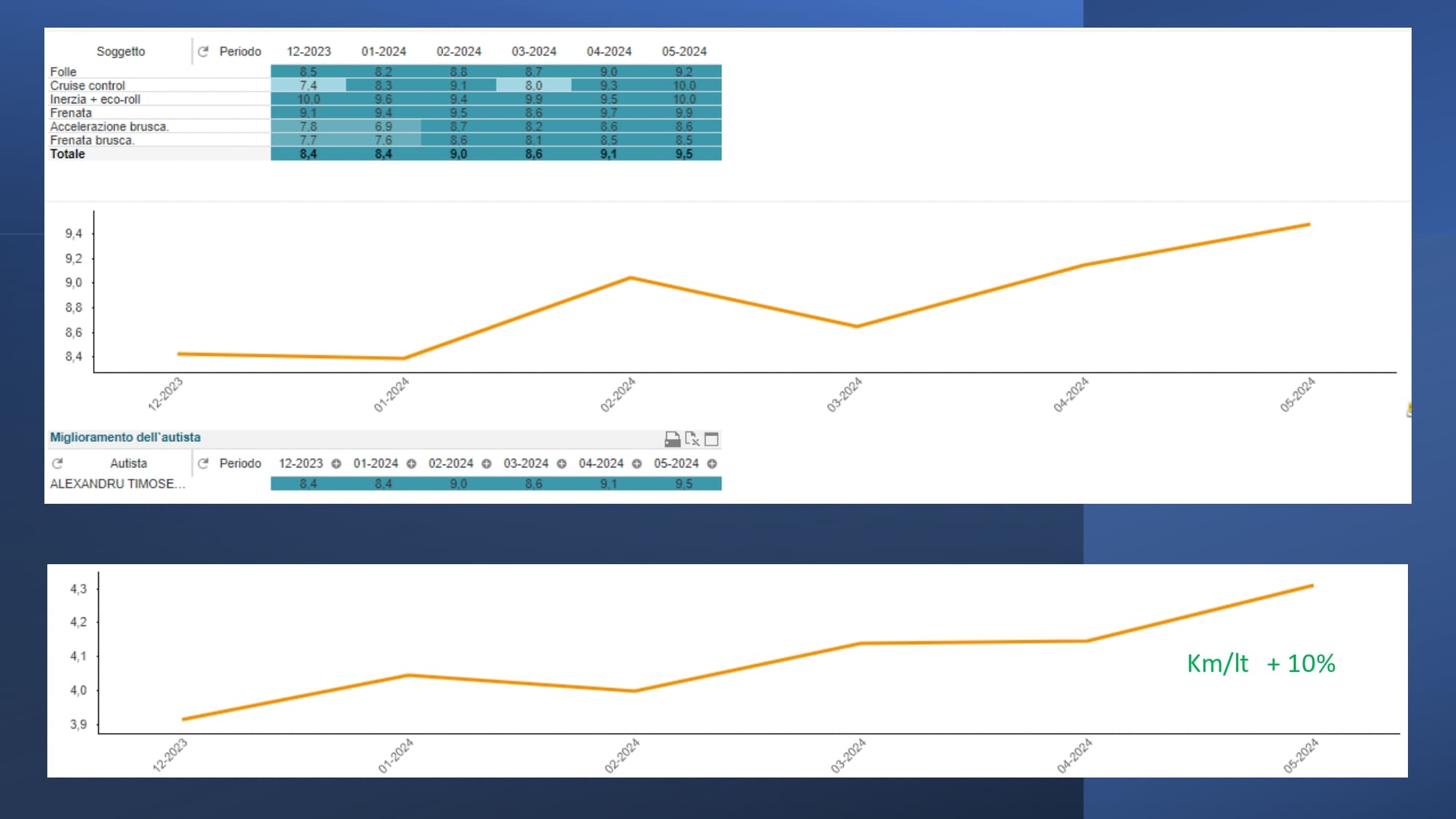
L’evoluzione della guida

IL comportamento di una autista nel tempo

Nella schermata della app, singoli indicatori di guida di un driver

"I arrived in 2020, at the height of the industry's digital transformation," he says. "The technical department was reorganised by separating mechanics, maintenance and systems. I was entrusted with the digital management of the fleet. It was the time when further development of telematics was needed in the company". A new job for everyone in which Barbara put her scientific training and research background to good use. "We started by selecting the telematics systems on the market. We realised the enormous potential that data, and especially its processing, could bring to management, and we built tailor-made systems for each individual vehicle and each customer," Barbara explains.

Real-time onboard instruments

.

Simplifying as much as possible, there are several instruments on a truck that monitor data. The tachograph, compulsory by law, which reports driving hours, speed, infringements. The satellite, which captures the truck's position and all the engine data: braking, acceleration, oil, battery, brakes, cruise control, cruising. The CAN-bus, the dashboard data, which also sends the numbers to the manufacturer. The cross-referencing of this data and the collaboration of the parties who manage it - the transporter, the telematics provider, the manufacturer and the customer - provide unimaginable tools for fleet management. "We have monitoring of speeds, consumption, virtuous and non-standard behaviour of individual vehicles, the maintenance status of trucks, emissions," says Barbara. "We can work to correct inappropriate behaviour, prevent breakdowns and accidents, and anticipate maintenance, but we can also work with customers to optimise loads and deliveries." This minimises vehicle downtime and diseconomies. As well as reducing the risk of accidents by half by 2022.

The company started a pilot project on driving styles involving drivers. Barbara shows a screenshot of one truck's monthly data. "The fuel consumption in neutral, i.e. when the vehicle is stationary," she explains, "was 1.2 litres per day. It was more than three before. In one year we can cut consumption by 4 per cent, about two million euro savings out of a cost of 45 million, and carbon emissions by 4 per cent, one thousand tonnes per year. The fleet already uses, for 50% of the total, Hvo, a biofuel that reduces CO2 emissions to zero. We also plan to allocate the savings to a welfare fund for the drivers themselves. I get messages all the time asking: how am I doing? How is my performance compared to the average? They don't feel observed, but involved". A road mapped out.

Copyright reserved ©
Loading...

Brand connect

Loading...

Newsletter

Notizie e approfondimenti sugli avvenimenti politici, economici e finanziari.

Iscriviti