
Barbara Hepworth ‘in colour’
The exhibition at the Courtauld Gallery, running until 6 September 2026, explores – with a few surprises along the way – the artist’s relationship with colour

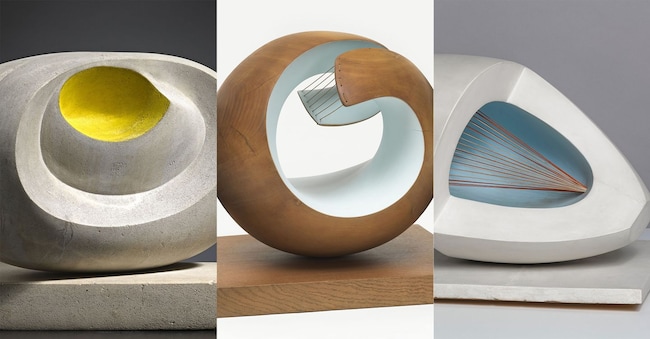
Even when it comes to the best-known artists, the Courtauld Gallery always manages to offer a fresh interpretation and an original perspective. Barbara Hepworth is the most celebrated English sculptor of the last century, with a museum dedicated to her in Cornwall – where she had her studio – and countless retrospectives over the last fifty years since her death in 1975. The Courtauld’s new exhibition, ‘Hepworth in Colour’, is the first ever to focus on the use of colour in the artist’s drawings and sculptures.
“The aim is to explore an aspect of her work that has never been studied, appreciated or understood,” explains Stephen Feeke, the exhibition’s creator and co-curator. “The photographs from that period are all in black and white, but Hepworth lived a life in colour.”
Sculptures and more
Best known for her large abstract sculptures in stone, marble and wood, Hepworth was an eclectic artist who drew, engraved, painted and sculpted, constantly exploring new materials and experimenting with different scales. The recurring theme of her life was her love of nature, which she sought to capture in her organic sculptures, distilling beauty into forms of simple, essential purity.
Having fled London in 1939 to escape the war, Hepworth found herself living in Cornwall, where the landscape was a constant source of inspiration that lasted her whole life, but where it was difficult to find materials during those years. Forced to scale back her artistic ambitions, and unable to create her monumental sculptures, Hepworth adapted by drawing and creating small sculptures in plaster, stone and wood, enriched by the use of colour.
Intended as sketches, models for works to be created in the future, these mini-sculptures were initially painted in bright colours – the reds and yellows of her friend Mondrian, whom she admired – and were often embellished with taut strings in contrasting colours, creating a visual dialogue between the interior and exterior spaces and evoking the close link between art and music.

