
Bari: a debate on local news and Southern Italy
An event organised by the Italpress news agency, in partnership with the Bari Chamber of Commerce and the Nuova Fiera del Levante
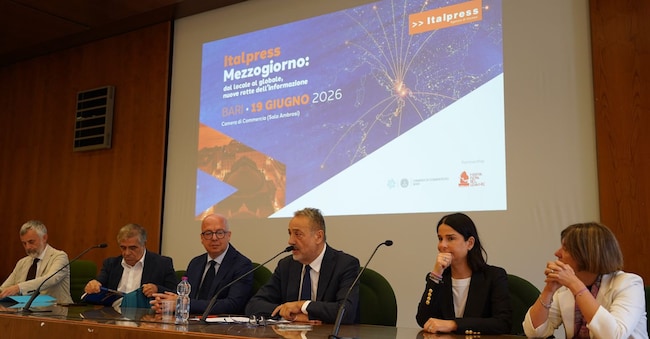
An opportunity to explore the value of local information at a time when news travels ever more rapidly on a global scale, yet continues to have deep roots in local places, communities and economies.
The Italpress news agency, in partnership with the Bari Chamber of Commerce and the Nuova Fiera del Levante, organised an event in the Apulian capital entitled “Italpress Mezzogiorno: from local to global, new paths for information”.
The debate, moderated by Claudio Brachino, provided an opportunity for discussion between institutions, local representatives and editors of leading newspapers in Southern Italia, with the aim of reflecting on the evolution of the news media, the relationship between local communities and the global landscape, and the strategic role of local media in processes of growth, cohesion and development.
“The chosen title, ‘From Local to Global’, captures one of the great challenges of our time. Today, news travels at an unprecedented speed, crossing borders and platforms, but for this very reason it requires quality, accountability and a firm grounding. News cannot be about speed alone: it must also involve verification, in-depth analysis, the ability to interpret the facts and convey them to the public with clarity. It is at a local level that social, economic and cultural transformations are first observed. It is at a local level that the stories which later become national issues often emerge. And it is from the local level that a more authentic narrative of the country can begin. In this sense, Southern Italy must not be portrayed solely through its difficulties, but also through its vitality, its businesses, its universities, its young people, its infrastructure and its strategic position in the Mediterranean,” said Gaspare Borsellino, founder and director of the Italpress news agency.
“We need to steadily narrow the gap between the South as depicted by the data and the one that still persists in the collective imagination. And in this context,” said Luigi Sbarra, Under-Secretary for Southern Italy Policy, “your work is vital, because it highlights the transformations already underway and helps to build a more balanced, modern narrative that reflects reality. For too long, the South has been associated almost exclusively with its difficulties: low growth, high unemployment, a limited ability to attract investment, infrastructure shortcomings and a marginal role on the international stage.”

