
‘Basilicata is a welcoming and inclusive region; open to innovation’
Francesco D’Alema has taken office as president of the regional branch, a role he will hold until 2030. Orsini: “Ensuring that businesses remain competitive”

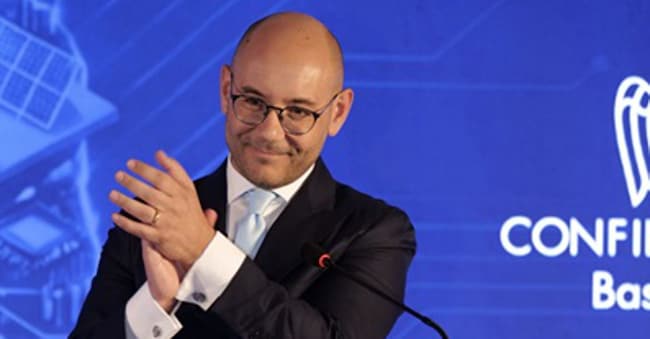
A programme for the maintenance and development of the regional industrial system, covering the five-year period 2026–2030. This was outlined by Francesco D’Alema, the newly appointed president of Confindustria Basilicata, during his inauguration at the public meeting ‘Basilicata at the heart of the future. Invest, Stay and Grow’, which took place at the Park Hotel in Potenza in the presence, amongst others, of Emanuele Orsini, president of Confindustria. It is far more than just a policy outline because ‘This is a time for responsibility and courageous choices, with the determination to rediscover the courage to redefine the development model’, said D’Alema, before introducing his team. ‘What I am proposing to you today is to share not just a policy outline but a vision: that of a Basilicata capable of welcoming and including; open to innovation, to external and internal investment, to cross-fertilisation between sectors, knowledge and skills, and to collaboration between businesses, institutions and the world of research; open, above all, to the ability to challenge established models’.
In his speech, D’Alema also outlined the economic trend in the South, noting that ‘the South, too, is seeing its momentum slow compared with the positive growth trends it has experienced in recent years, thereby slowing down its consolidation. Against this backdrop of growing complexity, Basilicata finds itself in a state of extreme fragility. Just a few days ago, the Bank of Italia’s report confirmed the stagnation of our economy. We are ending 2025 in negative territory (-0.2 per cent) after having fallen significantly behind in growth rates in recent years, particularly compared with the rest of the South. Between 2019 and 2023, the Basilicata economy grew by just 2.5 per cent in terms of value added, compared with the national average of 5.9 per cent and 7.8 per cent for the rest of the South. The figure is clear, but it must also be viewed in the context of significant regional differences, with the province of Potenza recording growth of just 1.4 per cent, whilst that of Matera reached 5.1 per cent.”
Then there is the demographic crisis, with a 5.16 per cent decline in the resident population since 2019: “We hold a sad record for the lowest birth rate,” said the newly elected president, who has made competitiveness a priority. “We are the Italian region with the lowest infrastructure accessibility index. No complete motorway crosses the region’s territory; the rail network is essentially secondary across the whole region, with the exception of the Potenza–Metaponto corridor; we have no airports’, whilst noting that the region is home to internationally recognised industrial excellence. This spans various sectors, from energy to advanced manufacturing, from chemicals to high-quality tourism, right through to agribusiness. “These foundations must be consolidated, strengthened and enriched.” Among the most pressing demands, D’Alema calls for: “Politicians must listen to us. This is a time for responsibility. We must put an end to unproductive welfare dependency and rebalance public spending in favour of investments capable of generating development, employment and competitiveness.”
In his speech, Emanuele Orsini, president of Confindustria, emphasised the need to ‘create the conditions to ensure that businesses remain competitive and that the new generations of young graduates do not go abroad. One of the most significant problems in Italia is the issue of the 100,000 graduates who left between 2020 and 2024 and who, unfortunately, have not returned. The aim must be to put merit back at the centre’. For Basilicata, the automotive sector represents a major industrial pillar, with the Stellantis plant in Melfi. ‘We managed to destroy Europe’s leading industrial product in order to appease a car manufacturer’s sense of guilt over Dieselgate, and at that moment someone exploited the situation by introducing regulations that are out of all proportion – regulations that no other continent is implementing – and we gave away our technology,’ remarked Orsini. “I am pleased to read that Stellantis, Renault and Volkswagen have requested that 70 per cent of the components in products sold in Europe be of European origin. The path to industrialising Europe is the right one; it is certainly not that of handing over our core industry to the Chinese.”
On the subject of energy costs, the president of Confindustria concluded: ‘Filosa was quite right when he spoke of the need to tackle this issue; today, for all our products, energy is the single biggest industrial cost. Energy is a matter of national security; we still have too many shortcomings in Italia. Europe must create a single energy market, which is essential, but at the same time Italia must deal with the four thousand renewable energy concessions. And in this regard, it is not just the Government; the regions must also do their ‘homework’ and push for a diversified energy mix. If the Germans are moving towards thermal power, we cannot simply switch ours off.”

