Media

Bassetti and Banijay’s expansion into the US: ‘Across the Atlantic with a strong product and solid backing’

The global CEO interviewed on the first day of MIA. On rights: ‘It is essential that they remain with the producers. Without rights, companies remain undercapitalised and cannot reinvest.’

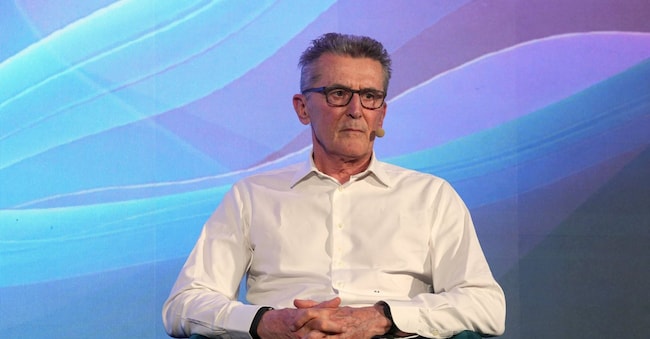
Marco Bassetti Ceo Banijay Imagoeconomica

5' min read

Translated by AI
Versione italiana

5' min read

Translated by AI
Versione italiana

‘We certainly need to expand our catalogue if we really want to cross the Atlantic and compete with those already there. But it’s a venture well within our means, and one I can see on the horizon in the coming years.’ Marco Bassetti points to the next frontier for Banijay, the production company behind global television hits such as ‘Peaky Blinders’, ‘Black Mirror’, ‘MasterChef’ and ‘Survivor’, which it leads on a global scale. The challenge is to take on the major American groups on their own turf. Bassetti, one of the key figures in the global audiovisual industry, is not announcing any acquisitions nor setting a deadline. But he is charting a course based on content ownership, financial stability and a business model capable of generating revenue beyond television.

In an interview with Marco Chimenz – former co-CEO of Cattleya and now a strategic consultant for the 12th edition of MIA, the International Audiovisual Market – Banijay’s global CEO outlines the company’s ambitions and the challenges it faces.

Loading...

The American Frontier

‘At present, we have no physical production facilities in the United States; we have seen other colleagues and competitors of ours leave with their tails between their legs.’ Bassetti does not underestimate the risk of investing in production on American soil: ‘It is no easy feat.’ However, he sees an opportunity to explore in a market that accounts for a significant proportion of global spending on content and which, in his view, will need to try to bring a larger share of production back to its own territory – production that is currently entrusted to overseas companies such as Banijay.

“Today, 52 per cent of our content is in English. This is a target we have achieved. That does not mean we are not interested in Italian, Spanish or German.” However, greater exposure to English broadens the scope for international circulation and supports our American ambitions.

From production to entertainment

The starting point is a group which, according to the figures presented at MIA, has a turnover of 4.3 billion, comprises around 170 companies across 25 countries and produces almost 20,000 hours of television a year. Banijay describes itself as the world’s leading independent studio and Europe’s largest producer of scripted content, encompassing series and drama. It sells 110 titles a year to streaming platforms and has a catalogue of 265,000 hours.

It is home to major programmes such as MasterChef and Big Brother, but the label of ‘television producer’ is beginning to feel too restrictive. Between distribution, digital, live events and sport, production in the strict sense now accounts for 75 per cent of the turnover reported by Bassetti. The aim is to become an entertainment company with a wider range of activities centred around the same content.

Unscripted entertainment remains the economic backbone: it generates profits and cash flow more quickly than drama. This balance underpins investment in other genres. And it helps to explain the growth from the 250 million in turnover mentioned by Bassetti upon his arrival to the current 4.3 billion.

Acquisitions: the numbers behind them

Banihay has expanded significantly through external growth over the years. Its most recent major acquisitions were those of All3Media and, prior to that, Balich Wonder Studio, a company active in live entertainment. However, Bassetti emphasises that growth does not mean buying at any cost. “We only acquire individual companies when we need to launch a new venture or when we are missing a genre – which could be comedy, romance, a game show, a reality programme or something else within a particular sector.”

The approach is to add new areas of expertise, genres or markets, and then leverage them through the international network. A format developed in one country can find opportunities in many others; a creative company can make use of shared financial, legal and commercial structures. This is what scale is for: freeing up resources for content and increasing the opportunities for its exploitation.

Rights come before quotas

It is on the subject of rights that the conversation becomes more cut and dry. ‘But if you don’t have the rights, there’s nothing you can do. The product can’t be distributed. That’s the key.’

Loading...

The relationship with streaming platforms brings in viewership, budgets and access to a global audience. But it often leaves the producer with little opportunity to share in the future value of the content. “Of course, we work with streaming platforms; we’re happy to work with them. However, we know that, unfortunately, we have no ownership of the IP there.”

Bassetti is not calling for the economic model to be scrapped. He is calling for creativity to be rewarded even when it yields extraordinary results. ‘But there must be a reward if someone achieves something extraordinary.’ Otherwise, you produce something, collect your fee and start from scratch again, without building up the assets needed to fund new projects.

The risk affects the entire sector. ‘It is essential that the rights remain with the producers. Without rights, catalogues die, companies remain undercapitalised and cannot reinvest.’ Without intellectual property, he warns, ‘the catalogue would die, but this isn’t just about us; it’s about all companies and the sector as a whole.’ This is why Banijay also seeks to support productions for broadcasters that allow it to retain rights: “Being a large group allows us to offer incentives to produce series where we retain the rights.”

Italia: delays are eating into profit margins

The financial aspect becomes even more important where longer payment terms extend the need for capital. And with regard to Italia, Bassetti highlights a specific problem: ‘Customers pay with appalling delays’. On top of the slow payments, there is also a delay in receiving the tax credit.

The result is evident in the companies’ accounts: ‘That meagre margin is eaten up by interest expense, and it is a truly typical Italian situation.’

This pressure weighs particularly heavily on smaller manufacturers, who have fewer resources to cover costs up front. According to the manager, the challenge facing the industry is to raise capital for companies and ensure the continuity of investment. Increasing local production is necessary, but it is not enough to build businesses capable of competing abroad if the rights remain elsewhere.

Artificial intelligence: who reaps the benefits of greater efficiency

‘I believe that artificial intelligence is the first human invention whose limits are unknown.’ Bassetti acknowledges the benefits already realised in business processes: “Artificial intelligence, at least as far as we’re concerned, is a system that has enabled us to make savings across all support functions, as is the case in companies all over the world.”

However, there remains an unresolved economic issue regarding production. If remuneration is linked to the cost of the work, reducing that cost may also reduce the producer’s revenue. There is therefore a risk that efficiency gains will be passed on to the client without leaving any additional resources for those who create the content.

Copyright reserved ©
Loading...

Brand connect

Loading...

Newsletter

Notizie e approfondimenti sugli avvenimenti politici, economici e finanziari.

Iscriviti