
Batteries, the stop of Northvolt and Volvo Trucks reinforces doubts about euroriscossa
The two Swedish companies' response to market conditions casts a shadow over the continental plans, which envisage 50 gigafactories by 2030

3' min read
Key points
3' min read
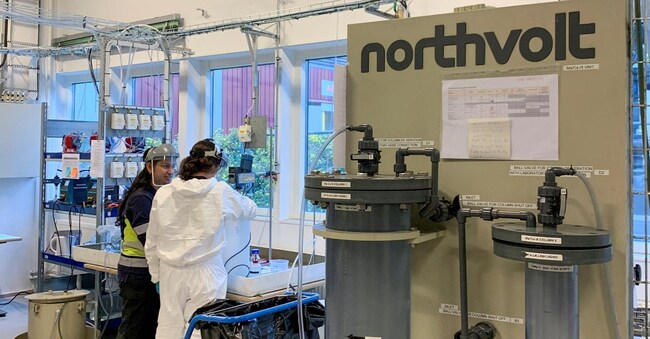
The black week of Northvolt, which on Monday announced a production stoppage at its main plant in Skelleftea, in Sweden's main mining district, and possible redundancies among its 7,000 employees, casts sinister shadows on the ambitions of the European car battery industry. The Swedish, and first European, manufacturer has raised more capital than any other continental start-up ($15 billion between equity and debt thanks to financiers such as Goldman Sachs and BlackRock, but also the EIB and Bnp Paribas). But in recent times it has suffered from the decline in demand for electric cars. And so, of course, the IPO that had been talked about in 2023, worth up to 20 billion, has also slipped. The slowdown also affected another Swedish big, Volvo Trucks, which just yesterday decided to postpone the construction of a new battery production plant in an attempt to cope with changed market conditions.
The advance of the eastern giants
.As for Northvolt, one of the most surprising decisions was the halting of production of active cathode materials, a key component of batteries. The company then cancelled plans for a new site in Sweden and is seeking investors for a facility in Poland. From now on, the main focus will be on the production of battery cells. This marks a departure from Northvolt's original mission, which aimed to cover the entire supply chain, from material production to battery recycling. The timing of this decision is particularly delicate, as the European renewable energy sector is undergoing a growing Chinese offensive. The recent report by Mario Draghi on the future of European competitiveness highlighted the rapid advance of eastern giants: South Koreans, Japanese but especially Chinese (CATL, BYD). With the discontinuation of production at home, Northvolt will have to resort to Chinese or South Korean suppliers.
Production delays, targets postponed
.Despite orders worth over 55 billion dollars from customers such as Volkswagen, Scania, Volvo and BMW, Northvolt has recently experienced significant production delays. Last June, Bmw cancelled a $2 billion contract precisely because the Stockholm-based company - co-founded by Peter Carlsson and Paolo Cerruti, both former Tesla managers - was two years behind schedule. The Northvolt Ett plant in Skelleftea is still far from reaching full capacity. The target of producing 16 gigawatt hours (GWh) per year has been postponed to 2026, three years later than planned. This has raised concerns about when, or even if, the plant will reach its full potential of 60 GWh, enough to power one million electric cars per year. And the future of the three other planned gigafactories - in Germany, Canada and Sweden - also hangs in the balance.
Expected capacity in Europe, more than half at risk
With problems leading to order cancellations and delivery delays, Northvolt's future remains uncertain. Just like the large-scale plans in Europe, i.e. 50 gigafactories by 2030 for 1.2 TWh, terawatt hours, the energy storage capacity of the batteries produced. About 30 per cent of the projects are at an advanced or completed stage (the Northvolt project in Heide, Germany, started work in March and is expected to open in 2026, the first gigafactory of the ACC consortium, France, started in May 2023, Hungary is aiming for 3 plants).
However, according to a report by Transport & Environment (May 2024), there would be certainty for less than half of the planned battery production. Fifty-three per cent of cell production capacity is still at medium or high risk of being delayed, downsized or cancelled without more decisive government and financial action. Europe, in theory, could, according to T&E (an organisation that carries out advocacy and political lobbying to influence public decisions, especially in the environmental and transport spheres, ed.), become 'self-sufficient in battery cell production by 2026 and produce most of its demand for key components (cathodes) and materials such as lithium by 2030'. Will it make it, keeping this pace?


