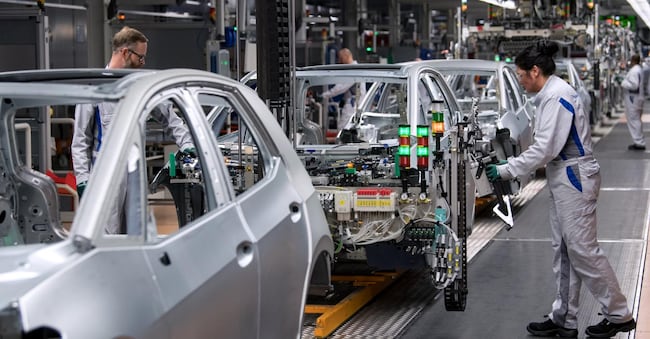
Batteries, tariff war and labour: the risks and potential of the EU electric car
The European industry has started its transformation to electric power, against the backdrop of political tensions with Beijing, internal disagreements at EU summits and fears about the impact on employment. Where we are going
by Alberto Annicchiarico (Il Sole 24 Ore,), Vlad Barza (Hotnews), Gábor Kovács (HVG), Petr Jedlička (Deník Referendum)
9' min read
Key points
9' min read
It all started with Dieselgate, in 2015. It was the scandal that engulfed the Volkswagen Group, accused of installing software that altered downward the emissions data of the diesel engines of millions of vehicles during control tests. The case was uncovered by the US Environmental Protection Agency (EPA) and has had global repercussions, leading to fines of tens of billions, recalls for half a million vehicles and considerable damage to Volkswagen's reputation.
Dieselgate had an even unpredictable impact on the European automotive industry, prompting many companies to review their practices and accelerating the transition to electric vehicles and other low-emission technologies. A year later, the launch of the Chevrolet Bolt and especially the Tesla Model 3 proved that electric vehicles could be the new reality for cleaner mobility, if not yet in terms of price certainly in terms of performance.
The transformation towards electrification of the European automotive industry seemed a great opportunity to improve environmental sustainability and technological innovation. A change that is, of course, fraught with significant challenges. In terms of competitiveness, given that the Old Continent is poor in key raw materials, for example for batteries, of which China has ample supply (around 80% of global production in 2023). And in terms of risks on the employment side, since the production of electric cars requires about one third less manpower.
Then came politics. The battle extended from pollutants that are directly harmful to health, such as nitrogen oxides, to the war on climate pollutants, i.e. mainly carbon dioxide, methane and nitrous oxide emissions. Several European countries, such as France and the UK, have announced long-term plans to ban the sale of new petrol and diesel cars. And as of December 2019, the EU has initiated a new phase with the Green Deal. The EU and its member states have committed to reduce net greenhouse gas emissions by at least 55% (the famous Fit for 55 target) by 2030, compared to 1990 levels. It should be remembered that the EU-27 accounts for just over 7.4% of CO2 emissions, China for 30.7%, India for 7.6, the rest of Asia for 20.3% (source: Ourworldindata.org)
The European automotive industry has therefore embarked on a significant transformation towards electrification, with profound impacts on several fronts. In February 2023, the European Parliament decreed that the production of internal combustion engines (so-called heat engines) should be stopped until 2035, a step that is considered decisive for achieving climate neutrality in 2050. A decision that on paper should have given wings to the transition to the electric car.
Historic transition, but not without risks. A year ago, a Boston Consulting Group study sounded the alarm due to the challenges of deglobalisation and energy transition. Bcg estimated a decline of the European car from a global market share of 26% to 12% in 2040, with the advance of Asian and American competition. As much as 145 billion euro less GDP, 1.5 million jobs lost and a stock market bonfire of almost 300 billion.
As for Italy, assesses another global consulting bigwig like AlixPartners, the current legislation poses a significant challenge for the automotive supply chain: to manage a growth of electric from 10% to a hypothetical 90% (64% in Europe) by the end of the decade. Moreover, the electric transition to 2030 could entail a reduction in turnover of Italian components for combustion engines of more than 50% (-7 billion) against +3 billion between common components and for Bevs (Battery electric vehicles) alone. In the components supply chain, about 40 thousand jobs are estimated to be at risk.
According to Acea - the European association of manufacturers of cars, trucks, vans and buses - the automotive sector accounts for more than 7% of the GDP of EU countries and 31% of R&D expenditure, employs 12.9 million people, and creates more than 100 billion trade surplus for the Union.
A controversial choice, then, the infamous ban to 2035 (preceded by the very high industrial costs of the Euro 7 standards, in force from 1 July 2027), but perhaps not yet truly definitive. And the reason is as follows. 2024 is proving that the battery car market has not yet taken off, according to the expectations of environmentalists but above all of manufacturers.
The latter have planned colossal investments on a global scale, exceeding USD 500 billion between 2022 and 2026, according to AlixPartners. The first European group alone, Volkswagen, has put investments of 180 billion in its latest 2023-2028 plan. A large part (122 billion) to support the development of software and the development of the electric vehicle range.
But in the early months of 2024, all European manufacturers, faced with weaker-than-expected sales figures and orders for electrics, began to revise their plans, lowering their targets to 2030. Mercedes-Benz, for example, has reduced the share of electrics and plug-in hybrids to 50 per cent from the 100 per cent forecast. After all, the target for 2025 was, again for the Stuttgart-based company, 50 per cent electric cars. Difficult to achieve, since in the current year it will not go beyond 21%.
Vw itself, like Renault, has confirmed that there is no going back, electric is the future. Meanwhile, in Wolfsburg, they are obsessively working on costs and developing more popular engines such as hybrids. All the big players have assured that for at least another decade they will continue to produce excellent thermal engines, perhaps to be powered by more sustainable fuels than traditional fossil fuels, such as e-fuels or synthetic fuels.
Meanwhile, the start of 2024 was moderately positive for the car market: +4.6% to 4.6 million units, after -3% in May. But the Bev share, say Acea data, has been stationary for months at around 12.5%, a figure updated after the thud (-12%) in May, driven by the collapse of the German market (-31%), orphaned for months by incentives. Prices that are still too high compared to similar thermal models (and will remain so for years, according to Mercedes-Benz CEO Ola Källenius), a recharging network that is still insufficient, the too-rapid fall in residual value as a result of a very competitive climate that pushes leading players such as Tesla to act too often on price lists (a very serious detriment for fleets), are all factors that play against a real boom. Not to mention the fact that the European car market is expected to grow very moderately (maximum +1%) until 2027.
The picture is clear: the era of electrification has begun and yet endothermic engines in the year 2024 dominate with 65.4 per cent: 35.5 per cent petrol vehicles plus 29.9 per cent hybrids (25 per cent in the same period in 2023). Early adopters, the enthusiasts, have already bought an electric car. The mass market is still to be conquered.
Then there is the battery front and the expensive factories to produce them. Europe invests too little relative to its competitors and risks sliding from dependence on Russia for gas to dependence on China. With the slowdown in sales of electric vehicles, groups such as Volkswagen, Stellantis and Mercedes-Benz are downsizing, putting on hold or reorienting their projects. For example, the project for the Termoli gigafactory has been postponed by the jv ACC (Stellantis, Mercedes-Benz, Total Energies), ostensibly to allow the introduction of new, low-cost cell chemistries. But that is not all. The European Commission and the UK have approved less than €7 billion in state aid for battery production from the beginning of 2022.
This is a fraction of the estimated $140 billion needed to reach the target of 1.4 terawatt hours of battery capacity by 2030. The US, on the other hand, will spend about $160 billion in tax credits by 2029 on solar cells and batteries, according to BloombergNEF. And Canada alone allocated $25 billion in incentives for batteries last year, attracting investment from Volkswagen and Stellantis.
In the background, but not too much, Chinese manufacturers already have factories in Europe, they already have surplus battery capacity, they can produce cells at a fraction of the cost compared to Europe and they are clearly ahead in next-generation technologies. All this means that the Old Continent risks (understatement) falling further behind in the race to build and power the electric vehicles of the future with its own resources.
The flop of pure electrics also poses a problem for the dreaded made-in-China invaders, which are stuck at around 6% of the Bev market and 3% of the total market, in Europe. A value of around EUR 6 billion in 2023, which from 4 July could be attacked by the new duties launched by the European Commission, up to 48% overall. Beijing's reaction was immediate. Retaliation is to be reckoned with, even if the final decision by Brussels will not come before November. Time to negotiate there is. And judging by what the financial markets are saying, with the Hong Kong automobile index outperforming the Stoxx 600 Automobiles & Parts since 12 June (the day of the news of the duties), sitting around a table is, after all, more convenient for Europe than for the Dragon.
In Romania, electric cars are still a niche
.Romania produces more than 500,000 Dacia and Ford cars per year. At the moment, no battery electric vehicles are produced, but Ford has announced that it will start building fully electric cars towards the end of 2024 with the Puma EV model.
Electric cars are still a niche in the country: there are about 50,000 out of a total of 8 million vehicles, less than 1%. The Dacia Spring is the best-selling electric model.
In 2023, more than 15,000 electric cars were registered, a record, but they remain uncommon because they are still too expensive. Moreover, many Romanians undertake long car journeys across the country and to Greece, Turkey and Bulgaria for their holidays: the reduced autonomy of electric cars is a big problem, as the journey would require much more time and meticulous planning.
It must be said that Romania does not have strong trade ties with China and Romanian officials have not been as friendly to China as their neighbours Hungary and Serbia have been.
Until 2023, Romania had among the highest subsidies for electric cars in the EU, i.e. over 9,000 euro for anyone buying an electric car. From 2024, the subsidies have been halved (EUR 5,100). One of the reasons for the cut is that the best-selling electric car is the Dacia Spring, which is produced in China. Several politicians have stated that it is unthinkable that the Romanian state would subsidise a car manufactured in China. The reduction of the subsidy is reflected in the drop in registrations of new electric cars: from January to May 2024, there were 4858, a decrease of 10 per cent compared to the same period in 2023.
Hungary and the race to become a 'battery superpower'
.The automotive sector is one of the main pillars of the Hungarian economy: it accounts for 25 per cent of GDP and employs around 150,000 people. As in other Central and Eastern European states, after the fall of the Iron Curtain, factories established by Western car manufacturers were driving forces behind economic growth and modernisation, in particular Opel, Suzuki and Audi. In recent years, the 'new' automobile industry has faced strong public opposition due to their real and perceived negative environmental effects, especially in the case of some battery factories built by Asian multinationals.
Electric cars are rather rare due to their high price and lack of charging infrastructure: in 2023, of the 107,720 new cars sold, only 5,807 were fully electric and 5,546 were plug-in hybrids. The Hungarian government has firmly rejected the additional duties imposed on Chinese electric vehicles by the European Commission, arguing that protectionism is not the solution, and that cooperation and free competition are needed instead.
The Hungarian government is trying to maintain close economic and political relations with Beijing. One of the large Chinese manufacturers of electric vehicles considered by the Commission in its investigation into Chinese exports of electric vehicles is BYD, which is currently building its first factory in Hungary. The government aims to turn the country into a 'battery superpower' by using diplomacy and all available means of state subsidies to convince battery and electric vehicle manufacturers, mainly from Asia, to establish factories in the country. With success: the production of electrical equipment already has a 10% share in manufacturing. In recent months, however, the weak performance of the battery sector has negatively influenced the overall manufacturing figures.
Czech Republic Concern
.The automotive industry is also a key industrial sector in the Czech Republic: it accounts for about 20% of the country's total production volume and employs 1.5% of the population. However, the local car manufacturers are all directly owned by, or subcontracted by, foreign companies, in particular Volkswagen, Toyota, Hyundai, which produce parts for their cars in the country. However, these are mainly parts for cars with combustion engines. The Czech automotive industry is therefore today almost entirely 'traditional'.
According to a survey conducted by the STEM/MARK agency in April, more than 60 per cent of Czech respondents are concerned about the destruction of the automobile industry in Europe and the Czech Republic, believing that there is a lack of investment to prepare the industry for the introduction of electric cars. Less than a fifth of Czechs perceive the introduction of electric cars positively. The majority of respondents also state that electric cars are too expensive for them.
The country is currently governed by a centre-right cabinet, which therefore
does not want to restrict the market, but at the same time perceives Chinese cars as over-subsidised. Therefore, to quote Transport Minister Martin Kupka, the government supports a 'level playing field', as long as cars 'do not become too expensive'.
*This article is part of the Pulse project and was written by Alberto Annicchiarico (Il Sole 24 Ore,), Vlad Barza (Hotnews), Gábor Kovács (HVG), Petr Jedlička (Deník Referendum). Edited by Silvia Martelli (Il Sole 24 Ore).

Alberto Annicchiaricovicecaposervizio
Luogo: Milano
Lingue parlate: inglese (C1), buona comprensione di francese e spagnolo
Argomenti: economia, auto, tech, social media, seo, blogging, viaggi, food