Doubts

Tech tycoon's sunken yacht: what the Bayesian recovered hard disks were hiding

The recovery of Mike Lynch's superyacht, which sank on 19 August 2024, will have to shed light on three aspects to be clarified: these are
by Angelica Migliorisi

8' min read

8' min read

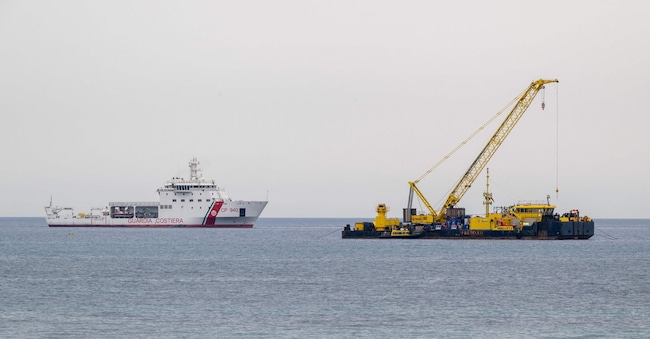
The important operation to float to the surface the wreck of the Bayesian, the luxury yacht of British tycoon Mike Lynch that sank on 19 August 2024 during a violent storm, has begun off the coast of Porticello, in the Palermo area. Leading the activities is the Hebo Lift 2 floating platform, which arrived in the area of the shipwreck with divers, underwater equipment and an on-board crane for preliminary inspections. Almost a year after the tragedy, many questions remain unanswered. Three, in particular: why did the Bayesian sink so quickly? Did it have design flaws? Did the captain or crew make fatal mistakes?

A lightning-fast and mysterious sinking

.

The Bayesian, a 56-metre luxury sailing ship considered to be 'unsinkable', sank in about 16 minutes off the coast of Sicily, in the middle of a sudden storm (severe atmospheric disturbance). Built by the Perini Navi shipyards of Viareggio, it was equipped with a 75-metre aluminium mast, the second tallest in the world.

Loading...

The speed of the sinking and the very nature of the vessel - built to very high standards - immediately raised doubts. A sudden violent storm could have hit the sailing ship with extreme force, suggesting a downburst, a rapid descent of cold air generating very strong horizontal wind gusts. A hypothesis also held by prosecutor Raffaele Cammarano.

However, according to some experts, even in the presence of an extreme weather phenomenon, a vessel of that size and with those safety systems should not have sunk so suddenly. Hence the first big question still unanswered: is bad weather enough to explain what happened?.

The coast guard said that, given the weather forecast, there was nothing abnormal about the Bayesian being moored offshore instead of sheltering in port. On the other hand, another yacht anchored nearby escaped the storm unharmed. The Mediterranean Sea was flat on 18 August, but the bad weather was moving southwards, from Naples towards Sicily. The Italian Air Force's Meteomar forecast predicted scattered thunderstorms, wind gusts and rough seas. But according to several yacht captains, the weather alert was anything but specific or extraordinary.

An investigation by the New York Times revealed that the Bayesian's most striking feature, its very tall mast and all the necessary system to accommodate it, made the boat vulnerable to capsizing. Lynch's super yacht was indeed an outlier: all boats in the same series, from the same builder, had two masts instead of one. Technical documents obtained by the US newspaper and computer models show that the boat could have capsized during a storm and sank rapidly.

At the same time, according to several naval architects, certain design choices, such as the two high doors on the side of the deck, would have increased the chances of the Bayesian taking on large amounts of water if strong winds had pushed it to one side. And the accounts of witnesses and survivors revealed that the yacht would have flipped completely over on its side and then sunk within minutes.

The Bayesian had been designed to ensure a high level of structural safety, with watertight compartments under the deck, designed to limit the spread of water in the event of a failure. The design had been assessed and approved by both the UK's Maritime and Coastguard Agency - a body attached to the Ministry of Transport - and the American Bureau of Shipping, the independent technical body that certifies the reliability of ships internationally.

However, investigations conducted after the shipwreck, supported by underwater images broadcast by Italian TV and statements by officials involved in the operations, did not find any obvious damage to the hull. This directed the investigators' attention to other possible points of vulnerability, related to the yacht's very configuration.

Like many vessels of its class, the Bayesian was equipped with numerous potentially critical openings: large air vents for the main engines, ventilation ducts for the interior and technical rooms, glass doors for access to the stern and sides, as well as service hatches for the crew and guests. All elements that,if left even partially open or poorly sealed, could have facilitated rapid flooding of the interior sections during the storm. Hence, another hypothesis.

Human error or chain of negligence?

.

It is not only its structural vulnerabilities that explain the sinking of the Bayesian. Three crew members - New Zealand's captain James Cutfield, engineer officer Tim Parker Eaton and watchman sailor Matthew Griffith - have been entered in the register of suspects by the Termini Imerese Public Prosecutor's Office for multiple manslaughter and manslaughter wreck. In particular, Griffiths, on watch during the night, allegedly failed to notice the ingress of water on board and did not promptly alert the captain. Eaton, on the other hand, allegedly failed to take adequate measures to manage the emergency, while Cutfield failed to inform passengers of the imminent danger, preventing them from reaching safety. The Italian authorities are also considering the crime of failure to rescue.

At the centre of the investigation, therefore, is a possible chain of errors in the management of the emergency and in timely communication with the people on board (some of whom would not have received clear instructions), but also the accidental opening of a hatch (sailors and nautical engineers claim that it would have taken hours for the ship to fill with enough water to sink) and the raised position of the keel that could have compromised stability.

The keel is a fin-shaped stabilising structure placed under the hull, which can be raised to reduce the depth of the yacht in shallow water or in harbours. In a model such as the Bayesian, it could reduce the underwater area of the yacht from about 10 to 4 metres.

On his profile LinkedIn, former captain of the Bayesian Stephen Edwards claimed that the yacht was able to tilt about 75-90 degrees, depending on whether the keel was raised or lowered, and still return to an upright position. He went on to explain that the angle of descent, i.e. the angle at which water can begin to enter the yacht through the engine room or ventilation ducts, was 40-45 degrees and, once exceeded, would have put the yacht 'in serious trouble'. Many experts questioned whether the yacht was moored with its keel raised, potentially compromising its stability, but according to Edwards, according to the vessel's operating rules,it was not mandatory that the keel be lowered while anchored.

According to sources reported by Adnkronos, some passengers tried in vain to escape to the other side of the boat, but the water had already invaded the cabins. The dynamics of the evacuation are indeed unclear. A detailed analysis by the MarineTraffic website, later confirmed by Reuters, based on Automatic Identification System (AIS) data, reports the sequence of events:

    .
  • At 3:50 a.m., the yacht began to suffer the effects of a storm, showing abnormal movements;
  • At 3:59am, the anchor gave way, leaving the yacht exposed to the elements;
  • At 4:00, the yacht began taking on water, resulting in a loss of power;
  • At 4:05, the Bayesian disappeared from the tracking systems, indicating complete sinking;
  • At 4:06, the EPIRB (Emergency Position-Indicating Radio Beacon) system automatically sent a distress signal to the Bari coastal station.

The emergency signal, therefore, would only have been transmitted after the vessel had sunk completely. The chief prosecutor of Termini Imerese, Ambrogio Cartosio, stated that a red flare to alert the emergency services was launched into the sky more than 30 minutes after the boat had sunk.

Giovanni Costantino, CEO of the Italian Sea Group, owner of Perini Navi and one of Italy's leading luxury yachting companies, specialising in the design, construction and refitting of super and mega yachts up to over 100 metres in length, stated that the Bayesian was 'one of the safest boats in the world', unsinkable. Based on some data from the Automatic Identification System, Constantine is convinced that the sinking was caused by a series of human errors, as the storm was predicted: if the crew had closed all the doors and hatches, started the engine, lifted the anchor, lowered the keel and turned the yacht against the wind, it would not have been damaged, he said. According to him, there was nothing wrong with the design and the massive mast had created 'no problems whatsoever'.

But witnesses, an Italian official familiar with the investigation and the underwater video disputed the company's version of events. The footage, in particular, appeared to show the watertight door of the engine room closed and the official claimed that the divers had not seen any open hatch on the hull.

What was really on board?

.

One of the most sensitive leads is that of the vessel's contents. On 30 April 2025, Italian authorities announced the recovery of two encrypted hard disks from the hull of the Bayesian belonging to Lynch, which could contain - according to unconfirmed sources - sensitive data linked to Western intelligence operations and information crucial to understanding the causes of the shipwreck. The British entrepreneur, best known for founding the cybersecurity company Darktrace, which was sold in 2024 to the US fund Thoma Bravo for more than $5 billion, was also technology advisor to the UK governments during the terms of office of David Cameron and Theresa May, offering support on issues related to cybersecurity and digital innovation.

In addition to this, in March 2024 Darktrace announced the creation of a new division called Darktrace Federal, designed to work closely with the US Department of Defence. The initiative involved working with high-profile figures from the intelligence world, including former officials with direct experience at agencies such as the CIA, the National Security Agency and the Pentagon.

After the shipwreck,underwater surveillance around the wreck was strengthened precisely to prevent those devices from falling into the wrong hands. The Guardian confirmed that the US State Department and British authorities were closely monitoring the progress of the salvage operation due to the potentially strategic contents stored inside the ship.

Autopsies

.

Autopsies performed at the Institute of Forensic Medicine at the Policlinico di Palermo revealed a significant detail: four of the seven Bayesian victims died without having ingested water into their lungs, windpipe or stomach. The diagnosis made by the forensic scientists is that of 'atypical drowning' or 'death by confinement', a condition compatible with temporary survival in a pocket of air trapped in the sinking hull. In other words, oxygen begins to run out and carbon dioxide rises rapidly, making the air toxic and unbreathable.

The hypothesis is that the victims were the lawyer Chris Morvillo and his wife Neda, the banker Jonathan Bloomer and his wife Judy, who were found in an area of the wreck that only flooded in the final stages. Their bodies were in a cabin on the port side of the yacht, the one that remained out of the water the longest.

Hannah Lynch, the tycoon's young daughter, was also found in the same area, not far away, suggesting that she may have sought shelter after being alerted to the danger. According to investigative sources, it may have been her mother, Angela Barcares - administrator of the company that owns the yacht - who alerted the passengers. She recounted that she had noticed the violent tilting of the hull and had tried to rescue her husband and daughter, but was unable to do so due to the darkness, the shattered glass and the now uncontrollable flow of water.

According to investigators, all six guests found in the wreck were awake, aware of the danger, but trapped in an inaccessible environment from the upper deck. Medical examiners believe they took their last breaths in a CO₂-saturated environment, unable to exit the flooded area.

The detail of 'atypical drowning' or 'death by confinement', which emerged from the autopsies, could become decisive if it is established that there was a delay in requesting and intervening rescue.

Investigators hope that the recovery of the yacht will provide useful clues: whether a series of human errors led to the sinking or whether other factors came into play. Once ashore, forensic examination will determine whether one of the hatches was left open and whether the keel was lifted improperly.

Copyright reserved ©
Loading...

Brand connect

Loading...

Newsletter

Notizie e approfondimenti sugli avvenimenti politici, economici e finanziari.

Iscriviti