
Because integration is a democratic imperative
Inclusion is what allows a right to become a pathway: orientation, being taken care of, not being left alone in the face of complexity

The scene appears, today, all too plausible. Two people arrive at the emergency room on the same day with similar complaints. The first comes out with an accurate diagnosis, a set therapy, an indication for a specialist check-up and a clear path to follow. The second is discharged with a few lines scribbled in barely intelligible handwriting, a generic recommendation to consult the attending physician, no operational link with the territory. She goes home with more questions than answers. Where do you book, how long do you wait, what is urgent and what can you put off?
It is not necessarily the case that behind this difference in treatment there was a form of intentional discrimination. Often, ordinary factors are at work: those who can tell symptoms better, those who have an orderly medical history, those who master the system's minimum vocabulary, those who have someone to accompany them, those who know which doors to knock on and in what order, or, trivially, those who are native speakers and have no difficulty making themselves understood. No ill intentions, yet the outcome is clear. For someone, the emergency room is the beginning of a takeover, while for someone else it is a parenthesis that closes, leaving the need intact, or almost intact.
Segregation as public ignorance
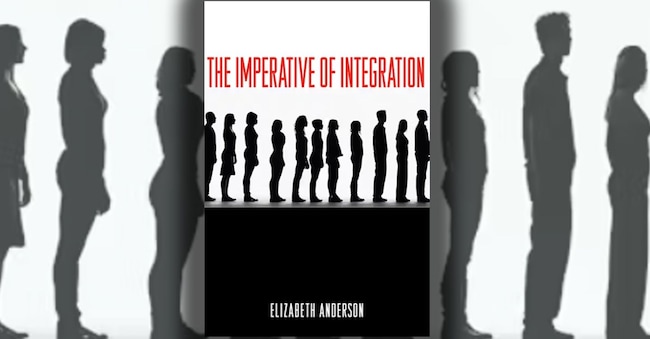
It is with respect to issues such as these, and not just the distribution of resources, that Elizabeth Anderson invites us to identify an essential dimension of justice: the way in which institutions recognise or deny people as full members of our democratic communities. It is here that the great theme of segregation, in its many facets - spatial, social, organisational - that Anderson analyses in her The Imperative of Integration (Princeton University Press, 2010), a book that represents not only a work 'on race', but a true general theory of 'justice as inclusion'.
The injustice of segregation, for Anderson, operates simultaneously on several levels. On the one hand, it restricts material opportunities - in employment, access to public goods, services, networks - and on the other hand, it fuels stigmatising representations that turn disadvantage into an 'internal defect' of subordinate groups. But the more philosophically fertile point is another: segregation degrades public life, because it reduces the ability to understand, even in perfect good faith, what policies produce for others, for those who do not originally belong to one's own social world.
In a very dense page, Anderson links these harms directly to the democratic ideal: 'Segregation,' she writes, 'hinders the inter-group communication necessary for democratic institutions to gather and use widely dispersed information on issues and policies of public interest. It blocks the mechanisms needed to make public office holders democratically accountable to the people as a whole. It embodies demeaning group relations incompatible with equal citizenship' (p. 111). The key idea is simple: if injustice is 'separation + hierarchy', the remedy cannot be reduced to compensating afterwards. Integration is needed as an architecture of relations between equals.


