
Why is Microsoft 365 Copilot also open to Anthropic models?
More choice and flexibility for companies for complex tasks such as market analysis, advanced reporting or workflow automation: Claude Sonnet 4 and Claude Opus 4.1 arrive

2' min read
2' min read
The agreement between Microsoft and OpenAI continues, but Redmond aims to provide users with maximum flexibility by offering access to the best artificial intelligence models available. Thus, in addition to continuing to leverage GPT and OpenAI technologies, Microsoft 365 Copilot now also supports Claude Sonnet 4 and Claude Opus 4.1 developed by Anthropic. The debut of Anthropic technologies within Microsoft 365 Copilot currently concerns Research agent and Copilot Studio.
The announcement, signed by Charles Lamanna, president of Copilot's Business & Industry division, marks an important step towards greater openness and customisation of AI tools for work.
Users subscribing to Microsoft 365 Copilot can decide whether to continue using Researcher agent based on OpenAI templates or opt for Anthropic's Claude Opus 4.1. Microsoft emphasises that this choice offers greater flexibility for performing tasks such as complex analyses, market strategies and detailed reporting.
In Copilot Studio, users can choose between OpenAI, Claude Sonnet 4 or Claude Opus 4.1 to create and customise AI agents that automate business workflows. Thanks to Copilot Studio's prompt tools, it is also possible to develop multi-agent systems, combining different templates for specific tasks and selecting any template from the Azure Template Catalogue.
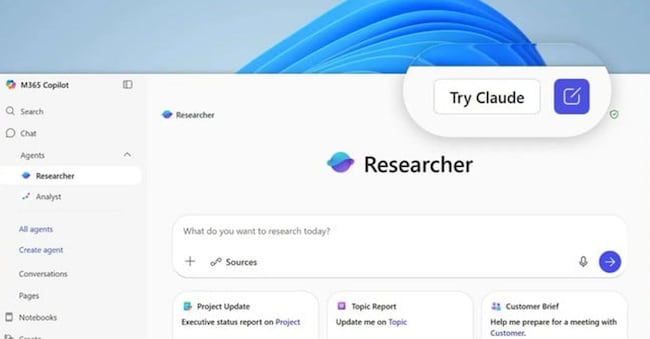
Concretely, Researcher users will see a 'Try Claude' button in the Copilot interface, allowing them to easily switch from an OpenAI model to Claude Opus 4.1. In Copilot Studio, however, the integration goes even further: it will be possible to generate agents that exploit Claude for complex reasoning tasks, workflow automation or multi-step tasks.

