
Why travelling helps to build connections that are also valuable in the workplace
In an age dominated by digital connections, there is a growing need for real-life experiences to build meaningful relationships

New technologies have multiplied opportunities for contact, but they have not necessarily strengthened the dynamics of relationships. Quite the contrary. The more digital connections increase, the more the need for shared experiences in the real world seems to grow. It is one of the paradoxes that characterise contemporary social life and which fuel what some observers now refer to as the ‘IRL economy’, where the acronym IRL stands for In Real Life economy. We are talking about a rapidly evolving phenomenon that is attracting the interest of businesses and investors and which aims to create value through opportunities for people to come together, ranging from events and communities to travel and group experiences. This phenomenon, in addition to its social significance, also takes on an economic dimension due to the effects that loneliness (in a negative sense) and the quality of relationships (in a positive sense) have on productivity, on workers’ wellbeing and, consequently, on the competitiveness of organisations.
A snapshot of this change was provided by the second edition of the “How Are Relationships Changing?” produced by the WeRoad platform based on a sample of 5,000 people aged between 20 and 40 in Italia, Spain, France, Germany and the United Kingdom. The most striking finding reveals a growing difficulty in forming new relationships, with 66 per cent of respondents believing it is harder to meet new people than in the past, whilst over half (52 per cent, to be precise) say they are dissatisfied with their social lives. The underlying problem does not seem to be a lack of interest in others, but rather the absence of conducive social settings, with 66 per cent of those surveyed stating that they do not find enough opportunities to meet people in their daily lives and 72 per cent saying they would like to have more offline experiences. Among these, travel emerges as one of the best settings for building new connections, and according to 45 per cent of respondents, it is the setting in which it is easiest to meet new people, ahead of the workplace and university, friends of friends, sport, hobbies, events and, above all, social media and apps (the latter mentioned by just 9% of the sample). It is therefore not surprising that 83 per cent say they feel more open towards others when travelling, and that two in three say they have built genuine, lasting relationships whilst travelling.
From social interaction to relational value
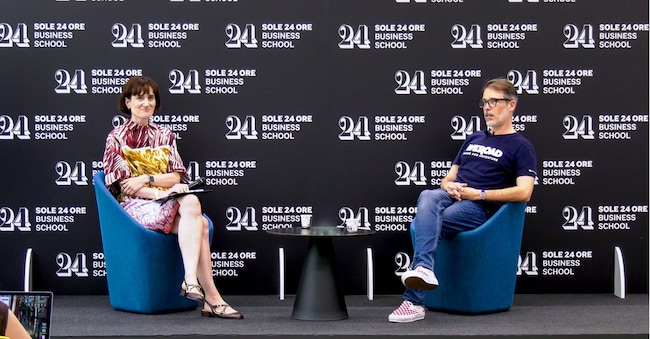
Shared time, shared experiences and a break from the daily routine can therefore become strategic levers for rethinking the contexts in which trust, a sense of belonging and collaboration are built, starting with organisations. These topics were discussed at the latest instalment of Meet&Grow, the initiative through which Sole 24 Ore Business School brings together CEOs, managers, students and professionals, creating a tangible bridge between education and the world of work through discussions on managerial experiences, strategic choices and future scenarios. The meeting on Wednesday 8 July was attended by Fabio Bin, Co-founder and Chief Marketing Officer of WeRoad, who shared with guests the growth journey of a company capable of innovating the travel sector by building an international community, and outlined the skills most in demand today for navigating a constantly evolving market.
The research also confirms an insight that WeRoad has developed by observing the behaviour of its community over the years. “We realised very early on,” Bin explained to *Il Sole 24 Ore*, “that the need we were meeting was not just to travel, but above all to create opportunities for socialising. We realised this by seeing relationships form during trips and noting how many people continued to socialise even after returning home. For many, travelling becomes the starting point for building a new network of relationships.” As for the growing difficulty in forming new bonds, one of the causes, according to the manager, is the wider transformation of social models. “For years,” Bin explains, “we thought that social networks and dating apps could solve this problem; in reality, they have mainly offered us a substitute made up of feeds, notifications and virtual connections, whilst people continue to seek shared experiences and relationships built in person.”
The skills that AI cannot replace
From this perspective, travelling creates conditions that are difficult to replicate in everyday life, because when you travel, you step outside your routine, many barriers come down, and you are naturally more open to meeting people. It should therefore come as no surprise, as the co-founder of WeRoad points out, that travelling is now seen as one of the most favourable contexts for meeting new people and building genuine, lasting relationships. According to Bin, this dynamic should also be understood in the light of the growing prevalence of artificial intelligence. ‘The more digital technology becomes capable of producing content, conversations and even forms of synthetic companionship, the more physical presence gains value. Technology – in the CMO’s view – does not eliminate the need to meet in person but, on the contrary, makes shared experiences even more valuable.” This line of reasoning, as we have seen, extends beyond the travel sector, however, and directly impacts the world of organisations, where the issue of skills remains a priority to be addressed. “Technical skills,” concluded Bin, “can be learnt, whilst it is far more difficult to teach curiosity, initiative and the ability to build relationships – qualities that help people and organisations grow.” For young people entering the world of work (this is the manager’s final piece of advice), it is therefore not enough simply to learn how to use artificial intelligence tools – which can be a formidable enabler – but rather to develop a hands-on approach: experimenting, developing projects, disrupting processes, exercising critical thinking and curatorial skills. In a nutshell, having a perspective that artificial intelligence alone cannot offer.

