
Protecting bees, from ENEA a biopesticide against beetles that damage hives
Researchers have developed a molecule that detects a key gene of the pest and stops its growth

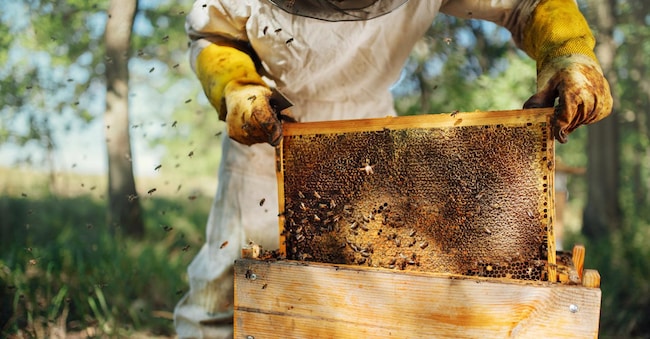
Almost like surgery. Except that in this case there is no medical intervention but an action to eliminate the beetles without harming the bees. It is a biopesticide developed by Enea researchers at the Trisaia centre under the coordination of entomologist Salvatore Arpaia.
Specifically, as the researchers point out, 'a special molecule has been developed that works like a targeted 'switch': it detects a key gene of the small hive beetle, Aethina tumida, and 'silences' it by blocking the production of a protein essential for its growth and development'. With the result that the parasite can be controlled without harming the bees.
The first results of this project, financed with 5x mille funds and carried out within the framework of the RNApi programme, have been published in the Springer-Nature group's trade journal Journal of Pest Science. 'Our studies have shown, for the first time, that,' saysSalvatore Arpaia, researcher in the Ene Bioenergy, Biorefinery and Green Chemistry Division, 'it is possible to effectively silence a key gene for the development and reproduction of the small hive beetle, Aethina tumida, by administering the molecule to larvae. And the molecule itself is harmless to bees. This is very similar to the route taken when the Covid vaccine was developed'.
The small hive beetle, Aethina tumida, is an invasive species native to sub-Saharan Africa that causes damage to European bee colonies by feeding on bee wax, eggs and larvae and causing acidity in the honey produced. Within the European Union, the insect is classified as an invasive exotic species of concern, following its detection in Calabria, Italy in 2014, where it is still a permanent presence. Its recent expansion from mainland Italia to Sicily, with infestations confirmed in apiaries in the province of Messina, underlines the urgency of effective containment to limit its territorial spread. To support research and to verify the efficacy of the molecule (double-stranded RNA) on the invasive species, experimental tests were carried out in the laboratory with the Istituto Zooprofilattico Sperimentale del Mezzogiorno.
In addition, as part of the project, the Trisaia Research Centre laboratory has obtained accreditation from the Ministry of Health to carry out genetic modification on a non-pathogenic strain of Escherichia coli: 'This will make it possible to produce double-stranded RNA molecules, the 'active ingredient' of the future biopesticide, more efficiently and at reduced costs,' the ENEA emphasise. On the basis of the results already obtained, these molecules will also be used in tests on infested hives, with the aim of arriving at the development of a specific product for beekeeping'. The new discovery, as emphasised by ENEA, launches a new course for safeguarding bees, given that "chemical control of hive parasites is particularly complex, because treatments must be effective against infestations without damaging the health of colonies or the quality and safety of hive products".

