
Before the race begins. John Roemer and the 'circumstances' of life

We pronounce the word 'merit' very naturally, as if it had the power to separate what each person owes to himself from all that he owes to others, to family, neighbourhood, school, health, language learned at home, trust received before he even knows he needs it. Merit promises a form of justice that appears sober, sporting. It does not matter where you come from, it matters how fast and how long you are willing to run. No matter who you are, it matters what you do. No matter what you have received, it matters how you use your abilities.
It is a powerful idea, because it contains a part of truth. No decent society can renounce the idea that people are protagonists and responsible for their own lives. No justice can treat individuals merely as passive products of circumstances. Of the lottery of genes and the lottery of birth. And yet the meritocratic promise walks a thin, slippery ridge. The slide into ideology is always just around the corner. When, for example, we forget to consider the moment before the race. Before the effort begins a world has already determined its consequences. Before individual choice there is already a distribution of possibilities, expectations, fears, encouragement and safety nets. Before merit, then, there is life that has taught some to imagine the future as a possibility, and others to treat it from the outset as an unattainable luxury.
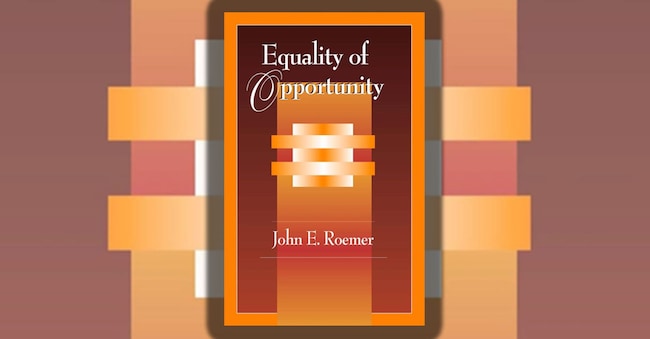
John Roemer, economist and political philosopher at Yale University, has devoted an essential part of his work to analysing this 'grey area' of justice. In his Equality of Opportunity (Harvard University Press, 1998) he attempts to do what public discourse often avoids. Take equality and responsibility seriously at the same time. It is not enough for him to say that merit is, after all, a fiction. Nor does he accept that individual responsibility becomes the word with which a society absolves itself. His problem is more difficult and the challenge is complex. How can we distinguish inequalities that arise from circumstances for which individuals cannot be held responsible from those that arise, instead, from personal choices and commitment?
Roemer starts from a well-known formula, the one according to which equality of opportunity requires first and foremost to 'level the playing field'. That is, to reduce structural advantages or disadvantages that make competition unfair to begin with. This image, however,' Roemer tells us, 'if we really take it seriously, appears much more demanding than it seems at first glance. It is not enough, in fact, to eliminate formal discrimination. It is not enough to say that, once the competition is open, everyone should only be judged on their performance. The problem is where we place the starting line. Roemer writes that in the idea of equality of opportunity there is a 'before' and a 'after': before competition, opportunities must be equalised; after it begins, individuals are on their own. The political dispute, then, is not only about how much to reward those who come ahead. It is above all about the decision as to where the competition begins.
It is here that the idea of meritocracy reveals its ambiguity. It can be a critique of hereditary privileges, when it rejects that birth, class, gender or affiliation decide a person's destiny. But it can become a more subtle justification of them, when it assesses as a personal achievement what has been prepared by an entire social ecology. The child of an educated family who grows up among books, conversations, travel and social stimuli, and the boy who, on the other hand, grows up in a home where the future is more of a concern than a prospect, may formally face the same exam or competition, but they do not arrive there in the same way. The test they face is the same, but the road they had to travel to get there is completely different.


