
Being able to touch Michelangelo's River God
The Accademia delle Arti del Disegno displays, after restoration, the model created (and never realised) for the San Lorenzo Sacristy: it is unicum

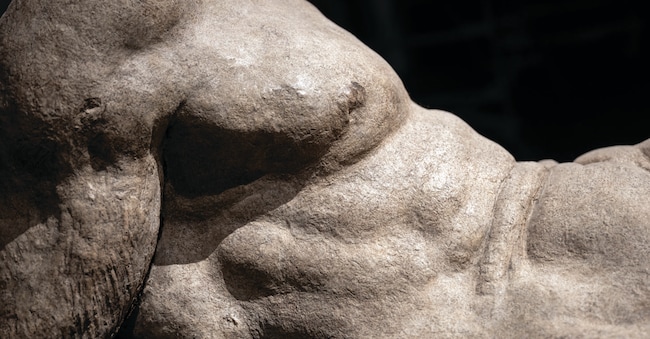
The room has a soft, suffused light, and the light on Michelangelo's torso gives it concrete life, and seems to tell it to rise up and become River God. At the Accademia delle Arti del Disegno in Florence, the earthenware model of Buonarroti's River God has been given a home after conservation restoration, and what a home! In the past, the masterpiece has travelled through venues and storerooms and made a few detours before returning to dialogue with the public, thanks to the Accademia delle Arti del Disegno, headed by Cristina Acidini, and the commitment of its Secretary General Giorgio Bonsanti.
We are close to Piazza della Signoria, in Via Orsanmichele, in the headquarters of the Accademia, and the profound silence only enlivens the senses in front of so much material: the River God is a life-size model conceived around 1526-1527 for the New Sacristy of San Lorenzo, where Michelangelo was making the tombs of Giuliano and Lorenzo de' Medici. It looks almost like an anthropomorphic torso from classical times and was meant to complement the Giorno e Notte for the tomb of Lorenzo Duke of Urbino. Its essence is that of the models that sculptors created before modelling marble and, in Vasari's Vita di Jacopo della Quercia, the type of workmanship is well understood: "pieces of wood and flat boards bound together, and then wrapped in hay and tow, and with ropes tied everything tightly together, and on top put earth mixed with linen cloth, paste and glue [...] they nevertheless appear light and, covered in white, similar to marble". Today, even the River God, which never became a marble statue, appears white, as it must have been when Michelangelo sculpted it, thanks to the restoration carried out by the Accademia and financed by the Friends of Florence. And here begins the work's journey, saved from the fortunes of history because these preparatory models were destroyed.
In April 1583, the model arrived at the Accademia, founded in 1563 to promote the social status of artists, as a gift from Bartolomeo Ammannati, the author of the Fontana del Nettuno, who had received it from Cosimo I, and was used by young people to learn to draw. Archival documents reveal the use of wooden bases and chestnut rods to move the work without damage and, after its rediscovery in 1906, it was given into storage at the Galleria dell'Accademia until the director of Casa Buonarroti, Charles de Tolnay, obtained its deposit from the Soprintendenza in 1965. Moves, different locations, the passage of time: the model showed its years and in 1978 the scholar Johannes Wilde described it 'in a much damaged state'. Thus, the exhibition on the Medici and the arts at Palazzo Strozzi led to a radical intervention, entrusted to Rosanna Moradei of the Opificio delle Pietre Dure, under the direction of Laura Speranza of the Opificio and Giorgio Bonsanti of the Accademia: "the dark varnish that covered the white lead layer, original and with which Michelangelo created an effect in imitation of marble, was removed. The Fluvial God is unique in the corpus of the artist but extremely rare in absolute terms because it belongs to a type of worksite destined for self-destruction and made in materials that are ephemeral by their very nature".
The tense muscles, the signs of workmanship on the surface: these are Michelangelo's fingertips that are also revealed thanks to the architectural design of the room by David Palterer and Norberto Medardi.
Light is shed on the River God and on the two works in this new treasure chest: the Adoration of the Shepherds by Francesco Granacci (circa 1500) and the wooden Crucifix (circa 1510-1520) from the Sangallo workshop, which were given to the Accademia in the early 19th century. Work is still underway on the reading of the River God and President Acidini explains: "among the many hypotheses I find convincing that the four River Gods allude to existing territorial identities, in accordance with ancient and Renaissance allegorism. In the tombs of Lorenzo Duke of Urbino and Giuliano Duke of Nemours, the Arno, the river of their hometown, and the Tiber, witness to their triumph on the Capitoline Hill in 1513, would be obligatory. It is possible that the other two Gods signified the domains of which the deceased Medici were invested with their titles, namely the Metauro for Urbino and the Loing, flowing in the Gâtinais, for Nemours. Our model, lacking in attributes, is not recognisable'. But wonder and silence remain in front of this god so human that he almost seems to stand up, facing the future.


