
Beko Europe CEO Balcioglu: 'With US duties more Chinese appliances in Europe'
In an interview, the manager calls for fairer trade policies and regulations to support European producers. In Italy the multinational has achieved a medium-term balance
4' min read
4' min read
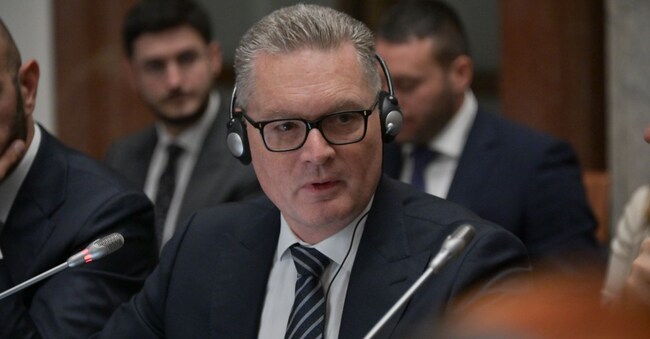
The day after the agreement at Mimit that closed the Beko dispute, for manager Ragıp Balcıoğlu, it was not the best of awakenings. Balcıoğlu is the ceo of Beko Europe, when we talk to him he is still in Rome for the signing of the union agreement which was very complicated and on which the future of Beko's industrial structure in Italy depends. Speaking of our country, he recognises its strong industrial culture, but also many weaknesses, largely due to those of the EU where 'industry should unite to promote fair trade policies and regulatory frameworks'. Balcıoğlu does not give his opinion on our country's prospects because there are too many uncertainties in the global context. Starting with US tariffs. If they are actually introduced, the manager argues that 'there could be a significant drop in Chinese production destined for the US market. As a consequence, a large part of that production capacity - no longer aimed at the US - could be diverted to Europe. Should this scenario materialise, a crucial question would arise: how will the European Union respond to this new wave of external competition? And what will be the impact on the consumer market? The European consumer market is unlikely to grow to such an extent that it will completely absorb this new production capacity, and this uncertainty makes it very difficult to predict how our production landscape will evolve over the next four to five years'.
Last November, the white goods multinational led by Balcıoğlu announced almost 2,000 redundancies in our country and 'it took over six months to close the dispute. It was not easy, Minister Urso took a very protective role towards production and the workers, the unions were strong. The industrial context throughout Europe is very challenging, but now all the negotiations are behind us and we can focus on our strategies'. Compared to the initial announcement, in the end Beko had to retrace its steps, with an almost doubling of investments and an almost halving of redundancies, if we take into account that the workers in Siena will be relocated in the reindustrialisation project. "We believe we have found a good balance between the need to transform our presence in Italy and improving competitiveness in the medium term," says Balcıoğlu. "The planned investments of 300 million euros are a commitment that goes well beyond the initial plan.
For the manager, Italy has to be seen within the European context, 'about 80-85% of what is produced in Italy is exported. Consequently, what happens in the rest of Europe has a direct and profound impact on what we do in Italy. The European white goods market is going through a significant transformation. Margins are under pressure, consumer behaviour is changing and competition continues to increase'. In numbers this means that "in 2024, the overall household appliance market grew by 2.6 per cent in terms of units, while distributor brands (trade brands) increased their share to 15.6 per cent. These brands now account for more than 27% of the sales value in the entry-level segment, strengthening their impact on prices and market dynamics. Overall volumes remain 5% below pre-pandemic levels in 2024, and volume contraction is compounded by price deflation'. Looking ahead, 'in the first two months of 2025 we are seeing a further gain in market share by Chinese brands. This change has been accelerated by more favourable government regulations and incentives for Asian manufacturers locally, creating a less equitable competitive environment'.
Thinking about Italy as a whole Balcıoğlu considers it an interesting country (yes and no, he says) more for the skills of the workers there and the ability to innovate than for the rest, because 'it is not competitive because of the cost of energy, the cost of raw materials, the cost of money, the cost of labour. If we look at Asia, the costs are much lower and there is strong support for industry. It is much easier to produce in China. Cost, however, is only one of many factors to consider 'when choosing a manufacturing location,' the manager continues. 'You also have to take into account research and development capabilities, engineering know-how, government support for manufacturing, supplier networks and the whole ecosystem. All these elements contribute to determining whether a country is really suitable for manufacturing. So, from a purely cost-based perspective, Italy might not seem competitive. But if one considers the complete package, Italy can absolutely be a viable option. If, on the other hand, one compares Italy, and more generally the EU countries, with the Far East, the discourse changes. The cost gap, especially for energy, becomes unbridgeable and even unfair, making it extremely difficult to compete on equal terms'.
Beko Europe, however, aims 'to make Italy a key strategic hub for the group, with a focus on built-in appliances, cooking and selected segments, as well as industrial design globally. This will be supported by our partnerships with leading global kitchen manufacturers, our investments in cooking products and processes, and our global expertise in research and development".

