United Kingdom

Belfast, fresh anti-immigration unrest: the UK is once again grappling with social tensions

The capital of Northern Ireland was the scene of a night of violence following the arrest of a Sudanese asylum seeker accused of a serious stabbing. Cars, homes and public transport were set alight, whilst political pressure on the British government over immigration and public order is mounting
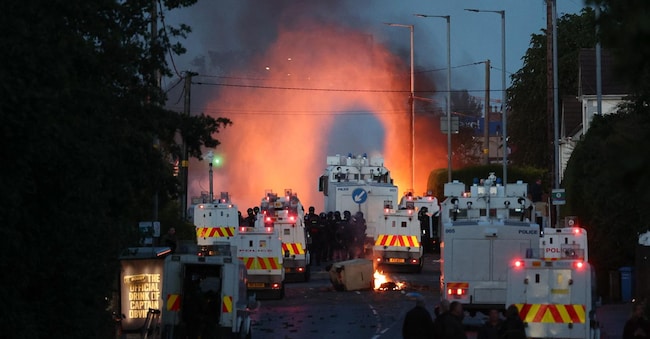
La polizia utilizza cannoni ad acqua per spegnere gli incendi appiccati dai manifestanti durante i disordini lungo Antrim Road, a Newtownabbey, nella parte settentrionale di Belfast, Irlanda del Nord, il 10 giugno 2026..  EPA/ADAM VAUGHAN EPA

3' min read

Translated by AI
Versione italiana

3' min read

Translated by AI
Versione italiana

An alleged attempted murder on Monday evening in Belfast has triggered a new wave of anti-immigration violence in the UK, bringing the issue of managing migration flows and maintaining social cohesion in the country’s most vulnerable areas back to the forefront of British political debate.

The incident that sparked the tension concerns the arrest of a Sudanese asylum seeker, accused of attacking a man in his forties with a knife in the north of the city. The victim suffered serious injuries to his face, eyes and back, but survived thanks to the intervention of some passers-by.

Loading...

Within a few hours, particularly graphic videos of the attack began circulating on social media, fuelling a spontaneous outcry that quickly escalated into violent unrest.

During the night between Tuesday and Wednesday, groups of masked men set fire to homes, cars and a city bus in various neighbourhoods of the Northern Irish capital, targeting mainly areas with a high concentration of immigrants.

According to eyewitness accounts gathered at the scene, some groups chanted anti-foreigner slogans and, in several cases, went so far as to check residents’ identities door to door. Some families were evacuated under police protection, whilst refugees from Ukraine were forced to flee their homes to escape the fires.

The authorities have recorded numerous incidents of vandalism and arson, some of which have been classified as hate crimes. The unrest has also spread to other parts of Northern Ireland and has sparked protests in Scotland and England.

Beyond the criminal incident that acted as the trigger, the events in Belfast highlight social tensions that have long been present across various British communities. Religious leaders and local representatives have condemned the violence, but have also drawn attention to structural problems fuelling discontent: a housing shortage, employment difficulties and a perceived increase in competition for access to public services. These are issues that are intertwined with the rise in immigration seen in recent years and which find fertile ground in neighbourhoods already marked by economic fragility and social marginalisation.

The political dimension

The incident immediately took on national significance. Representatives of anti-immigration movements have used the incident to criticise British immigration policies and the border control system. Particular attention was paid to the suspect’s route, which, according to the police, saw him arrive in Europe from Sudan, travel through France and then on to Ireland before settling in Belfast. Ireland and the UK share a historic area of free movement, which makes it more difficult to control movement between the two countries. Anti-immigration groups have long argued that this arrangement represents a vulnerability in the British system.

On the other hand, the government led by Keir Starmer has called for calm, emphasising the need to let the investigations run their course without turning a single criminal act into a generalisation against entire communities. The main Northern Irish parties have also issued a joint statement condemning both the attack and the subsequent violence.

A test for the Starmer government

For the Labour government, the crisis represents a particularly delicate test. On the one hand, there is a need to ensure security and public order; on the other, to prevent immigration from becoming the main catalyst for social tensions in a country that continues to rely heavily on foreign labour, particularly in the health, care and hospitality sectors.

Copyright reserved ©
Loading...

Brand connect

Loading...

Newsletter

Notizie e approfondimenti sugli avvenimenti politici, economici e finanziari.

Iscriviti