
‘Benedetto Croce is of interest in China, and an encyclopaedia about him will soon be published’
Benedetta Craveri. The granddaughter of the Neapolitan philosopher and a distinguished author of books that blend history and biography, she speaks, in her capacity as president of the Foundation, about the relevance of her grandfather’s ideas today.

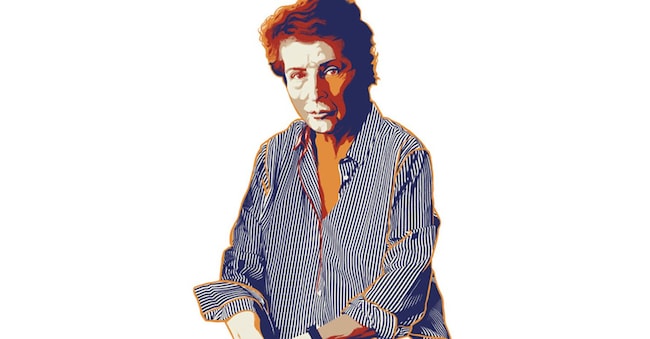
‘Croce’s thought is attracting renewed interest in China. His conception of art as intuition, and the identity between intuition and expression, has much in common with Confucian aesthetics. Jiaotong University in Shanghai has just published a study on the history of the reception in China of *Aesthetics* and *Aesthetics: A Handbook*, and on the enduring influence of Croce. Attention in China is focused on both the philosopher and the writer. A translation of *Neapolitan Stories and Legends* is currently underway.”
Benedetta Craveri, a writer, is many things at once. She belongs to that group of authors who, through their ideas and style, breathe life into the stories of historical figures who actually existed and who, using these women and men as their focal point, reconstruct critical and difficult eras – fascinating yet harsh – clear and ambiguous in narrative essays which – as one might have said in the ‘Third Page’ section back when newspapers were proper newspapers – are met with critical and popular acclaim. At the same time, she herself is part of a real and imaginative story, one of love and intellect, concrete yet full of metaphorical significance for her family, for our country and for European culture. Benedetta is the granddaughter of Benedetto Croce.
We are on the second floor of Palazzo Filomarino in Naples, which houses the Benedetto Croce Foundation Library: ‘I have been president for three years and carry out this role with deep commitment and a spirit of service, supported by my scientific council and leading Croce scholars. We have just launched, in collaboration with Treccani, a three-volume Croce Encyclopaedia, which will be one of our main projects over the next three years.”
We move into the dining room. ‘Even during the long anti-Croce period that followed my grandfather’s death, my mother and her sisters viewed with detachment the – I would say – natural phenomenon of a new generation seeking new models and new methodologies. Such are the ebb and flow of history,’ he observes, lightly quoting Giambattista Vico – a favourite of Croce’s, who kept first editions of the author of *Scienza Nuova* in his library – to study them, annotate them, almost to savour their scent.”
The Foundation’s dining room was the dining room of the Croce family, comprising the philosopher, his wife Adele, and their daughters Alda, Lidia, Silvia and their eldest daughter Elena, Benedetta’s mother: ‘I remember the day of his death very well. He was an affectionate grandfather, used to dealing with little girls, and whenever I went to Naples he was willing to devote his precious time to me, to make me feel important, by asking me to fetch his post, teasing me about my love of princesses and queens, and giving me free access to some marvellous, strictly forbidden chocolates that he kept locked away in a drawer. I was ten when he left us. What stayed with me was a sense of wonder rather than grief. I thought his life would never end. And I couldn’t get my head round what had happened.’


