
Benetton: 'Young people are not a cost but an investment. 30% of our employees are under 30 years old'
At the Trento Festival of Economics, the chairman of Edizione and Mundys, interviewed by the editor-in-chief of Il Sole 24 Ore Fabio Tamburini, explained why Italia can only return to being a country for young people by investing in wages, listening and experimentation

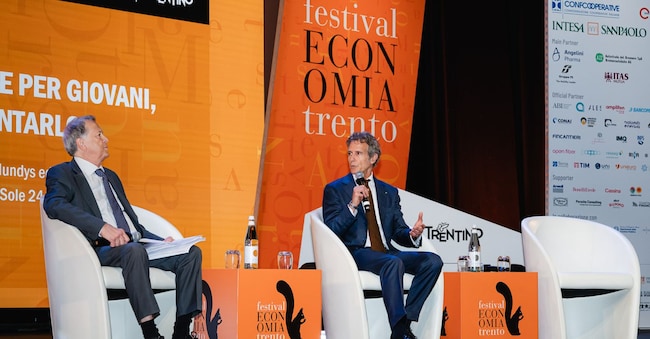
"50% of our employees are women and 30% are young people under 30". Alessandro Benetton opened his discussion with the director of Il Sole 24 Ore Fabio Tamburini with this figure during the 2026 edition of theTrentino Festival of Economics. Chairman of Edizione since 2022 and, from March 2026, of the infrastructure parent company Mundys, Benetton linked those numbers to a precise choice: "An intern with us at Mundys earns 1,200 euros a month" because a young person joining the company should not be considered "a cost, but an investment".
The theme of the meeting was whether Italia is really a country for young people. Benetton avoided a purely negative answer: 'We must be convinced that Italia can be a country for young people'. But he also pointed to a clear divide between potential and confidence. On the one hand, he recalled that Italy ranks fifth in Europe for young people interested in the challenge of generative artificial intelligence. On the other, he cited a study carried out by the UNHATE foundation, dedicated to young people, together with Professor Mauro Magatti, of the Università Cattolica del Sacro Cuore in Milan, according to which only 17% of young people look forward to the future that awaits them.
For Benetton, the problem in Italia lies in the ability to retain those who are trained. "We prepare young people very well in academic and cultural terms," he said, but then the country struggles to offer "the right context". Hence also the phenomenon of youth emigration: according to the most optimistic estimates quoted, "40-50 thousand young people" have been leaving Italy every year for about ten years.
The entrepreneur then brought up the example of the Rome airport, indicated as one of the group's main assets. There, he explained, 350 metres of space were given to young people capable of proposing ideas to improve the service to travellers. One thousand proposals arrived, twelve were applied and five were studied in depth. For Benetton, this is proof that boys and girls can also have an impact on economic results, if companies agree to step out of their 'comfort zone'.
The point, he insisted, is to build organisations capable of experimenting. "They are the ones who bring innovation. We must put ourselves in a listening mode'. He recalled Michelangelo, Bill Gates, Einstein and Vasco Rossi to emphasise how many breakthroughs came before the age of 30. Even his personal experience, he added, was born from a discontinuity: at the age of 26 he founded 21Invest, his private equity business, in a sector that hardly existed in Italy at the time.


