
Berengo Gardin captures Giorgio Morandi's silence
At the Gallerie d'Italia in Milan, photos taken in the artist's studio: vases become souls and silence is metaphysical

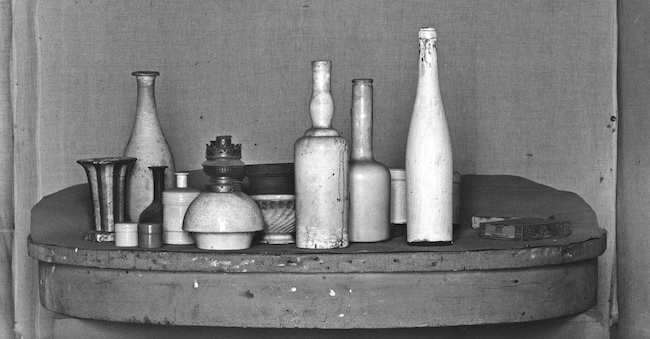
In the bowels of Milan, there is a very high mountain silence, palpable and material. Piazza della Scala, Gallerie d'Italia: in the caveau of what used to be the Banca Commerciale Italiana, the silence is superhuman and exalts the 26 photographs that Gianni Berengo Gardin took in Giorgio Morandi's Bologna studio in 1993, before that creative lair was dismantled and rebuilt inside the Museo Morandi in Palazzo d'Accursio, Bologna. Everything is motionless, like the silence, like the perfection of the black and white that is part of the Metafisica/Metafisiche project, curated by Vincenzo Trione, also running at Palazzo Reale, Palazzo Citterio and the Museo del Novecento.
From the cloakroom area, one descends a few steps that lead to the caveau - usually visited only on Thursdays -, the room designed in the early twentieth century by Luca Beltrami: two imposing columns, cast-iron balustrades and phytomorphic stylistic elements. Where more than 5,000 safe-deposit boxes of Milan's upper middle class used to be kept, today 500 of the more than 3,500 works in the Intesa Sanpaolo collection are kept in rotation. And so, amidst the blazing colours of Boccioni and Fontana, of Richter and Picasso, the refined silence of Berengo Gardin's photographs emerges. Even the reserved space of the caveau somehow reproduces the atmosphere that Morandi lived in via Fondazza: he spent his days almost in a hermitage because 'what matters is to touch the bottom, the essence of things'. He would arrange vases and bottles with painstaking care, shifting them by a few millimetres to compose a perfection reminiscent of certain metaphysical silences by Giorgio de Chirico. Morandi had decided to cover these bottles with white, giving them almost a ceramic soul and above all a personality. Thus, Berengo Gardin, in that still light, does not immortalise objects of various shapes and heights, but captures the soul of people standing in the grazing light of an open window. There is a maniacal care in creating the scene, just a few millimetres and everything changes, as can be seen in the photo of the table with the circumferences of the bottles, one next to the other, that the artist traced to find the perfect picture. It looks like an intersection of planetary orbits: it is an attempt to define space and time as exactly as possible, in which real people also live. Like his sister Maria Teresa, identified in little pink boxes.
Morandi sought silence in his monastic studio, nothing was to distract him from his research. Few objects to get to the essence, to a classical form and forever. As Bruno Munari stated, 'Morandi made abstract paintings using bottles and vases as a formal pretext. The subject of one of his paintings is not the bottles but the painting stopped in those spaces', and in Berengo Gardin's pictures silence becomes geometric, solid, taking on the lines and volumes of classicism. The objects are always the same, bottles, vases, dried flowers, and yet, composed and recomposed, they create worlds upon worlds. Morandi travelled in a room: there is still a chair with its stacked volumes, the easel waiting for the next canvas or some postcards hanging on the wall. In the studio, even his bed so that there would not be the distraction of having to change rooms.
The feeling is of a constructed and cherished purity, which pervades our eyes: it is a ubi consistam in which to think only of art, to live on finite things. All that is needed to express the world is a room with its objects, the light that penetrates through a window and caresses the surfaces, perhaps veiled by that dust that is the charm of time. Morandi, a soul inclined to contemplation, loved dust, which becomes memory, lived, while the three sisters, diligent, tried to clean it without realising that that patina is time that comes and goes, the flow of the hours. It is finiteness becoming infinite, the visible becoming invisible. There are two simple lanyards enlivening a wall and a white enamel switch, roundish, with a hint of dust in which to recognise Lucretius' atoms of life: 'Observe every time that rays leak / and infuse sunlight into the darkness of rooms: / you will see many tiny bodies whirling / in manifold ways of the void in the very light of the rays, / and as in an eternal contention moving contrasts and battles / they are thrashing about in torments, never finding peace / continually agitated by rapid conjunctions or breakthroughs' (De rerum natura, II, vv. 114-120).
Gianni Berengo Gardin. Lo studio di Giorgio Morandi, curated by Vincenzo Trione, part of the project Metafisica/MetafisicheMilano, Gallerie d'Italia
F through 6 April 2026


