Holding company

Berkshire Hathaway buys back its own shares on Wall Street

New CEO Greg Abel has made a dent in the group’s mountain of cash, but over 4.5 billion has been spent on share buy-backs this quarter

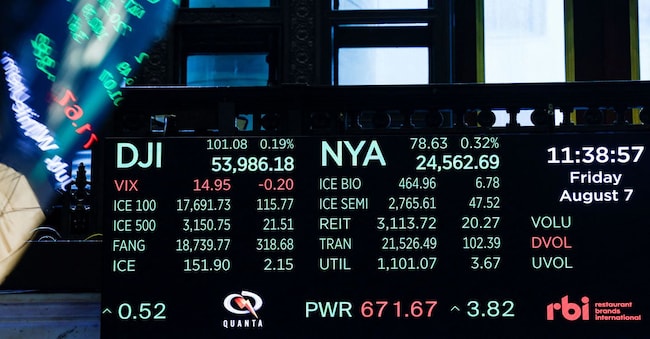
A screen displays stock market information after the opening bell at the New York Stock Exchange (NYSE) in New York City, U.S., August 7, 2026. REUTERS/Jeenah Moon REUTERS

4' min read

Translated by AI
Versione italiana

4' min read

Translated by AI
Versione italiana

Berkshire Hathaway seems to prefer its own shares to investments in Wall Street-listed companies, although the latter do exist and are significant. The new CEO, Greg Abel, is beginning to make use of the mountain of cash held by the group founded by Warren Buffett, whilst focusing largely on its own capital. Berkshire Hathaway spent around $4.5 billion on share buybacks in the second quarter, offering shareholders the highest quarterly dividend since 2021, thanks to a surge in operating profits. This figure rose by 16 per cent in the three months to June, reaching nearly $13 billion, driven in part by earnings from the conglomerate’s manufacturing, services and retail divisions, as announced on Saturday in a press release by the company based in Omaha, Nebraska.

Accumulated liquidity

The company’s cash reserves fell to $365.5 billion in the second quarter, whilst net share purchases reached nearly $20 billion over the same period, a sign that Chief Executive Greg Abel is investing a greater proportion of the company’s cash. Halfway through his first year at the helm of Berkshire Hathaway, Abel has received praise from shareholders for his leadership.

Loading...

However, Berkshire’s Class B shares have risen by 3.8 per cent this year up to Friday’s market close, compared with a gain of around 13 per cent for the S&P 500.

Berkshire’s profits are generally closely watched because the conglomerate’s businesses – which range from insurance to railways, and from energy to manufacturing – provide a snapshot of the state of the US economy.

In the first quarter, Berkshire resumed its share buyback programme for the first time in over a year. Earlier this year, Abel had stated that Berkshire had restarted the buy-back programme because the management had found that the ‘intrinsic value’ of these shares exceeded their market price.

Investments

In short, Berkshire Hathaway’s new CEO, Greg Abel, has spent a significant portion of the company’s vast cash reserves, investing $10 billion in Google’s parent company and buying back shares worth around $4.5 billion.

The conglomerate founded by the legendary investor Warren Buffett has published its second-quarter results, revealing that its cash reserves have fallen to $365.5 billion, down from nearly $400 billion at the end of March.

Berkshire’s report suggests that the company has added commercial, industrial and other shares worth more than $24 billion to its portfolio, but does not specify which securities have been purchased. These will be disclosed in a separate document to be filed by the end of the month.

Abel took over as CEO in January, when Buffett stepped down after six decades at the helm of the company. Buffett remains, however, chairman of the board.

In March, Abel had announced that Berkshire had resumed share buybacks for the first time in over two years, but investors were disappointed when the company repurchased Berkshire shares worth just $234 million in the first quarter. The second-quarter purchases, announced on Saturday, show that Berkshire is serious about share buybacks, but they fall at the lower end of investors’ expectations. Buffett watchers had predicted buybacks of between $5bn and $11bn, based on a document filed by Buffett when he announced his annual charitable donations in July.

Loading...

Company policy stipulates that shares should only be bought back when Abel and Buffett believe the selling price is below market value. Unlike many other companies, there is no specific amount set aside for this purpose. Most of Berkshire’s share buybacks took place in June. It is possible that purchases will now be more modest, given that the share price has just reached a new 52-week high on Thursday.

Between 2018 and 2024, Berkshire has already bought back $78 billion worth of its own shares.

Other bets

In addition to the Google shares purchased in the spring, the company, based in Omaha, Nebraska, has also completed the acquisition of the property developer Taylor Morrison for $6.8 billion, a deal that was only finalised in July and is therefore not yet included in the quarterly figures.

Berkshire’s net profit more than doubled, reaching $25.667 billion, equivalent to $17,868.44 per Class A share, thanks to a significant accounting gain arising from the $3.8 billion write-down recorded last year on its stake in Kraft Foods. A year ago, Berkshire reported profits of $12.37 billion, equivalent to $8,600.89 per Class A share.

However, Buffett has long urged investors to pay closer attention to Berkshire’s operating profits in order to better understand the performance of its numerous companies, as these figures exclude investments. According to this measure, Berkshire’s operating profit rose to $12.983 billion, or $9,038.30 per Class A share, compared with $11.16 billion, or $7,759.58 per Class A share, in the previous year.

Berkshire owns several major insurance companies, including Geico, a group of large utility companies, the BNSF railway company and a diverse range of manufacturing and retail firms, including Precision Castparts and See’s Candy.

Copyright reserved ©
Loading...

Brand connect

Loading...

Newsletter

Notizie e approfondimenti sugli avvenimenti politici, economici e finanziari.

Iscriviti