
Bernard Moitessier, a lesson in courage and authenticity (even for managers)
The story of the French navigator shows the ability to follow one's inner compass, even when the simplest course would lead to the laurels of recognition

3' min read
3' min read
In an unusual combination of the pitfalls of the ocean and the challenges of the working world, the story of Bernard Moitessier embodies courage, awareness and that freedom that is never a definitive destination, but a horizon to be relentlessly pursued. His enterprise is not limited to the tale of an extraordinary navigation: it is an exploration of the invisible territories of the mind and soul, a challenge in which courage is measured against the incessant mutability of reality, where every choice marks the thin line between appearance and truth. Staying true to oneself, in a world that pushes in the opposite direction, is perhaps the most profound of the lessons left by this extraordinary navigator.
From childhood, the sea exerted an irresistible fascination on Bernard. It was a deep call, a symbiotic bond with the ocean, as if the boundary between man and nature was just an illusion. With his adventurous spirit, he began to scan the infinite, like a sailor searching for answers in the mysterious language of the waves. Every storm was a test, every wind an inspiration, every course an existential question. In the boundless vastness of the waters, he found his own essence, developing an awareness that went beyond mere sailing: rather, it represented a way of life, of perceiving the world and understanding its profound forces.
A vision of life
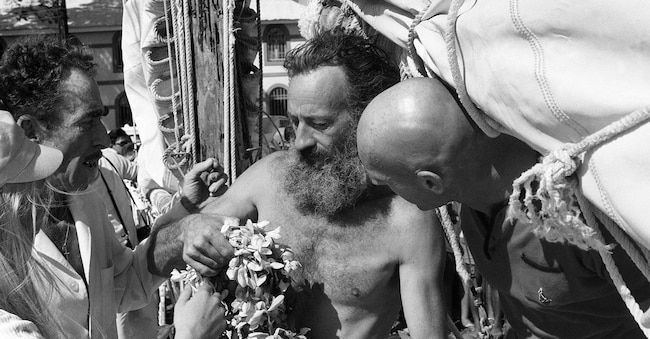
.In 1968, the Golden Globe Race became the perfect stage for his vision of the sea and life. It was the first solo, non-stop, unassisted circumnavigation race. A grandiose feat that required stamina, strategy and an uncommon temperament. Moitessier, leading the race, did something unthinkable. He was not content with winning, nor did he seek success or the substantial prize money. In a gesture that defies all conventional logic, he decided not to finish the race. Instead of returning to England and claiming victory, he sailed to Tahiti, prolonging the journey for months. This gesture, which to many might seem like madness, was actually an extraordinary affirmation of his indomitable spirit, a search for a horizon that went beyond the physical goal to touch the depths of his own existence. In that solitary journey, far from any jury and all recognition, Moitessier became the guardian of an ethic that transcended the race itself.
In an act that borders on myth, he launched a message with a sling at a passing merchant ship: "I continue because I am happy at sea, and perhaps also to save my soul." Those words encapsulated an essential truth: the realisation that not every achievement is worthwhile and that true victory lies in adherence to one's values.
Follow your compass
.At first glance, Moitessier's story might seem a romantic digression, far removed from the cold logic of management. Yet, behind this story lies a lesson of extraordinary power: the ability to follow one's inner compass, even when the simplest course would lead to the laurels of recognition. In the world of work, this principle translates into the strength to make decisions that respect the most authentic values, even when this means straying from the usual goals of success. It is a reminder of consistency, of inner steadfastness, of the importance of resisting the pressure of short-termism, of the ability to say no to opportunities that are seemingly advantageous but inconsistent with an organisation's identity. Companies that resist the temptation of immediate profit by staying true to their mission build lasting value. They are the ones that choose to invest in innovation rather than chase easy profits, the ones that prioritise sustainability over unbridled growth, the ones that, like Moitessier, understand that it is not just about getting there first, but about sailing in the right direction.

