
Bernardo Bertolucci: class struggle with John Ford
In Parma 'Novecento' is told in an exhibition between conscious and unconscious paths, from the earth to the father. Until 26 July

Key points
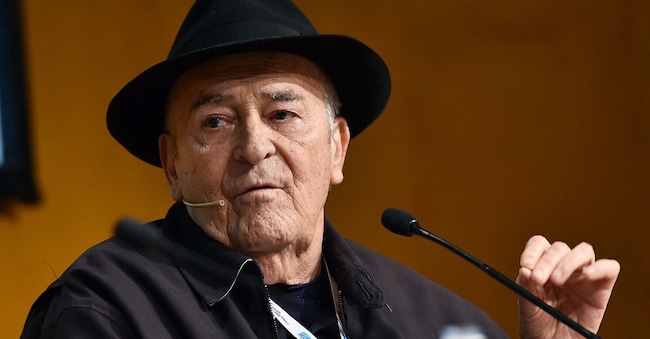
From the grand staircase of Parma's Palazzo del Governatore, a giant Bernardo Bertolucci poster on a bold red background welcomes visitors to Bernardo Bertolucci. "THE" Novecento, the exhibition that pays homage to the 50th anniversary of the 1976 film of the same name in two acts. B.B. looks at his interlocutor with a sardonic smile from his bourgeois clothes - tweed jacket, felt hat, Scottish tie - immediately declaring his wealthy origins. With a distinction. He is not one of the Berlingheri, the gentlemen of the 20th century - his family belongs to the middle class - nor is he one of the exploited peasants, represented in the film by the Dalcò family. But it is for the latter that he puts his 'art at the service of the revolution', recounting the class struggle from the early 1900s to the Liberation in the Emilian plain, where he was born and raised.
The exhibition strands
There are many strands of the exhibition, excellently curated by Gabriele Pedullà, that sew around this epic film, including pictorial and filmic references, the weight of roots and love for them, the seasonality of the countryside, music, the linearity and circularity of time. The first room inevitably starts with Pellizza da Volpedo's Quarto Stato, the film's incipit with a backward tracking shot of the painting, supported by Ennio Morricone's soundtrack. Then, skilfully, the exhibition mixes the era and the intimacy, experienced by the director, also bringing to the surface unconscious impulses: the overcoming of the figure of his biological father Attilio, "a poet, a great poet", writes Bernardo; and of his cinematographic father, Pier Paolo Pasolini, who made B.B.'s debut as assistant director in Accattone.
More than 5 hours
The 5.20 hours of Novecento is framed in the period's tendency to construct works of encyclopaedic pace. Such as Morante's La storia, Volponi's Corporale, Pasolini's Petrolio, Calvino's combinatorial books, as well as La camera da letto, the work on which his father Attilio spent ten years working. The concept albums of the Beatles, Pink Floyd, De André. The all-encompassing communist dream of Emilia, where the combativeness of the Parmesans is appreciated by Gramsci. Everywhere, dominating with its pigs and cows is the 'bassa' of Parma, Cremona and Reggio Emilia, the Corte delle Piacentine farmstead in Roncole Verdi (Busseto), Guastalla, Rivarolo del Re, where the two acts were filmed. These places are the projection of Casarola and Baccanelli, the homes of Bernardo's father and mother, Ninetta Giovanardi. In their flatness, the interiors are also investigated, igniting the pictorial imagination of the director of photography, Vittorio Storaro, and the architectural one of the set designer, Ezio Frigerio, who later, with Strehler, would do the Poor Falstaff at La Scala.
The Plain and John Ford
As a child, Bernardo experienced the plains as a middle ground, from which to look at the distant city, distant, however, also from the Po, experienced in a mythical dimension as much as the Mississippi River and the Nile. Together with Giuseppe, his six-year-old younger brother, he plays Indians with the farmers' children. Novecento feeds on the western atmospheres of John Ford and Howard Hawks, and Sentieri Selvaggi is the true touchstone of the screenplay written by Bernardo, Giuseppe and Franco "Kim" Arcalli in Casarola. Other directors dear to their hearts, of course, wink out: Godard with La Chinoise, Ėjzenštejn and Tarkovsky, the Rossellini of Roma città aperta and Generale della Rovere. Among paintings, photos and books, the director's childhood runs through, until he moved to Rome to join his father in 1951, when Bernardo was ten and Giuseppe four. In a letter to his father, who was obsessed with cinema, Bernardo tells of the Lux in Parma, packed to the rafters for Don Camillo and Peppone, and of a woman who faints next to him for lack of air. Alongside, there is a poem by the young Giuseppe - who will also be a screenwriter and director -, of rare depth and maturity which, together with some drawings, indicates a precocious genius. Unfortunately, he never received due recognition: he remained, for the most part, the 'brother of'. In the exhibition itinerary, you can see the documentary in which the making of the Novecento is recounted.
The choice of actors
Among the fascinating aspects of the exhibition is the reconstruction of the choice of actors, studded with synchronicities. Bernardo wanted Robert De Niro for Alfredo Berlinghieri, after having seen him in 1973 in Mean Streets by Scorsese, one of the greatest admirers of the 20th century. The choice was kissed by the Oscar for Best Supporting Actor for The Godfather- Part Two in 1975. Alfredo is a name from Traviata: the Bertoluccis are, in fact, devotees of the opera and have a tapestry at home (exhibited at the Palazzo) depicting Verdi, who is mourned in the film by a character called Rigoletto. Gérard Depardieu - known as the baby sitter of Varda and Demy's children, great friends of B.B. - with his stray life immediately appears as the revolutionary peasant, Olmo Dalcò. To Stefania Sandrelli, whom he dated with his then companion Gino Paoli, Bertolucci gives one of the few roles, as in Pietrangeli's Io la conoscevo bene, in which his innate sensuality is not privileged. She is a well-chosen Anita (a name inspired by Garibaldi), Olmo's companion, a pasionary teacher. Dominique Sanda was rightly Ada, a naive creature, violated by the powerful. B. B. had already wrested her for The Conformist from Bresson, who was convinced he had persuaded her not to act any more after So Beautiful, So Sweet. Donald Sutherland was a magnificent cowardly fascist prevaricator. Bernardo would not have wanted Laura Betti for the role of Regina. She was too attached to P.P., but she was too good in the role of the perfidious bourgeois viper. B.B. in Novecento was able to detach himself from Pasolini in his pictorial gaze: in the Friulian poet he was turned to the spiritual Middle Ages, in Bertolucci to pointillism and the politically motivated Delacroix. Anita (Anna Henkel), Olmo's daughter, is Freedom leading the people with a pitchfork instead of a flag.


