
Bernd and Hilla Becher: Industrial Photography as Art
At the MAST Foundation, over 350 original prints trace the themes and methods of the German couple

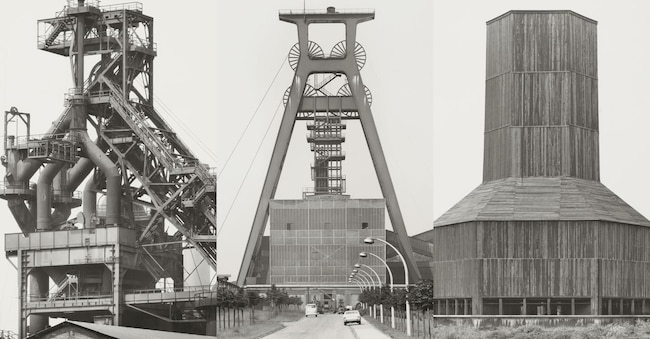
Mighty concrete water towers show themselves as precious vases of tender porcelain. The photographic art of the late German couple Bernd and Hilla Becher is so formally impeccable and clean, objective and rigorously documentary, that it leaves plenty of room for its viewer: he or she can delve into Urbex explorations in those industrial ruins; populate the geometries of houses with people looking out of windows and out shopping; or just turn extremely functional architecture into sculptural objects of accomplished beauty.
That is why it is not surprising that the "plasticity of their photographic work" - this is the motivation - earned them the Golden Lion at the Venice Biennale in 1990 precisely for sculpture. Without ever having been sculptors - he trained as a decorative painter with his father, she as a freelance photographer thanks to her mother, and together their dedication to graphic design - they pursued an autonomous and urgent project of industrial photography, just as it was disappearing from the internal departments of the factories that were dismantling their archives and budgets.
Düsseldorf School
From 1959 to the early 2000s, from the German Ruhr to Europe via the USA, they assembled an encyclopaedic corpus of over two hundred production plants with around six hundred negatives per site. And they set the standard. Never has this been truer than for the Düsseldorf School, known to all as the "Bechers' Class", synonymous with that German photography born in the wake of the New Objectivity from their teachings at the city's Academy of Fine Arts.
Galeotto a joint assignment at the Düsseldorf advertising firm Troost, Bernd Becher (1931/2007) and Hilla Wobeser (1934/2015) married in 1961 and for their entire lives shared a mission. As in a video game, in which the relentless coal and steel crisis advances "eating away" at all the constructions typical of post-war industry, to run harder in their Volkswagen van, so as to deliver to humanity a photographic testimony, an economic and social documentation that has the status of art at the same time. "We knew very well," they will say, "that if we had not managed to photograph everything at that moment, in all likelihood the opportunity would not have arisen again."
Poetics and practice of their work are revived today at the MAST Foundation in Bologna - which has made industrial photography its must-have - as always with free admission, in Bernd & Hilla Becher - History of Method, the largest Italian retrospective dedicated to them: 350 original black and white photographs in large format (mostly silver salts prints), as well as posters, books and drawings. Thanks to the curatorship of Urs Stahel, a project that here is enriched by the focus on the Düsseldorf School - with works by Andreas Gursky, Thomas Struth, Thomas Ruth and Tata Ronkkholtz, from the Mast Collection - after its European debut at Die Photographische Sammlung/SK Stiftung Kultur in Cologne, curated by Gabriele Conrath-School and Max Becher, the only son of the couple, now head of the Studio and Estate Bernd & Hilla Becher (i.e. of both the archive and the company that manages relations with the galleries). His is the film shot in Ohio in 1987, included in the route. "We had entire trains moved in exchange for a crate of beer," Hilla tells us, emphasising the backstage of those works of rare compositional composure. And again, adds Bernd: "It is necessary to photograph at the right distance so that the spherical tanks are not distorted."

