
Bernini: ‘30,000 new hospital beds by mid-2027’
This was stated by the Minister for Universities and Research at the conference organised by the Fondazione Collegio delle Università Milanesi in the Lombard capital. The MUR portal is now online to provide guidance to families and students living away from home who are looking for accommodation

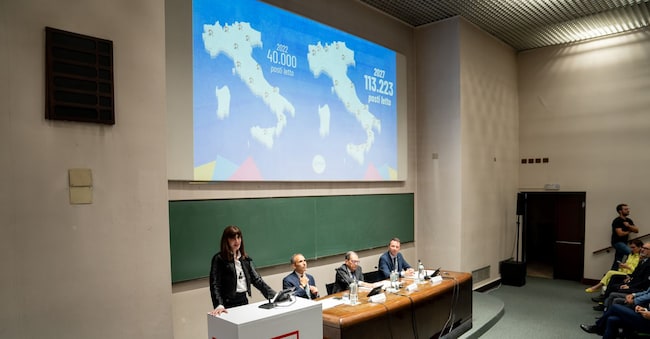
The Ministry of Universities and Research’s new platform on university accommodation is now online. The new portal – developed in collaboration with the Polytechnic University of Turin – was launched today in Milan by Minister Anna Maria Bernini. The site, explains the Ministry, provides students and their families with an interactive map to locate university accommodation facilities and initiatives, view their main features and find their way around when searching for accommodation.
Infographics, data and indicators also provide an insight into the scale, distribution and outcomes of the main public initiatives dedicated to university housing, from Law 338/2000 to the NRRP.
The Housing Plan of the Ministry of Universities and Research, funded by the NRRP, has – as the Ministry explains – enabled the NRRP target of 60,000 new beds for university students to be met and exceeded. In fact, the Plan has created a total of over 63,200 places nationwide, and their distribution across the country will now be visible via the new platform.
“There are around 30,000 student beds that still need to be built as part of the NRRP and which must be ready by mid-2027,” explained Anna Maria Bernini, Minister for Universities and Research, on the sidelines of the conference organised by the Fondazione Collegio delle Università Milanesi. “ The NRRP scheme has created 63,220 beds, of which 33,000 are already ready. For the approximately 30,000 still to be built, by 30 August we had the contractors sign the binding agreements and commitments, as this is the agreement we reached with the Commission and the European Union.”
The Minister assured that the Ministry will continue to oversee the implementation, together with the Commission’s office and the bodies responsible for the right to education.
“We have entered into a strengthened agreement with the Guardia di Finanza to support us in managing this phase, during which the beds must be organised, managed and, of course, completed by mid-2027. A hall of residence is not just accommodation: it is a place where you live, study, meet other people and grow. Today we are also taking a further step to make it easier to find information. With the new MUR housing platform, students and families will be able to find out about the halls of residence available in the area, navigate the options on offer and gain a clearer picture of how the provision of university accommodation in Italia is growing.”
A word on costs. “The most important thing right now,” added Bernini, “is to bring down property prices, and certainly adding 73,000 more beds than the 40,000 I found will also help to bring down prices for families, for the middle class, for everyone. We do not have a fixed cost: at least 30 per cent of the places are free as they are linked to organisations promoting the right to education, whilst for the others there is a reduction of at least 15 per cent compared with average market rates.” These figures, according to the minister, have been certified by the Revenue Agency ‘town by town, street by street’.
“University accommodation is an essential component of the university system and the right to education. The challenge we face is no longer merely about the availability of accommodation, but about offering a new standard of quality for the university experience,” said Stefano Blanco, Director-General of the Fondazione Collegio delle Università Milanesi. ‘The spaces where students spend such a significant part of their lives have an impact on their academic and educational journey. The architectural quality and the care taken with these spaces foster relationships, create a sense of community and make university life more meaningful, especially in a major city like Milan.’
Brand connect


Newsletter RealEstate+
La newsletter premium dedicata al mondo del mercato immobiliare con inchieste esclusive, notizie, analisi ed approfondimenti
Abbonati