Exporting literature

Better to translate a foreign author than to publish an Italian one

Italy, guest country at the Frankfurter Buchmesse, struggles to give an image of itself beyond the stereotype and to promote its writers abroad

by Lara Ricci
6' min read

6' min read

"Let yourself be inspired by Igiaba Scego, with her postcolonial literature, by Vincenzo Latronico, with his novel on young Italians in Berlin, or by Claudia Durastanti with her autofiction between Rome and Brooklyn: all of them represent a different, modern, young Italy": this and only this was what its director Juergen Boos said, in introducing Italy as the guest country of the Franfurter Buchmesse, to the press, inaugurating the 2024 edition. 

Earlier, he had mentioned Roberto Saviano as the first name of the international authors present, perhaps a response to the controversy aroused by the latter when he was not included in the Italian delegation, a controversy that led to a programme of Italian writers parallel to the one selected by the extraordinary commissioner for the Buchmesse Mauro Mazza and hosted on the stand of Pen international in Berlin.

Loading...

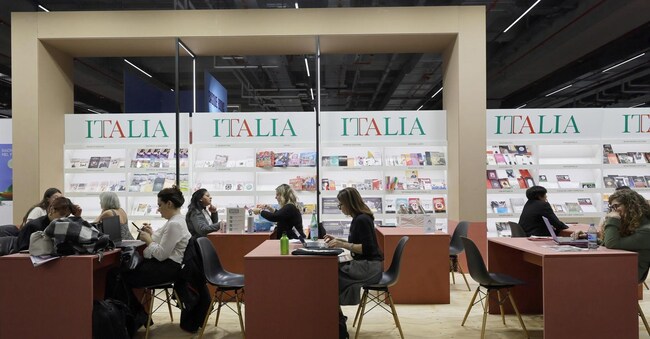
In the Italian pavilion, however, the 'young' Italian authors had their fair share of difficulties to show this 'different, modern, young' Italy and to bring forward an image of our literature that was not only 'ethnic': "I hope that Italy will be known in its plurality and beyond the stereotype," said Scego, an Afro-descendant writer, during a meeting at the literary café, but her voice could barely be heard, overpowered as it was by that of the piano-bar singer who, in the darkened hall next door, adorned by a fake starry sky and a white-columned portico, was singing O sole mio, or something like that.

She was still singing ditties at the top of her lungs when Alice Urciuolo, an author who describes Italian girls struggling with a patriarchal culture in her novels, found herself having to answer the question: 'But how come you Italian authors always write about mum and dad?

Is it more convenient to translate a foreign author?

Several presentations by writers in the official programme had almost no audience, especially that audience of agents and publishers that is the strength of a business-to-business fair. A big missed opportunity, some publishers murmured, arguing that Italy had moved too late to try to involve the professionals who could have led to a translation of Italian authors. They also added that it was more convenient for them to translate a foreign author who benefits from their country's translation support, than to translate an Italian, on which they are unlikely to make money by selling the rights abroad, since Italian translation support is few and far between.

These will amount to around one million per year from 2020. "Like most advanced publishers in the world, we too have a system of reading aid," explains the director of the Italian Publishers' Association, Fabio Del Giudice. It dates back to the 1990s and is under the Ministry of Foreign Affairs. It provides about 600,000 euro a year to foreign publishers who apply because they are about to buy the rights of an Italian author. If the Farnesina assesses that the request is admissible, it disburses a percentage that varies between 30 and 75 per cent of the cost of translation (other countries such as France or Spain do not disburse a percentage of the costs, but the entirety, if it does not exceed a certain amount, another factor that could make our literature less competitive, ndr). The call for proposals is annual, so if you apply when one has just closed, it takes up to a year to get the money (the French, on the other hand, work on a counter basis, until the funds run out). But the system today has become much more efficient than in the past, when it suffered from bureaucratic slowness and other problems'.

"In 2020, a complicated year," De Giudice continues, "the Ministry of Culture, and in particular the Centre for Books and Reading (Cepel), decided to make money available for similar purposes, about 400,000 euros per year. Only that Cepel cannot pay foreign publishers, so another system was devised, i.e. that - again on the basis of a contract for the assignment of rights - it was the Italian publisher that applied, in the name and on behalf of the foreign publisher. When the Italian publisher receives confirmation that the funding will be granted, it advances the money to the foreign publisher and then asks Cepel to have that money reimbursed. This has generated some problems because not all publishers, especially the smaller ones, are able to advance the money, but it is the only way that has been found to strengthen the contribution system and in my opinion it remains an effective system'.

Translation aid in other countries

A million euros a year is not much, however, compared to, for example, Switzerland, which, despite being a small country with only 8.7 million inhabitants, invests the same amount; or tiny Iceland, with its 378,000 inhabitants, which provides 200,000 euros a year; to France, which, between the aid of the Foreign Ministry and that of the Centre national du livre alone, has allocated EUR 1.2 million in 2023, in addition to organising many effective - according to the publishers - promotional activities, and having the advantage of the fact that French is a well-known language in the world. One million euros per year is less than those made available by Spain and much less than those invested by South Korea: as much as 19 million euros per year (a country that two weeks ago won the Nobel Prize for Literature).

It is not a lot if you think that 9 million euros were invested in the construction of the pavilion and the Italian mission in Frankfurt. And it does not seem much when you consider that very few Italian is spoken around the world, even among editors. 'The reason why we founded our publishing house Europa Edition in the US in 2005 is that we wanted to translate Elena Ferrante's books but could not find anyone in the American publishing houses who read Italian,' said Sandro Ferri, publisher of e/o, during a conference entitled 'Italian publishing goes abroad: not only rights', suggesting the creation of fellowships for foreign editors who want to learn Italian. This, according to him, could encourage the export of our literature.

Elena Ferrante's international success would have dragged along that of Alba de Céspedes, now translated into 23 languages, said Fiammetta Giorgi, of Mondadori Libri, because of the closeness of themes and atmospheres evoked.

Sandra Ozzola, co-founder of and/or and Ferri's wife, confirmed that they, in their capacity as American publishers, have more incentive to translate foreign authors than Italian ones, due to the scarce incentives, adding, however, that one has to translate quality books if one does not want to make our literature look bad.

The quality of translated books

In contrast to countries such as France, Switzerland, Germany or Spain, translation funding in Italy is not provided on the basis of the quality of the book. "Today, the distribution capacity of the foreign publishing house and the seriousness of the chosen translator are evaluated, but not the quality of the translated work,' Del Giudice explains. 'This is because any qualitative analysis of a work made by a public body is open to scrutiny. We asked the government to avoid any kind of qualitative analysis, also because we have seen in the past that this discretionary power could lead to distortions. Once, for example, I heard 'this book does not give a good image of Italy abroad'. And the remark did not concern whether it was more or less of quality, but how it spoke of Italy. Entrusting a public commission with the qualitative assessment of works to be exported is something that is done in countries where democracy is very limited'.

However, one also has to wonder what kind of democracy is it that thinks it cannot find a jury of experts that cannot be influenced by the political power in government.

The difficulties of independent publishers

The absence of a network of independent bookshops supporting independent publishers and the problem of the concentration of those involved in the distribution of books is a factor that penalises small publishers, Annamaria Malato, founder of Più libri più liberi, an independent publishing fair, noted during the conference 'Small and medium-sized publishing in Italy and Europe'. Also participating in the conference was Nicolas Filicic of Les belles Lettres, who explained how 25 years ago they founded a subsidiary that distributes and promotes small publishers and that today brings together some 150 publishers.

While there are 8700 publishers in Italy who produce at least one title a year, only 750 have sales in the trade market of more than EUR 100,000 a year,' said Lorenzo Armando of Lexis, 'and of these only 650 are not part of large groups. They represent about a quarter of the market. Among them are 36 companies with revenues in excess of five million. 'Small publishers struggle to grow because they have no independent national distribution channels,' Armando added. A single national distributor concentrates 80 per cent of the turnover, and the small ones are unable to negotiate conditions that are convenient for them. Their market share does not reflect marginality. The fact that during the pandemic, when sales in bookshops were at their lowest, the small publishers' share of sales was higher and then went down again shows how they struggle to sell their books in bookshops'.

Copyright reserved ©
  • Lara Ricci

    Lara Riccivicecaposervizio curatrice delle pagine di letteratura e poesia

    Luogo: Milano e Ginevra

    Lingue parlate: Inglese e francese correntemente, tedesco scolastico

    Argomenti: Letteratura, poesia, scienza, diritti umani

    Premi: Voltolino, Piazzano, Laigueglia, Quasimodo

Loading...

Brand connect

Loading...

Newsletter

Notizie e approfondimenti sugli avvenimenti politici, economici e finanziari.

Iscriviti