The cycle traveller

Between the Atlantic and the Mediterranean along the Canal du Midi, the Languedoc on two wheels

A ride through history dating back to the Sun King along a Unesco heritage canal: an easy, flat, well-marked route that touches enchanting towns and villages in the LINGU

by Manlio Pisu

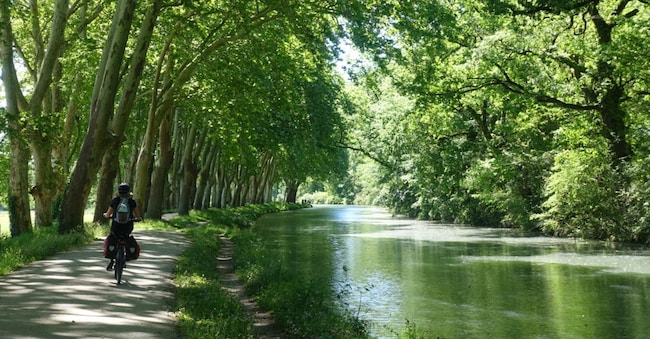
All’ombra dei platani lungo il Canal du Midi

6' min read

6' min read

It is a ride through history through the gentle landscapes of the Languedoc in southern France along the Canal du Midi, a waterway built at the end of the 17th century by Louis XIV, the Sun King (the 'I am the State'), to connect the Atlantic to the Mediterranean.
The route has many merits: scenically it is beautiful; it is easy and flat; it is well signposted; it touches on enchanting villages and towns of great interest, including Toulouse, Carcassonne (a Unesco site), Béziers and Le Somail; it is also suitable for inexperienced cyclists; it is itself, the Canal, a Unesco site.

A dream pursued since the time of Augustus

.

Yes, because this extraordinary infrastructure, a bold work of hydraulic engineering, futuristic for its time, was recognised as a World Heritage Site in 1996. And with good reason.
The project to connect the Atlantic to the Mediterranean with an artificial canal that would cut diagonally across France, from the points where Montpellier and Bordeaux are today, dates back over two thousand years. The Roman Senate had already considered it in the times of Augustus and Nero, but rejected it. The undertaking presented insurmountable technical and financial difficulties: too much difference in height to overcome; lack of water to feed the canal; exorbitant costs. Charlemagne had considered it again, but he too did nothing with it.

Loading...

The genesis of the canal: a compelling historical novel

.

One has to reach the middle of the 17th century to find the technical capabilities and political will to engage in such an ambitious work. The birth of the canal is in itself a very compelling historical novel. The protagonists are the Sun King, his very powerful Finance Minister, Jean-Baptiste Colbert, and a certain Pierre-Paul Riquet, a notable of Béziers and Louis XIV's great tax collector, in charge of tax collection in Languedoc for the French crown.

Riquet, an amateur and self-taught hydraulic engineer, had set out from an early age to succeed where others before him had failed. And in the middle of the 17th century, when he was already over 50 years old, he found a solution: in an area poor in water, he thought of digging a large reservoir at the foot of the Black Mountain, where many small streams would flow. From there, the water would be channelled along a mountain ridge up to the Narouze ridge (190 metres above sea level), from where it would then flow towards the Atlantic and the Mediterranean. Et voila: with this, the problem of ensuring sufficient water for canal navigation was solved. To overcome the difference in height, a complex system of 63 locks, a canal-tunnel, 130 bridges plus 49 canal-bridges on the model of those devised in Italy by Leonardo da Vinci for the canals in Milan would have been necessary. For the route, Riquet partly followed the ancient Via Domizia, opened by the Romans for the conquest of Gaul.

Project financing

.

On the strength of his relations with Colbert, Riquet succeeded in convincing Louis XIV. The project started in 1667. But the difficulties were enormous. The costs were rising. Paris cornered Riquet: the money was not enough, other financiers had to be found. The great bailiff did not lose heart. He involved the local governments of the Languedoc in the venture and committed himself to co-financing the work out of his own pocket in a kind of project financing. With shovel and pickaxe in just 14 years of work, the Canal was ready. But to realise his lifelong dream, Riquet squandered his fortune, leaving his heirs with a mountain of debts. It took 40 years to pay them off. Riquet died a poor man at the end of 1680, a few months before the Canal was inaugurated in May 1681. In gratitude, Louis XIV granted the Riquet family the right to impose tolls on passing boats.

Una pedalata nella storia lungo il Canal du Midi

Photogallery35 foto

A water highway, now a paradise for cyclists

.

The waterway was immediately successful as a communication channel for goods and passenger transport. It avoided the circumnavigation of the Iberian Peninsula, saving 3000 kilometres of navigation along the treacherous coasts of Spain and Portugal, hostile to France. In 1786, with the French Revolution, the Canal was nationalised. After 1815, with the Restoration, it was returned to the Riquets. In the second half of the 19th century, with the advent of the railway, the Canal gradually lost its relevance, until it was abandoned in the 1880s. Then came a second life thanks to cycle tourism and pleasure boating on the péniches, the house-barges.

Today, the Canal du Midi is a cycle traveller's paradise. It starts in Toulouse, capital of the Languedoc (or Occitania), a beautiful, rich and lively city, easily reached by plane from Italy with direct low-cost flights. It is home to the Airbus headquarters. In the past it was one of the strongholds of the Cathars or Albigensians, a dissident Christian movement with respect to the temporal power of the Church. In the late medieval struggles for control of Languedoc, the Cathars were branded as heretics and persecuted. In 1209 Pope Innocent III, under the motto 'Kill them all! God will recognise his own', launched the first crusade against the Albigensians; then the second, until the complete extermination of this community.

Perfect organisation

.

For those who do not want to take their own bike with them, it is easy to find rental bikes in Toulouse, even good quality ones. The route is well signposted. Just follow the course of the canal. For the more technologically advanced cyclists, it is possible to download a well-made GPS track from www.francevelotourisme.com. In about 240 flat kilometres (negligible gradients), you arrive in Sète, a town on the Thau lagoon. This is where the Canal du Midi flows. It is a stretch of water that communicates with the Mediterranean. A strip of sandy land with beautiful dunes divides it from the sea. Once in Sète, a bike recovery service is available from the hirers themselves. There are several guides to the Canal on the market. Plan the stages according to your own tastes, approximately three to six days.

Under the shade of the plane trees

.

In Toulouse the Canal du Midi joins the Garonne. From there to Bordeaux, navigation continues along the river in a north-westerly direction. From the Port de l'Embouchure, in the city centre, one takes the Canal, beginning to cycle on the chemin de halage, i.e. the towpath, the path along the bank parallel to the canal on which horses pulled the boats. Thousands of plane trees provide cyclists with plenty of shade for much of the way to Carcassone. For the past twenty years or so, the enchantment of this landscape has been disturbed by a pest that has caused an epidemic among the plane trees. So many trees have been felled, particularly from Carcassonne onwards. Thousands have also been replanted with maniacal care. But it will be years before the landscape can return to what it was.

Carcassonne, Le Somail, Bèziers: the jewels in the crown

.

There are many villages along the Canal, some very picturesque, where you can stop to rest, eat and sleep. After about forty kilometres from Toulouse, you will find the watershed point at Narouze. Shortly after is the large reservoir of Castelnaudary, the Canal's main port. Then Carcassone, a splendid medieval town fortified with a double wall, another stronghold of the Albigensians. At the end of the 19th century, the fortress of Carcassone was the subject of a controversial restoration led by the archistar of the time, Eugène Viollet-le-Duc, who was later criticised for his excesses of fantasy in the renovation work that made the citadel a sort of Disneyland of the Middle Ages. Carcassonne, now a Unesco site, is nevertheless worth a visit.

Détour to Narbonne in Gaul

.

From Carcassone, the towpath runs quickly towards the sea. Other unmissable stops include Le Somail, one of the prettiest villages, where the magnificent Librarie Ancienne, specialising in rare books, is worth a visit. From there, a 40-kilometre diversions (round trip) takes you to Narbonne, the ancient Roman city of Narbona, capital of Gallia Narbonensis. Next comes the Malpas Tunnel, where the Canal passes through a tunnel. Then the little gem of Bèziers, Riquet's hometown. See the eight consecutive locks at Fonseranes to overcome a 33-metre drop, the magnificent cathedral and the splendid canal-bridge over the Orb river. Finally Agde, a former colony of Magna Graecia. Another 20 kilometres and you will be in Sète, your destination, where a refreshing dip in the sea awaits you. Enjoy your ride!

Copyright reserved ©
Loading...

Brand connect

Loading...

Newsletter

Notizie e approfondimenti sugli avvenimenti politici, economici e finanziari.

Iscriviti

Tutto mercato WEB