Cycle tourism

Exploring the history of the Venice Lagoon by boat and bicycle

A proposal for slow, sustainable tourism that takes you off the beaten track to unique places rich in art and history, between Venice and Mantua: the Vicenza-based tour operator Girolibero has brought the concept of cycling along the canals from Northern Europe

6' min read

Translated by AI
Versione italiana

6' min read

Translated by AI
Versione italiana

Leave behind the massive cruise ships moored off St Mark’s Square and the groups of tourists herded along the traditional routes down the Grand Canal. Because Venice is a city to be experienced and discovered on your own terms, a city that isn’t limited to picture-postcard sights and crowded streets, but which extends to the surrounding lagoon where it has developed over the centuries. Whilst for the city itself – which attracts tourists from all over the world all year round – the usual way to get around is by vaporetto and on foot, the islands surrounding it conceal remote and unique spots, the result of the joint work of humankind and nature, best discovered using alternative and innovative means that embrace a slower pace.

The bicycle – all the more so when combined with a boat to move nimbly between the various areas of the lagoon – is the ideal way to reach one of the area’s oldest settlements, where the spark that led to the birth of Venice was first kindled. Malamocco, on the inner coast of the Lido, was a thriving centre as the port of Padua in Etruscan and later Roman times: it was the last strip of land before the Adriatic, near the mouth of the Brenta – which was later diverted further south – and represented a vital crossroads for the economy of the lagoon and of ancient Veneto. Then the invasion of Attila’s Huns, who arrived from the East to plunder the riches of what remained of the Roman Empire, forced the inhabitants to take refuge further inland, on the islands of the Rialto, where the first settlements arose that would give rise to the glorious history of the Serenissima.

Loading...

In the footsteps of Corto Maltese

Malamocco has lost none of its charm, so much so that Hugo Pratt made it his favourite retreat, which inspired so many of Corto Maltese’s adventures. Even today, in the little square behind the old podestà’s palace – recognisable by the earliest depictions of the lion that would go on to become the symbol of Venetian power along the Mediterranean coast – one can still sense that history of commercial expansion and understated wealth.

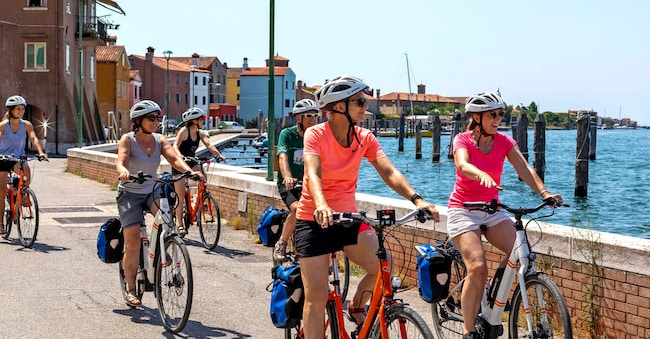
This small town is one of the stops on the ‘boat and bike’ week-long tour along the canals between Mantua and Venice, organised by Girolibero, a Vicenza-based tour operator specialising in original, sustainability-focused holidays, which makes the combination of boat and bicycle one of the key features of its tourism offering. The tour of the lesser-known islands of the Venetian Lagoon marks the start of the week, but it is also the final leg if you travel the canals of the Venetian Lower Po Valley in the opposite direction, setting off from the Lombard city, home of the Gonzagas and Mantegna. In one direction, the journey is made aboard the ‘Vita pugna’, the group’s first historic boat, purchased in the Netherlands – where canal cycling holidays originated – and which arrived in the Lagoon after a month-long river journey down the Rhine, passing through Istanbul and Corinth before sailing up the Adriatic. In the opposite direction, you can travel on the ‘Ave Maria’, the other vessel – larger and more modern – acquired in Italia and refitted with comfortable cabins, all with en-suite bathrooms, to make for a unique journey that combines the tranquillity of sailing and cycling with the history and culture of unique places, such as Mantua, Venice and Ferrara, without neglecting Italian hospitality and cuisine, which places a strong emphasis on locally sourced produce.

Snippets of lagoon history

So, in the Lagoon, you set off from Giudecca to explore the lesser-known side of Venice, travelling independently but with the guide’s advice pointing you towards the most authentic and unspoilt spots, off the beaten track of the traditional tourist routes. And if you’re lucky enough to be there on the Saturday before the third Sunday in July, you’ll find yourself immersed in the Redentore festival, which commemorates the end of the plague epidemic in 1577, and you’ll be able to watch the night-time fireworks display in St Mark’s Basin right from the banks of the Giudecca.

History is in the air everywhere in this unique setting, which is not immune to the effects of climate change. It is therefore easy to spot flamingos even outside the migration seasons, as they have now become almost resident due to the warming of the land and waters. Meanwhile, the salt marshes overlooking the bell towers of Burano and Torcello are dominated by the lilac hue of limonium, the ‘laguna lavender’ that is taking hold along the shores of the brackish water bodies, where salinity is rising dramatically, thereby altering even the traditions of local farming.

Even clam farms are now more vulnerable to the unchecked infestation of the blue crab – which is spreading from the Po Delta – than to violent night-time clashes with poachers. In Lio Piccolo, a village of about twenty souls situated in the middle of the strip of land that closes off the lagoon to the north as far as Punta Sabbioni, you can visit (but be warned, it’s only open on Sundays) the small museum ‘Frammenti di laguna’, where you can immerse yourself in the story of the lagoon ‘before Venice’, discovering that oysters were already being farmed here as early as the 1st century AD.

Moving on to more recent history, not far away – and accessible via a splendid ‘suspended cycle path’ that is also lit up in the evening – lies the old Via dei Forti, the defensive line of artillery batteries built on the eve of the First World War in anticipation of attacks from the sea by Austro-Hungarian ships, but which were quickly turned inland following the defeat at Caporetto. The guns remained unused, but inside the Vittor Pisani Battery one can truly grasp the reality of a tragic conflict – the first of the 20th century – fought using strategies and weapons from the 19th century.

The detail is the product

Among the region’s treasures is an economy that has managed to embrace industrialisation whilst retaining the spirit of craftsmanship. You might therefore pop along to the Bisazza Foundation, which houses a unique collection by the Vicenza-based design brand, featuring works by great contemporary artists who have interpreted the mosaic in various ways, combining technical skill with artisanal flair to create unique forms and harmonies. The coloured glass tiles for which Bisazza is famous worldwide thus form a neoclassical journey inspired by Canova, as well as a Baroque itinerary designed to amaze with monumental works, ranging from a Pinocchio complete with tattoos to an oversized, multicoloured Proust armchair, from enormous spoons and silver-plated mirrors to everyday masculine forms – always on a grand scale – such as a hat, a suit, shoes and golden briefcase by Alessandro Mendini: tiny glass tiles, the result of artisanal expertise drawing on the traditions of master glassmakers, are transformed into an infinite array of coloured pixels that bring to life surreal, oversized objects, which transcend the everyday to become eternal.

They’re also useful for getting the world turning, given that in the halls of the Foundation – which has taken over the premises of the old factory – there’s also a car, powered by a Volkswagen Beetle engine, completely covered in colourful glass tiles, complete with a trailer, used by the artist himself, Marcel Wanders. That car, laden with the weight of hundreds of thousands of glass tiles, is certainly not a model of sustainability, unlike the bicycle. What is missing from those exhibition halls is precisely a two-wheeler covered in multicoloured mosaics, which might not be entirely impossible: ‘With a single mosaic tile, you can cover the world,’ Mendini used to say.

Loading...

However, it does not appear that the Foundation will be included in Girolibero’s tours: its headquarters in Montecchio, near Vicenza, are difficult to reach without travelling along busy main roads that are highly dangerous for cyclists. This is all the more true for a tour operator that cannot afford to overlook the safety of travellers and the sustainability of its trips. Because, as the motto of the designer couple James and Ray Eames states – displayed in several languages on the wall of the warehouse where Girolibero’s two thousand traditional bicycles and a further six hundred electric bikes are stored – “The detail is not the detail. The detail is the product”.

Copyright reserved ©
Loading...

Brand connect

Loading...

Newsletter

Notizie e approfondimenti sugli avvenimenti politici, economici e finanziari.

Iscriviti

Tutto mercato WEB