Between fantasy and non-sense echoes of Surrealism in Italian children's books
At the MUSLI in Palazzo Tancredi di Barolo the interesting exhibition curated by Pompeo Valiani, until 29 June
3' min read
3' min read
The remarkable history of Italian illustration between the 19th and 20th century has been historicised since the 1970s by the work of numerous scholars, including Antonio Faeti and Paola Pallottino. The world of the fantastic is the dominant feature in a very rich production, which recent years have further historicised. There are many tangencies between the world of modern aesthetic research and the graphic signs of stories often written by the greatest authors of the time, as the collection I tre talismani by Guido Gozzano, published in 1914 by La Scolastica di Ostiglia, Arnoldo Mondadori's first brand, adorned with magnificent plates by Antonio Rubino, well illustrates. Mario Sironi created perfect forms for the forgotten Storia di un gatto bigio, di una gallina nera e di una marmottina prigioniera, by Pina Gonzales (1923). Elena Croce aptly summed up an important aesthetic nexus of the 20th century in her memoir Golden Childhood (1966), recounting how the nurseries of her childhood gave hospitality to the most restless icons of Art Nouveau, who would never have found hospitality in her father's austere bourgeois home.
Childhood, in art and theatre
Childhood, in art and in theatre, is on the other hand a constant inspiration: it is no coincidence that the great Vsevolod Mejerhol'd reopened the Moscow Art Theatre, after the fire of the revolution, with the play Alinur, an adaptation of Oscar Wilde's The Child of the Stars, in which street children, orphans of the conflict, starred. In short, as Elsa Morante beautifully summarised, in art, the world is always 'saved by little boys', as the title of her 1968 revolutionary poem put it. It is not surprising, therefore, that the world of the fantastic in art has also crossed over into the dimension of fairy tales, which are little historicised in the canon of Italian literature.
The MUSLI Museum in Turin
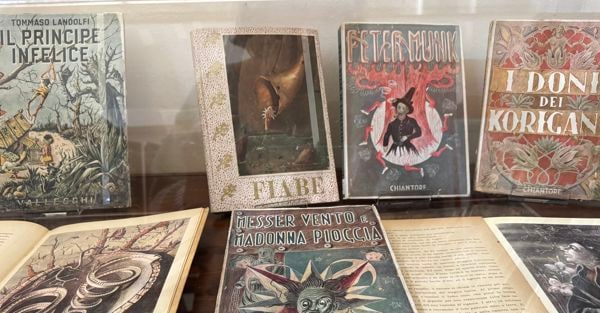
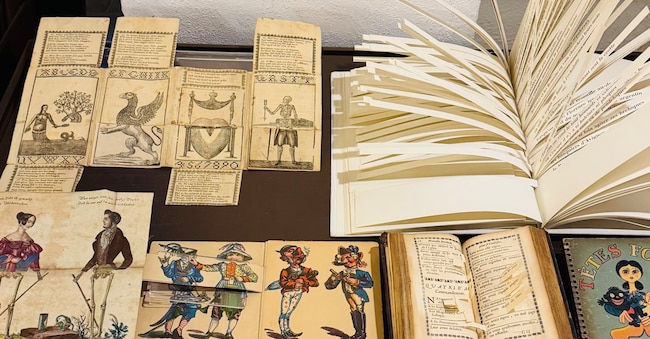
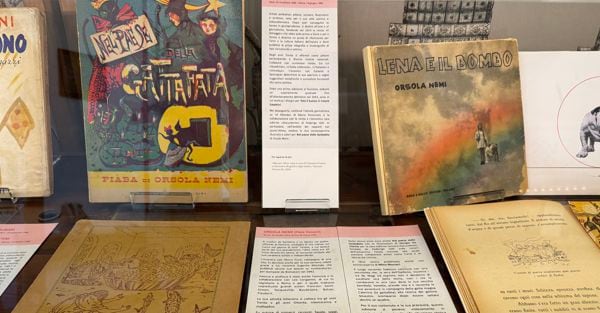
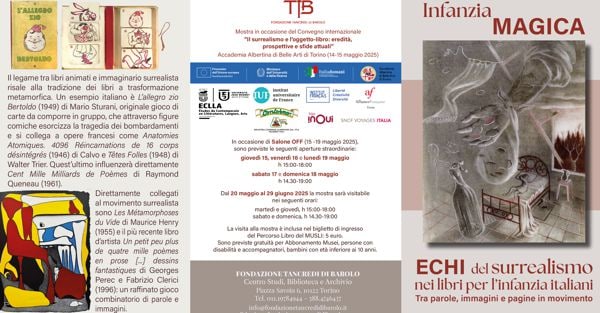
The MUSLI Museum in Turin, dedicated to the history of school and children's books, animated by Pompeo Vagliani, an avid collector and long-standing scholar of the subject, proposes at Palazzo Tancredi di Barolo the interesting exhibition, curated by himself, Echoes of Surrealism in Italian children's books, running until 29 June (no catalogue), in parallel with a forthcoming conference on the same subject. The investigation into "words, images and moving pages" brings to the fore a series of works inspired in Italy by Lewis Carroll's model, starting with La scacchiera davanti allo specchio, an enchanting variant by Massimo Bontempelli, published in 1922, with perfect representations by Sergio Tofano. It was precisely nonsense that especially seduced the post-war generation, who wanted to break out of the meshes of the rhetoric of the Ventennio. In 1946, The Book of Follies, the classic translation of Edward Lear's Nonsense was published in Vicenza under the Pellicano banner (one of the trademarks used by Neri Pozza in his youth) The Book of Follies. Among the works exhibited in Turin, often of great charm, many are linked to the enthusiasm of liberation: Alice in Wonderland and The Hunting of the Snarco, in the version by Ketty Castellucci and Attraverso lo specchio, in the version by the dechirican Felicita Frai, who also brings into play in her illustrations references to her other master Alberto Savinio. The fantastic played a last extraordinary season of images in modern, often forgotten Italian fairy tales, books became objects, games, with daring papercraft realisations. The exhibition juxtaposes, not by chance, L'allegro zio Bertoldo by Mario Sturani (1949), a card game to be composed in groups, with the sophisticated Un petit peu plus de quatre mille poèmes en prose by Fabrizio Clerici and Georges Perec (1996), a machine that superimposes images and texts in a modular manner, between the Manual Oracle by Baltasar Gracián and the surface effects of Oulipo. Often the stories are literary gems, sometimes the figures take over the narrative productions. Tommaso Landolfi's Il principe infelice, with plates by Sabino Profeta, stands out in the first part, while Orsola Nemi, now little visited, is given magnificent pictures by Giorgio De Chirico (Nel paese della gattafata, 1945, the book was recently reissued by Bompiani) and Luigi Veronesi (Lena e il bombo, 1944). Two classics, Bruno Munari's Le macchine (1942) and La famosa invasione degli orsi in Sicilia (1945) declare a territory of invention that has been very rich in the Italian twentieth century, and that still reveals quite a few surprises.