
In the fjords at the edge of the world, cruising between Cape Horn and Patagonia
The landscapes are as unique as the one on the rocky promontory that marks the end of the Americas for centuries a testing ground for the sailing ships of the great navigators

-kALG-U30446145026SFe-1440x752@IlSole24Ore-Web.jpg?r=650x341)
There are places on the planet where geography becomes a physical experience and a travel destination that literally broadens our horizons. One of these is Southern Patagonia, that maze of channels that connects the Strait of Magellan to Cape Horn. This is where Australis, a Chilean company specialising in cruises between the fjords and glaciers of Tierra del Fuego (operating in Europe from Barcelona since 2003), has been sailing for over 35 years. In fact, it is the only company to offer a regular programme of tourist expeditions in these waters with departures during the austral spring and autumn (from September to April), when temperatures are less prohibitive (in the order of a few degrees above zero) and allow for shore excursions and safe navigation. In these territories and in the silence of an enveloping and still mysterious nature, Charles Darwin passed through almost two centuries ago, while in 1912 the missionary and explorer Alberto Maria De Agostini was among the first to describe them as a destination of discovery and not only of conquest. Today, the approach that accompanies the Australis proposal is that of a conscious tourism, which makes contact with the environment by learning to know and respect it, far from the exotic destinations taken by storm by mass tourism. Collaborations with scientific institutes, universities and natural parks, from the Centre for Quaternary Studies to the Chilean Antarctic Institute to contribute to research in the climatic and biological fields, go in this direction.
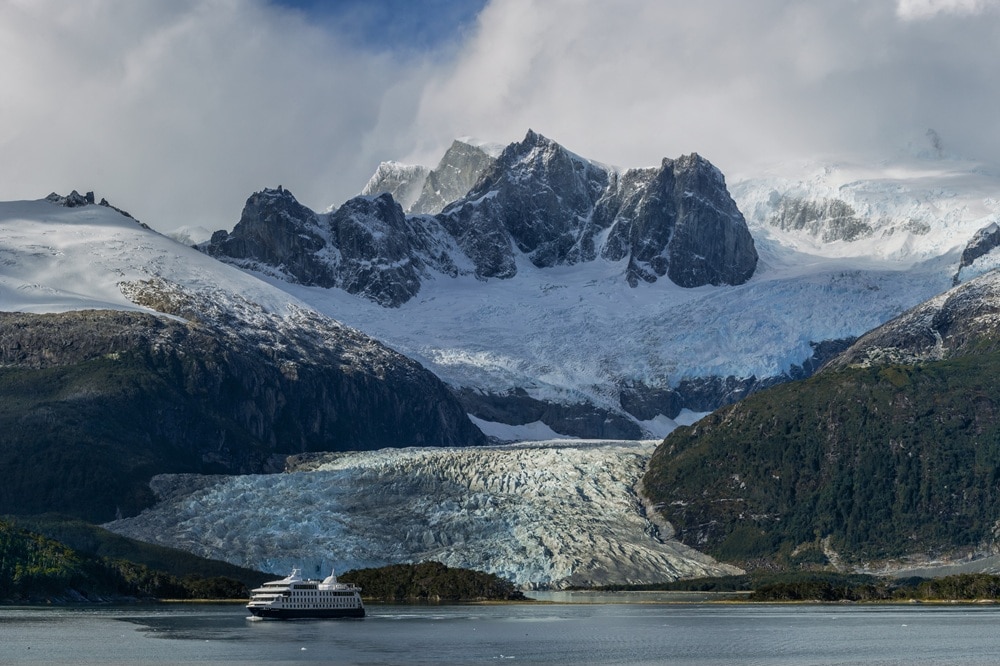
With Australis heading south from Chile or Argentina
Punta Arenas and Ushuaia are the two ends of the journey: to reach them coming from Europe one takes the plane from Santiago de Chile in the first case or from Buenos Aires in the second. The classic itinerary is organised over four nights and links the two cities by crossing one of the most legendary stretches of sea in the world. Once disembarked, one can continue by flight to El Calafate (a stopover that allows one to return to Buenos Aires) and from there organise a visit to the Perito Moreno glacier, about 70 kilometres away. To return to Santiago del Chile, on the other hand, one must descend to Puerto Natales or Punta Arenas, since there is no direct connection to the Chilean capital from the southernmost city on the planet. It is not a cruise in the classic sense of the term: the two boats (maximum 150 people on board, costing between two and four thousand euros) with which the company operates are designed to navigate narrow channels and sometimes challenging waters. There is no Wi-Fi connectivity on board and this choice (as well as a technical one) favours total immersion in the landscape. Days are spent between briefings with the excursion team, most of whom are Patagonian natives, meetings on glaciology and the history of exploration, and relaxing moments in the panoramic lounges. The atmosphere is informal and almost family-like and reflects the concept of a trip that turns into a true exploration experience. Comfort is not lacking but everything is subordinate to nature. The real luxury is the silence one feels when the ship moves slowly past a glacial front or the distance (geographical and digital) that separates it from the rest of the world. Because here you are, for real, at the end of the world.
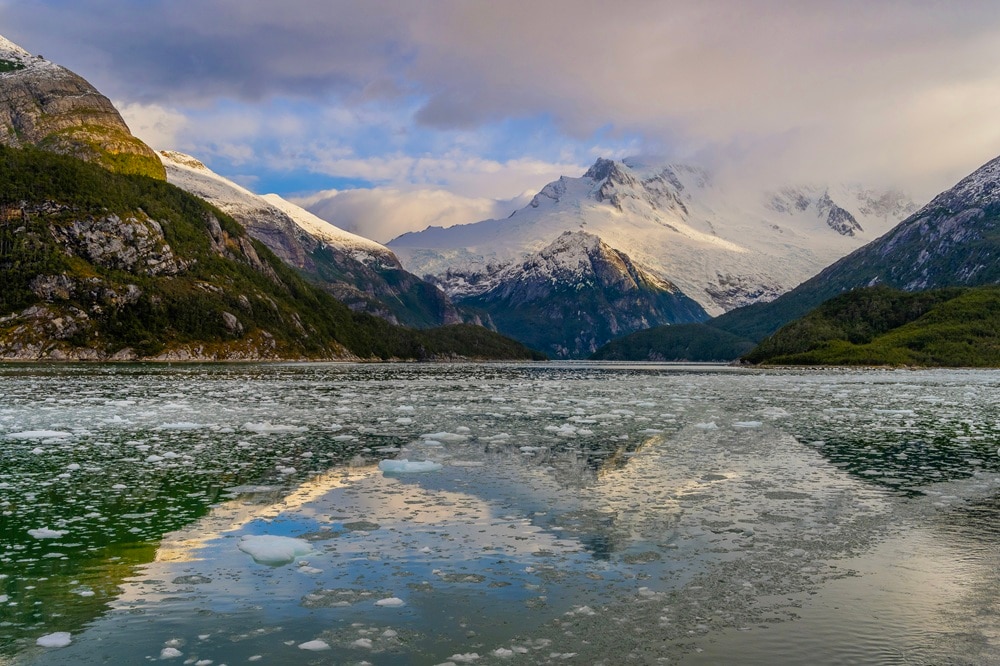
Nature's spectacle between fjords and glaciers
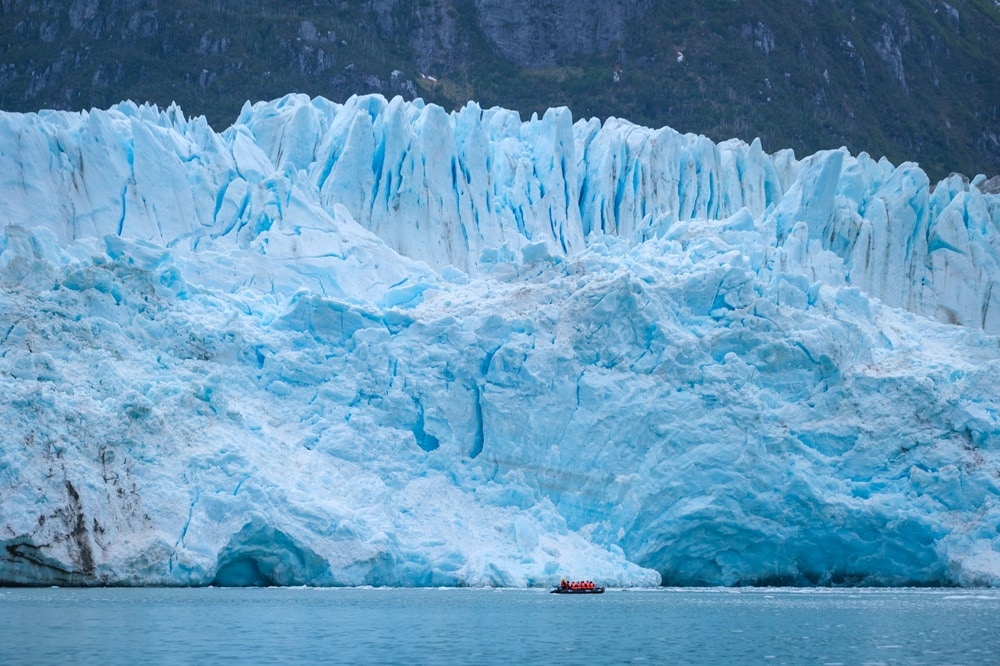
The voyage is a succession of primordial scenery such as the Cordillera Darwin, in the presence of which the spectacle of blue ice walls breaking away with a deafening roar and sub-Antarctic forests of lenga and coihue (two of the most important and characteristic tree species of the Andean-Patagonian forests) descend to the sea. The so-called 'Glacier Route' is one of the most spectacular stretches and one can observe its glacial tongues creeping between the mountains directly from the deck of the ship, which slows down at very low speed for photos and naturalistic explanations. One of the most iconic experiences is at the Pia Glacier, in the north-western arm of the Beagle Channel, where you get close to its forehead by landing on land with the aid of Zodiac dinghies. The more experienced can participate in a hike of about two hours on moraine terrain with a significant difference in altitude, culminating in a vantage point overlooking the entire glacial amphitheatre. Other similar experiences can be had at Glaciar Condor and Ainsworth Bay, where it is possible to choose between an easier nature trail and a more challenging trek that requires adequate equipment (waterproof boots and a windproof jacket) and good resistance to fatigue.
Face to face with southern fauna
At Wulaia, an ancient site of the indigenous Yámana people, the trail climbs through peat bogs and forests to a lookout point that opens its gaze over the Fuegian canals, where the wind shapes the vegetation and is a constant reminder of the extreme latitude. The passage to Cape Horn remains one of the symbolic moments of the voyage: the rocky promontory that marks the end of the American continent was for centuries a severe test for the sailing ships of the great navigators, today one contemplates it admiringly from the deck of the ship with the concrete sensation of being on the edge of the inhabited world. If conditions permit, one goes ashore on the island of the same name to reach the lighthouse and the small chapel commemorating the lost sailors. Along the way, there is no shortage of encounters with fauna. On Magdalena Island, you walk among hundreds of Magellanic penguins nesting undisturbed, while on Isla Marta, you can observe colonies of seals, sea lions and cormorants at strictly regulated distances (each landing is always preceded by briefings given by Australis guides on the rules of behaviour in a protected environment). It is advisable to plan at least one pre- or post-cruise night in Punta Arenas or Ushuaia, to guard against possible flight changes and to visit towns that retain a frontier soul, amidst naval museums and windswept low architecture.

