Climate

Between Greenland and Antarctica, 11,000 billion tonnes of ice have been lost over the past 70 years

This is the finding of the Imbie study carried out as part of the project supported by the ESA and NASA

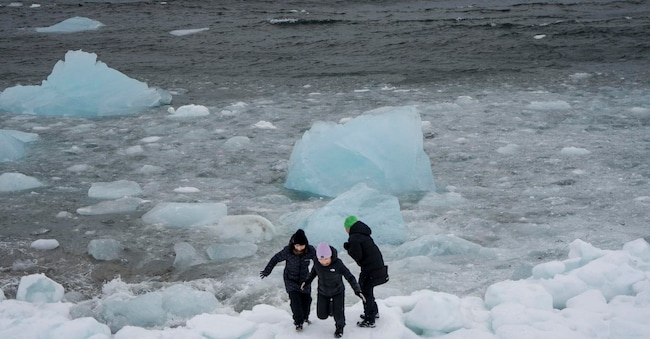
EPA/Mads Claus Rasmussen  DENMARK OUT EPA

3' min read

Translated by AI
Versione italiana

3' min read

Translated by AI
Versione italiana

Over the last 70 years, Greenland and Antarctica have lost 11,000 billion tonnes of ice, causing a global sea-level rise of over 3 centimetres.  Furthermore, the issue is not simply one of surface ice melt. ‘Even the glaciers that drain these vast ice sheets are flowing faster, channelling enormous quantities of ice directly into the ocean.’  

The Imbie initiative

Loading...

These are the latest findings, published today in the journal *Scientific Data*, and they stem from the Imbie (Ice Sheet Mass Balance Intercomparison Exercise) initiative. The project, supported by the ESA and NASA, collates and harmonises measurements from various satellite missions to build the most consistent picture possible of how the planet’s two major ice caps have changed over several decades. 

Greenland and Antarctica

‘Taken together,’ the study emphasises, ‘Greenland and Antarctica are currently responsible for around a quarter of global sea-level rise.’ And that’s not all. As the study highlights, “by combining these observations, researchers can better understand the amount of ice lost, where this loss is occurring and how rapidly it is accelerating: all crucial factors for improving projections on future sea-level rise.”  

The researchers’ challenge

This poses a challenge for researchers, given that not all satellites measure ice in the same way, and the challenge lies in ‘making these different observations comparable’. The Imbie team achieved this by “aggregating independent estimates of the mass balance of the ice caps and carefully taking into account the differences between satellite missions, measurement techniques and observation periods”. 

70 years of change

Inès Otosaka, the lead author of the study from Northumbria University, emphasises that there have been changes over the course of 70 years. ‘Over four-fifths of the ice loss has been discharged into the ocean by glaciers which – she points out – are flowing faster, rather than melting at the surface; this indicates that the long-term trend is driven by the dynamic response of the ice sheets to ocean warming.’ 

11.3 trillion tonnes of ice

Loading...

The study reveals that between 1979 and 2023, Greenland and Antarctica lost a combined total of 11.3 trillion tonnes of ice, contributing 3.14 centimetres to global sea-level rise. Not only that: the research found that Greenland contributed 1.81 centimetres to sea-level rise, compared with 1.33 centimetres from Antarctica. “It is significant to note that 84 per cent of the total ice loss – the study emphasises – resulted from the acceleration of glaciers and the consequent discharge of greater quantities of ice into the ocean, whilst only 16 per cent was caused by surface melting of the ice sheets.” 

3 centimetres is quite a lot

As for the rise in sea level – just over 3 centimetres – as Andrew Shepherd points out, “it may seem modest, but it exposes a further six to nine million people to the risk of coastal flooding and erosion. As the ice caps are set to lose much more ice in the coming decades, global assessments such as Imbie’s are crucial to protecting communities affected by climate change”. For ESA representatives, these findings ‘demonstrate the fundamental importance of international scientific collaboration in tackling the major environmental changes of our time’. It is no coincidence, as highlighted by Diego Fernandez of the ESA, that over the coming years ‘innovative missions such as Cristal and Rose-L will be crucial to building on this work, enabling advanced monitoring of the rapid changes currently affecting the ice sheets’. All with the aim of better understanding the evolving climate system, “in which sudden and irreversible changes can no longer be ruled out”.

Copyright reserved ©
Loading...

Brand connect

Loading...

Newsletter

Notizie e approfondimenti sugli avvenimenti politici, economici e finanziari.

Iscriviti