

La guerra in Iran avvicina la Thailandia all’orbita della Russia
dal nostro corrispondente Marco Masciaga

4' min read
4' min read
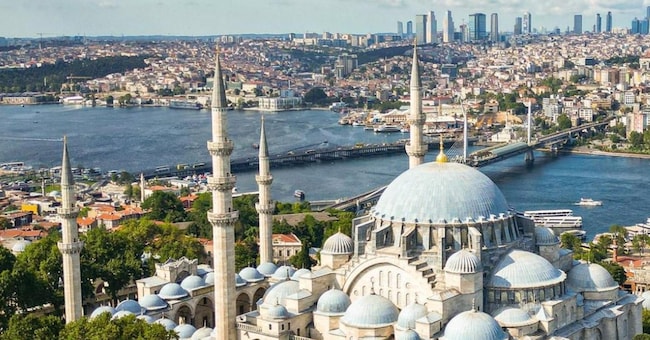
Arriving by sea in Istanbul means embracing with your gaze a megalopolis (it has more than 15 million inhabitants) that offers no certainty: amid salty smells and seagulls, in fact, you will probably feel neither in Europe nor in Asia. At the same time, you will be on both continents, here inseparable - amidst mosques, minarets, churches, cosmopolitan atmospheres, futuristic architecture and Islamic traditions -, were it not for the Bosphorus, the strait that connects the Black Sea to the Sea of Marmara and reminds us of the border. A physical boundary that does not, however, separate East and West, mixed together in a play of cultural, urban and religious contaminations that makes this metropolis unique. Chaotic, busy, yet incredibly fascinating, especially when the traditional chanting of the muezzin rises from its many minarets, inviting devout Muslims to prayer: a mantle of sound that envelops the city.
There are many ways to get to Istanbul. You can get there by plane with Turkish Airlines, which flies from many airports in Italy (Rome Fiumicino, Milan Malpensa, Bari, Bologna, Naples, Turin, Catania, Palermo and Venice), and then you can also book a boat tour on the Bosphorus, choosing between short ones of two hours and longer ones of up to six hours. Or one can reach one's destination by ship, then disembark and visit. This is a more unusual but certainly suggestive way: it will give you a breathtaking scenery, an exciting overview. One option is, for example, offered by Msc Crociere with the ship Sinfonia (almost 300 metres long, 371 outside cabins with balcony, 272 inside), departing from Bari, all year round, with an itinerary that also touches on Greece (Athens and Corfu) and, again in Turkey, Izmir.
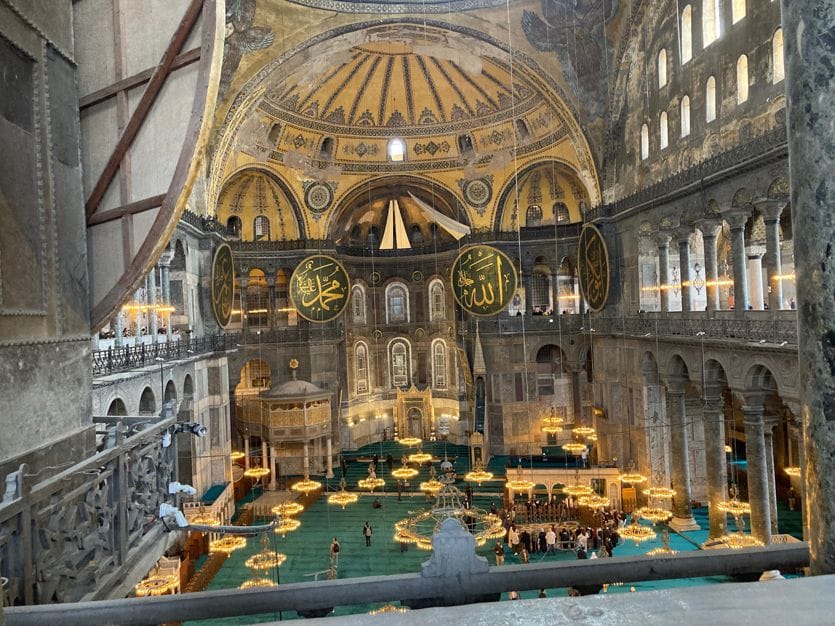
The Italian-Swiss shipping company also offers various excursions. A practically obligatory stop is the famous Blue Mosque (so called because the dome and upper walls are adorned with 20,000 turquoise ceramic tiles) with its six minarets and the equally famous Hagia Sophia Mosque. Both are located in Sultanahmet Square - in the district of the same name that is in fact the centre of the city -, almost overlooking the sea (arriving by boat you will see the domes shining). The first dates back to 1617. The second - erected between 532 and 537 - is a splendid example of Byzantine art.
Also not to be missed is a visit to the beautiful Topkapi Palace, at the time of the Ottoman Empire home of the sultans (it was built in the 15th century). Declared a Unesco World Heritage Site, it is characterised by a mixture of Islamic, European and Ottoman architectural styles. At one time, 4,000 people lived in its more than 400 rooms.
But Istanbul is also something else. There is a part of the city, little travelled by tourists, within the old city walls, where in a maze of narrow streets and colourful houses centuries of overlapping peoples and religions follow one another. It consists of the neighbourhoods of Fatir, Feneth and Balat, where once again many architectural styles, the most authentic flavours of culinary traditions (among many small restaurants), beautiful mosques, ancient synagogues and Orthodox churches intersect. Arm yourself with a navigator and delve into its streets, it is worth it. Then there is the modern, cosmopolitan, future-oriented city. Don't miss Istanbul Modern, the museum of contemporary art in rough concrete designed by Renzo Piano and opened in 2023 in the Galataport complex, now also a multi-purpose cultural centre with a panoramic terrace overlooking the Bosphorus. Nor, in the Eyüp district, SantralIstanbul, born from the renovation of the former power station of the Ottoman Empire. Made of reinforced concrete, with steel and glass façades, it houses an energy museum, an amphitheatre, concert halls and a public library.

