The book

Between leadership, AI and strategic communication: when relationships are a science

The importance of strategic communication and relationships for personal and professional success

4' min read

4' min read

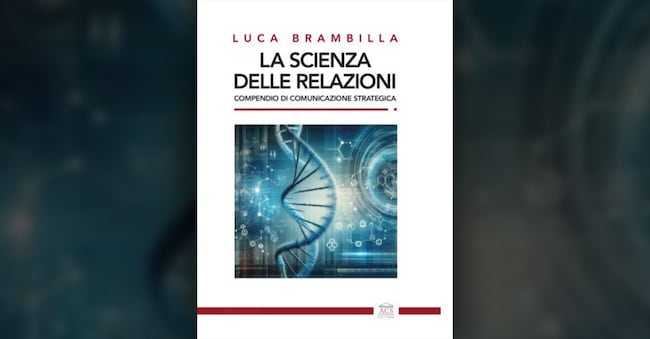
Relationships are the real key to personal and professional success: this is an axiom on which many business management experts agree. So why not treat them as a scientific subject to be studied? Why not learn and embrace practical tools to improve communication, create authentic connections and achieve ever more ambitious goals? This is what Luca Brambilla, EMBA Professor at the Polimi GSoM (Graduate School of Management) and Director of the Accademia di Comunicazione Strategica, one of the first companies in Italy specialising in negotiation consultancy for executives, asked himself. In his latest essay, "The Science of Relationships - A Compendium of Strategic Communication", he deals in depth with the impacts, critical issues and opportunities related to this topic, addressing not only insiders but also business leaders, organisers, representatives of institutions and associations. In this long interview with the author, we have tried to focus on the key aspects of a path that can lead to 'mastering', in a positive sense, this science in order to relate more effectively.

In what context is the reflection on strategic communication that you propose in your book?

Loading...

This is a very profound and complex question, which can only be fully answered through some preliminary contextual steps, which help us to frame the question. The first of these concerns what we have observed: there is a kind of trilogy, a sequence of three fundamental elements - goals, relationships and communication - which are interconnected. We can see them as a path from top to bottom, or vice versa, but it is clear in any case that if we want to achieve truly challenging goals in an increasingly interconnected and fast-paced scenario, nobody can do it alone. No one, today, can think of acting in isolation, and it is therefore essential to build relational, authentic and solid alliances.

And this is where communication comes in...

Exactly. Relationships exist between human subjects, and strategic communication must arise precisely in this interpersonal sphere. Zygmunt Bauman, in his "Liquid Love", states that almost every relational failure is almost always a communicative failure. Communication is a tool, indeed a toolbox, at the service of relationships.

How do you go from theory to practice?

This is the second of the steps I referred to earlier. A paradigm shift is needed, we need to move from the question to the statement. If we recognise that relationships are decisive, then it makes sense to talk about a science of relationships. That is why we have studied and codified a 'hard', engineering approach to soft skills, because today everyone talks about them but they are often treated as a set of vague, fuzzy concepts, without rigour. This means creating methods, techniques and matrices that can be replicated and taught to anyone, so that everyone can use them freely and effectively: it is a systematic model, with a strong psychological component, that rejects the 'guru' on duty. The ultimate goal is to enable real and fruitful connections, emphasise complexity and bring value through concrete actions between people, without limiting ourselves to generic phrases. Our work is measured in the 'goals' of our customers. If they win, we win. We help them create alliances, negotiate, generate agreements. If they do not succeed in this, we have not done our job well.

This approach seems even more urgent today, in an era of great transformation, in the age of AI...

That's right. We are not living in a time of change, but in a change of epoch. This statement, I believe uttered some time ago by Pope Francis, sums up well the period of transformation in which we are. Today there is much talk about artificial intelligence, but often in a trivial way. The debate on AI is oversimplified to the opposition of 'man versus machine', but it is a sterile comparison and a tired narrative. It is much more useful to understand, instead, which tasks and duties we can entrust to AI, namely all the repetitive and recurring activities to free up time and focus our energies on what is really strategic. The key point is not to do less, but to do better. Delegating what is automatable to machines helps us focus on what really matters.

How should we therefore 'relate' to Gen AI? .

The advent of artificial intelligence should not frighten us but see us as protagonists, and it is up to us to ask the right questions that guide our thinking and determine our actions. At the root of it all, the critical human capacity remains: to decide. In the end, AI provides data and summaries, but it cannot (and should not) choose for us: we are the ones who guide strategies and make decisions, we are the ones who have to interpret the data and decide what to do with the information. Those who fear AI, after all, are those who do not recognise the human being's role as a strategic guide and do not want to take responsibility for leading. Technology amplifies and is a multiplier of what we are: if we value zero, even multiplied by infinity, it remains zero.

In the book you propose a relational model based on four relational styles. Can you explain them in brief?  

They are inspired by biology: effective, manipulative, persuasive and strategic. Each person alternates between these styles, just as in DNA we alternate between adenine, thymine, cytosine and guanine. We are not different because of the elements, but because of the alternation with which we use them. The most evolved is the strategic style, the one that allows us to create lasting relationships and generate value for all, and towards which organisations and leaders should increasingly turn. In short, we must focus on the strategic aspects of our interaction, establish solid partnerships and decision-making that drive innovative projects forward. As a teacher of mine said, 'the greatest power in the world is not in artificial intelligence or the atomic bomb, but it is the meeting of two people who co-design something new'.

Let's take an example.

Think of Steve Jobs and Steve Wozniak, they changed the world. The future is a blank canvas and it is up to us to decide what colours to use, what to draw and what vision to realise. Every relationship can be a creative act, if it arises from the will to build together.

Copyright reserved ©
Loading...

Brand connect

Loading...

Newsletter

Notizie e approfondimenti sugli avvenimenti politici, economici e finanziari.

Iscriviti