
Between lucidity and disintegration Duncan Macmillan's Emma
At the Ambra Jovinelli until 15 March People, Places & Things, directed by Pierfrancesco Favino and with Anna Ferzetti

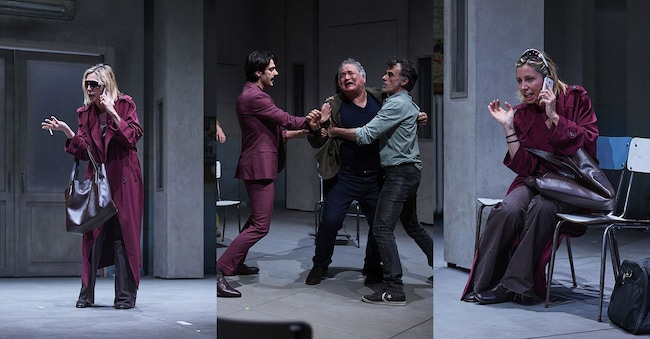
An actress forgetting her lines while on stage is not just a theatrical accident: it is a crack in reality. From that crack, in Duncan Macmillan's text - People, Places & Things - seeps everything that normally remains hidden beneath the surface of our lives: addiction, shame, the memory of places and the weight of encounters. It is a fracture that affects not only the character, but the viewer himself, suddenly forced to question how fragile the boundary is between interpreting a life and actually living it.
The opening scene is already a vertigo. Emma, an actress of talent and restlessness, is playing Nina in Chekhov's Seagull. Kostja speaks to her, she responds, but something cracks. The voice no longer obeys, the gesture loses precision and consciousness falls apart. It is not clear whether it is Nina who falls or Emma who is lost. Theatre and reality begin to overlap like two sheets of glass that no longer coincide. Macmillan builds from this fracture one of the most intense texts in contemporary British dramaturgy.
People, Places & Things
People, Places & Things does not simply tell the story of addiction, but stages it as a device of altered perception, a system of defences that the mind builds up in order not to look too deeply. The language is broken, fragmentary, almost musical. Dialogues multiply, voices become chorus and times overlap. Everything contributes to the sensation of a consciousness desperately trying to protect itself from itself. The title is already an existential map: people, places, things. Three elementary coordinates through which each person constructs his or her identity, yet these very coordinates can turn into memory traps. A place can become an archive of guilt; a person a mirror in which one no longer wants to look; an object the detonator of memories one would rather erase. Pierfrancesco Favino's direction lucidly captures this tension. In his notes, he writes that things, places and people make up "the map of our journey on this earth", but also the territory in which the most difficult wounds to face lurk. Emma's journey thus becomes a traversal of this emotional geography: the descent into the abysses of addiction and, at the same time, the arduous ascent towards a possible form of truth. At the centre of this journey is Anna Ferzetti, who tackles the character with almost surgical precision. Her work never indulges in melodramatic emphasis: Emma takes shape through minimal deviations of voice, hesitations of the body, sudden flashes of irony. The result is a mobile portrait, constantly hovering between lucidity and disintegration. Ferzetti has been crossing film and stage with naturalness for some time. After her cinematographic success in the film La grazia by Paolo Sorrentino and other recent works on the big screen (Domani interrogo), the actress returns to the theatre with a performance that confirms her interpretative maturity. Alongside her moves an ensemble of great scenic solidity. Betti Pedrazzi builds a presence of considerable authority, capable of combining rigour and humanity; Thomas Trabacchi modulates his character with a subtle balance between irony and disquiet; while Totò Onnis adds to the dramaturgical texture an interpretative sensitivity that contributes to giving the show a choral breath. The result is a compact theatrical organism in which each voice participates in the construction of the collective consciousness that the text evokes. Anna/Emma is at the centre of it, not simply playing a woman struggling with addiction, but embodying the vertigo of an identity trying to recompose itself. Macmillan, moreover, is not interested in the chronicle of detoxification. His gaze is more radical: he questions our age, obsessed with image and the permanent performance of the self. Emma is also an actress offstage, as if contemporary life demands that everyone constantly play a convincing role. At one point in the text, a sentence emerges that sounds almost like a universal confession: 'The truth is that I no longer know who I am without all this'. In that brief admission lies the heart of the play. Addiction becomes a metaphor for any identity built on a fragile balance of habits, relationships and illusions. The theatre, then, returns to being what it has always been in its highest moments: a mirror capable of cracking in front of the spectator. Through Emma, through the people, places and things that inhabit her memory, the audience is invited to recognise its own inner topography. When the lights dim, one is left with the feeling of having walked through not just a story but a consciousness. Perhaps, the secret of Macmillan's text lies precisely here: to remind us that the distance between what we are and what we pretend to be is much thinner than we want to admit and that it only takes a moment, on the edge of a stage, for that distance to dissolve.
Duncan Macmillan,People, Places & Things, directed by Pierfrancesco Favino, with Anna Ferzetti, Betti Pedrazzi, Thomas Trabacchi, Totò Onni; Rome, Teatro Ambra Jovinelli, until 15 March

