
Between talent and luck, the role of chance in the career of managers
Marco Rosetti's book tells how unexpected events and coincidences influence CEOs' careers, proposing a new paradigm of non-linear and imperfect success

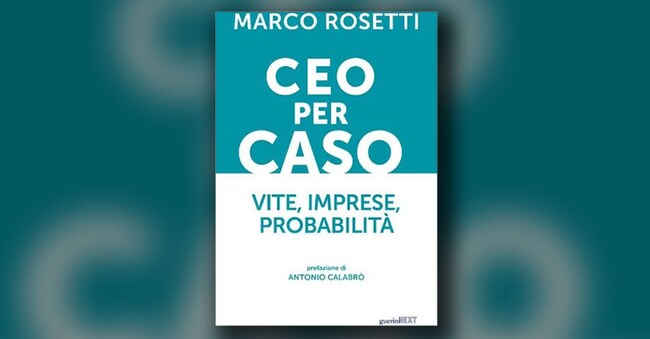
A CEO can (and must) plan strategies, manage crises, lead teams, promote innovation and much more. But what role do chance, the unexpected and vulnerability play in the journey of a manager and a company towards success? This is the question Marco Rosetti tries to answer in his new book CEOs by Chance. Vite, imprese, probabilità (Guerini Next), a text that, through ten interviews with ten CEOs (or former CEOs) of major companies (including Geox and Artsana), puts under the magnifying glass the lesser-known and less-told side of leadership, the side made up of coincidences, deviations and intuitions. Chance, as the author also explains, thus becomes a narrative element and intersects in the stories of the interviewees, who recount without filters the moments of discontinuity, uncertainty and disorientation that accompanied them in the management of their respective organisations and in the choices that changed their career path.
What "Ceo per caso" tackles is also a journey that invites us to rethink the concept of success and to re-evaluate the value of imperfection in an era dominated by planning and control, a journey that is, moreover, well known to Rosetti himself, a Turin-based entrepreneur with a background as an industrial psychologist, who after more than 25 years spent in the world of management consulting has chosen to found two new small businesses: DI Works, specialising in the design of new products, and i²d, an innovative company that applies artificial intelligence to research and development and marketing processes.
This essay, as the author goes on to specify, is therefore not a manual and does not aim to teach how to become a CEO. Its purpose is to investigate the value of adaptation and to affirm a paradigm that the 'old economy' has always denied and that the digital economy is instead able to legitimise: success is not always the result of a linear trajectory and rational choices, but is sometimes the result of coincidences and errors, lucky episodes and unforeseen variables. In short, 'chance' can be a valuable element in building stories of excellence and making the fortunes of companies and careers, and as such can be studied and analysed.
Discovering the work and life of the CEO, in this sense, means exploring the ability to navigate the randomness of events. And that is what Rosetti tried to do by confronting his 'special' interlocutors. "I collected the personal and professional life experiences of several people," he told Sole24Ore.com, "to try to explain and explain some concepts. The first concerns the ability to interact with CEOs, and therefore with people who face and manage complexity at a very high level. The second is about laziness, which sometimes becomes a stimulus to improve the ability to relate in a controlled manner with people who manage decision-making power and increase the level of control in relations with them. The third is to demystify the cliché that sees CEOs as being certain of the career path to be taken from birth, to be all-round figures who are never afraid.
The CEO, in Rosetti's imagination, represents the ultimate controller of a company's activities, the one who guides it towards success and prevents it from rolling downhill, and it is therefore important to understand how this ability to control a variable that cannot yet be controlled, namely chance, is born and what it is based on. 'My synthetic definition of chance,' adds Rosetti, 'is what we cannot control yet. It is something very asymmetrical. Chance, to quote Nassim Nicholas Taleb, author of Black Swan, generates opportunities and the real luxury is to have options, while life, as James Clerk Maxwell, the theorist of electromagnetism, said, is a matter of probability. I see myself as a gambler who likes the moment when the roulette wheel spins and the ball has not yet stopped: when that happens, the game is over and the anxiety of winning even though you cannot control everything is why you need to calculate everything around you. And my curiosity drove me to want to understand how others, the CEOs, try to calculate this world'.

