
Among the trulli and the atmosphere of the Itria Valley
Alberobello (a Unesco World Heritage site since 1996) chose the Pietramadre project for its candidature as Italian Capital of Culture 2027, enhancing the stone element of the area

6' min read
6' min read
Kilometres of dry stone walls tracing linear geometries enclosing vineyards and orchards. Herds grazing in the hot summer sun. And then silence combined with the chirping of cicadas. Along the road leading to Alberobello and the Valle d'Itria, thoughts go back to the past, rich in evidence of prehistoric villages, which settled in the valley due to its favourable geographical position in the Mediterranean and the fertility of the soil. This is a borderland, a place of transit, where sea and land breezes blow. A magical place that over the years has been able to attract artists, writers and followers of philosophical and religious practices of oriental origin who have chosen to live here.
Alberobello and the culture of stone
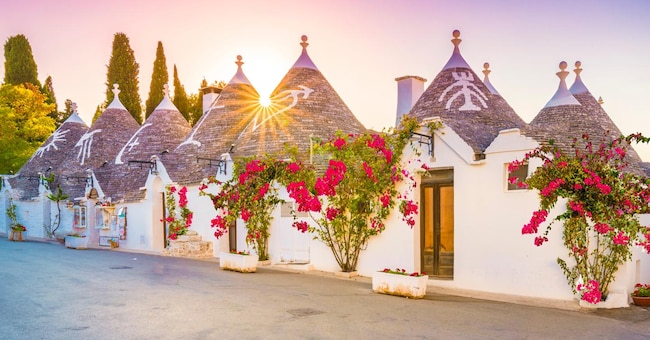
Being a candidate for Capital of Culture 2027 has meant for Alberobello (a Unesco World Heritage Site since 1996) rethinking its future in the field of tourism, trying to bring together as harmoniously as possible the past linked to the architecture of the trulli and a rural culture with a present that maintains traditions but is projected towards future potential. This is why the project supporting the candidacy has been named 'Pietramadre'. Stone is in fact the undisputed mother element of the territory: it is what has made it iconic and shaped its identity. The stone of the dry-stone walls, Intangible Cultural Heritage of Unesco since 2018, leads in an emotional journey through the territory, penetrating from the sea, descending into the caves, embracing the masserie and closing its course on the pinnacle of the Trullo Sovrano. The most widespread thesis on the historical origins of Alberobello is based on the existence of a Sylva Arboris Belli, the forest that stretched over the hills where the town now stands, already populated in the 15th century when Giovanni Geronimo Acquaviva d'Aragona, Count of Conversano, was feudal lord, who allowed peasants to build dry-stone dwellings. The monumental 'trulli' part stands on two hills separated by a karstic canal, now an urban artery. Today many trulli are still inhabited, others are used as tourist accommodation and others have been converted into craft workshops. A stroll through the alleys of Alberobello allows you to visit the Museo del Territorio and Casa Pezzolla (a tangible example of an evolving architectural culture), the Trullo Sovrano (a two-storey dwelling), the Aia Piccola (a neighbourhood to the south-east of Alberobello) and the trullo church.
Locorotondo and its flowery balconies
The 'trulli' districts of the Itria Valley, especially in the countryside of Martina Franca, Locorotondo, Cisternino and nearby Ostuni, continue to be places permanently populated by elderly farmers and their descendants, who now carry out other activities. Many choose them as residential places, moving from the nearby cities to live in the Apulian countryside. And populating these places are visitors from all over the world who cross paths in the white streets in a babel of different languages. Arriving in Locorotondo (9 km from Alberobello and reachable in an hour from Bari, 50 minutes from Brindisi and half an hour from Polignano), one is immediately struck by the round plan of its village, which dominates from above the rest of the town and the entire Itria valley. Among the picturesque alleyways, surrounded by the white walls of the houses, one notices the cummerse, ancient rectangular dwelling settlements with a sloping roof made of chiancarelle, local limestone. Some have been converted into diffuse hotels and are open for hospitality. There are two main gates to the historic centre: Porta Vecchia and, on the opposite side, Porta Nuova. Monuments of interest are the municipal library building, Palazzo Morelli and the churches in the historic centre, including that of San Giorgio Martire. From Largo Bellavista and Via Nardelli, considered Locorotondo's seafront promenade, as well as from the municipal villa, one can look out over the Itria Valley and admire its rural charm. What is striking is the extreme care that the inhabitants have for the town: everywhere in the historic centre there are balconies and terraces full of flowers and at the end of August the winner of the most beautiful flowered balcony is elected. During the summer, the old town comes alive with cultural events and open-air concerts. The most eagerly awaited is the Locus Festival, which started in 2001 and has become a coveted stage for Italian and international artists.
Cisternino and the oriental village atmosphere
With its medieval heart, Cisternino (about 10 km from Locorotondo) is reminiscent of an eastern village, with whitewashed houses, alleys, arches, flights of steps, small squares and flowered balconies. At the entrance to the historic centre, one of the most beautiful in Italy and an Orange Flag holder, stands the quadrangular Norman-Swabian tower, while Piazza Vittorio Emanuele is the meeting point for aperitifs. For dinner, it is a good idea to stop at one of the many butcher shops to enjoy the legendary bombette allo spiedo.
Trekking in the valley, from the hills to the woods of the brigands
The valley lends itself to 'open-air' experiences, walking accompanied by expert environmental excursion guides such as those of the cultural association PugliaTrekking Escursionismo, who take you on a discovery of the area. You will be spoilt for choice between a trek on the hills of Cisternino, which for years have been chosen for meditation and relaxing holidays immersed in silence and nature, walking among magnificent heights, panoramas and woods, to the itinerary along the waterways, following one of the historical conduits of the Apulian Aqueduct, in the heart of the Itria Valley between Cisternino, Martina Franca and Ostuni. The tour enters an enchanted landscape, suspended in time among vineyards, olive groves, the stones of ancient trulli and dry stone walls, evidence of a centuries-old and constant relationship between man, nature and water. It is also possible to explore ancient districts, discovering for example the oldest and most hidden part of Cocolicchio, where there are ancient villages, churches and abandoned trulli, framed by an uncontaminated and enveloping nature among narrow country roads and traditional vineyards, or follow the trekking of the brigand, in the dense Pianelle forest (in Martina Franca), which leads away from the more typical paths, among the rocks and ancient blade beds, where brigands, revolutionaries and landless ramblers found refuge. The Bosco Selva Alberobello trek leads instead into the heart of the land of the trulli, in an ancient oak forest that once gave shelter to the Alberobello peasants. Finally, between Alberobello and Fasano, the Pistola Gardens, a splendid six-terraced garden, winner of the Landscape Society Award, inspired by the ancient tradition of southern European botanical gardens, are worth a visit.

