
BEX – Beyond Exploration Expo: in Rimini, the space economy meets the terrestrial industry

There is a market in Italia worth 4.5 billion euros which has grown by 12.3 per cent in a year, employing more than 15,000 people across 400 companies. This is the space economy, and for those looking at the figures, another statistic is also significant: Italia ranks sixth in the world in terms of the ratio of space investment to gross domestic product (source: Deloitte 2026 Report based on data from SDA Bocconi-Eurispes). On the global stage, the trajectory is even clearer, with the sector set to grow from $630 billion in 2023 to $1,800 billion by 2035 (source: World Economic Forum and McKinsey, 2024).
Behind these figures lies a story that involves far more businesses than they realise. Data from Earth observation satellites is incorporated into insurance models and crop management; materials developed to withstand the stresses of launch are finding their way into the automotive and sports sectors; and the miniaturisation of space components is driving down costs across much of the manufacturing sector. At the same time, space needs Earth: expertise in industrial production, materials science and process certification – familiar to companies on the ground for decades – is essential for those building satellites and orbital infrastructure. The exchange flows both ways. The point is that when it does happen, it almost always happens by chance.
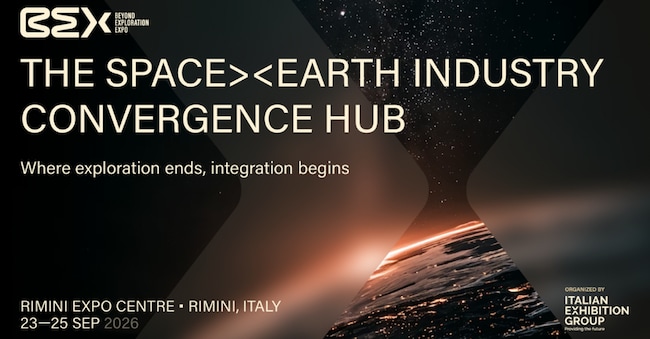
BEX - Beyond Exploration Expo aims to provide a framework for this exchange. It is the first Italian expo-conference dedicated to the convergence between the space economy and terrestrial industries, scheduled to take place at the Rimini exhibition centre from 23 to 25 September 2026, organised by Italian Exhibition Group.
The first edition is an official stop on the ‘Stati Generali della Space Economy 2026’ itinerary, placing it firmly on the path through which the country is developing its national strategy for the sector.
“We want to create a space where expertise, including that from sectors not traditionally associated with space, can generate innovations and transform them into new market opportunities,” explains Alessandra Astolfi, Global Exhibition Director of the Green & Technology division at IEG. “The exchange is two-way: technologies developed for space find applications in terrestrial sectors, whilst expertise gained on Earth contributes to the development of the space industry.”
The programme is structured across three areas, each designed for a different audience.
The first concerns capital, the most sensitive issue for those working in the space sector, where projects have long timelines and require significant investment. The Space Finance Arena, organised by BEX in collaboration with Plug and Play Tech Center, brings start-ups, SMEs, investors, banks and insurance companies together around the same table. The format turns convention on its head, as in a ‘reverse pitch’ it is the investors who present themselves to the companies, rather than the other way round. Seated around the table are EY, CDP Venture Capital SGR and specialist funds such as Galaxia and Primo Space, alongside INCUBED, the ESA’s co-funding programme.
The second theme is the big picture. To kick things off, the BEX Vision Summit brings Axiom Space and Leonardo Space to the main stage, with MEPs Elena Donazzan and Giorgio Gori representing the perspective of the European institutions.
The third section focuses on industrial convergence. The BEX Technical and Scientific Committee, together with the ESA, is dedicating a keynote session to advanced manufacturing for space: certifying components on the ground before manufacturing them directly in orbit. Explaining how to build a component capable of withstanding such conditions is Dallara, the Motor Valley-based company specialising in composites, which works with these materials every day for a world that, only at first glance, appears to have little in common with space.
The same logic is evident amongst the exhibitors. Alongside the space industry, represented by Leonardo, Thales Alenia Space, Telespazio, OHB, Argotec, Altec, Planetek and D-Orbit, are companies from worlds far removed from one another, such as Dallara, Spacewear, GVM, Gruppo Hera, Legor and BTT Impianti, alongside EY. On the institutional side, the conference programme involves, amongst others, ASI, CNR, ENEA, ESA, the Ministry of Enterprise and ‘Made in Italy’, Confindustria, Confagricoltura, the Italian Air Force, the Italian Navy and the Politecnico di Milano.
A Technical and Scientific Committee chaired by Professor Giuseppe Sala, a full professor at the Politecnico di Milano, ensures the rigour of the content. A dedicated space, the Open Innovation District, brings together start-ups, universities and research centres with businesses and investors, forming the programme’s most dynamic and experimental component.
The fundamental question remains – the one posed by a company that has never had anything to do with space: what can it take home? BEX responds by bringing together, in the same venue for three days, those who produce the technology and those who might use it, with the aim of ensuring that the convergence between space and industry ceases to be a mere coincidence and becomes a market. The event will take place in Rimini, from 23 to 25 September 2026.

