
Beyond the sea, explorations in the quiet countryside of Sicily
In the hinterland, hospitality projects have sprung up and are being developed that enhance the inland areas and revive ancient bagli and villages between tradition and innovation

4' min read
4' min read
Piero Guccione loved the moody sea in the province of Ragusa. All his life he painted it trying to capture at times its calm stillness, at others its thunderous anger, as can be seen in his splendid oils exhibited in the new Stanze di Piero, in Scicli where he has also just opened the Carmine Museum of Contemporary Art. There wasn't a day when he didn't go for a walk on the beach at Sampieri, two kilometres to the old Pisciotto kiln with its now halved chimney. The other painters of the Scicli Group, of which he was leader with Franco Sarnari, preferred to paint the countryside. That countryside that in spring is an exuberant green and in summer brushes the hinterland with gold. Yellows, ochres, browns, hedges of prickly pears, almond trees and carobs with twisted trunks sprouting from that scorched earth like desperate souls. Courtyards, sunny terraces, doors closed until eight o'clock in the evening, when the light finally gives a respite and leaves a glimmer of coolness. In those paintings, one seems to smell the scent of jasmine and the chirping of cicadas, so real are they.
The Sicilian hinterland is mysterious, a masterpiece of nature and man who has drawn the borders with dry stone walls, and every plot is a story of small producers and noble estates, where cheese and ricotta, salami and sausages, oil and gold-medal wine are born. It seems that Sleeping Beauty has finally woken up after centuries and suddenly wants to tell her stories.
New projects for the hinterland
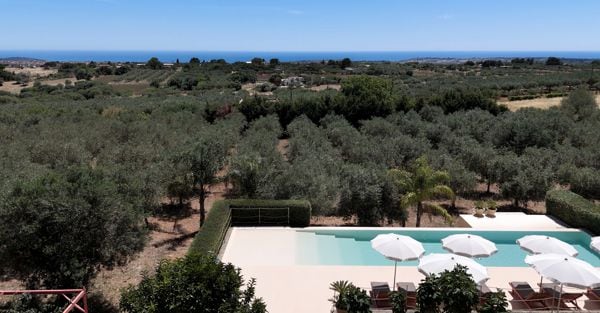
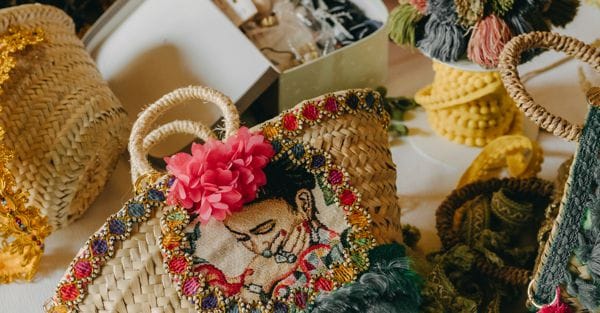
.The hunger for more authentic tourism has put Sicily in the spotlight, and here it is announcing ambitious renovation projects under the banner of its proverbial hospitality. Large groups have garrisoned the coast, such as Belmond and more recently Four Seasons, which has induced a sell-out in Taormina over the last two years with its 'The White Lotus' series. While Rocco Forte, after two successful outposts on the sea - the Verdura in Sciacca and the Villa Igiea in Palermo - is transforming the 18th-century Palazzo Castelluccio in Noto into a new five-star hotel expected in 2026. A satellite for designers and creatives who have found their corner of paradise there and a film set location for their social events, Noto is now a star, beautiful and already too famous. But you need only move a little to find places and atmospheres far removed from fashion. In the sea-view countryside of Avola, Braccialieri opened in April, four rooms in the historic masseria and six eco-villas scattered around an estate of 2,200 olive trees and 250 almond trees. On the one hand the agricultural project, on the other the small hotel curated by the explosive Alessandro Enriquez for the Cancemi family. The centrepiece is the red and white chequered swimming pool with the inscription 'Don't forget to love' on the bottom, surrounded by sun loungers and umbrellas with red geraniums, as well as wall hangings with lemons and mandarins and dinnerware with the project's theme: love for Sicily and for life in general. In that little world that churns out parmigiane and serves granita at will, one feels at home with relatives or friends. You don't miss the sea, which can also be reached by sight, before arriving at the beach club. The Occhipinti sisters, on the other hand, have given the province of Ragusa, one of the most reticent to make a name for themselves. Arianna, an oenologist, with her amazing wine cellar in Vittoria, and Fausta, an architect and landscape architect, with Baglio Occhipinti, a flourishing farm with vegetable gardens and charming rooms nearby. Their main activity is relaxation, alternating with lessons in cooking, pastry making, painting, and decorating straw coffees. But this is just a taste.
The Rebirth of the Belice
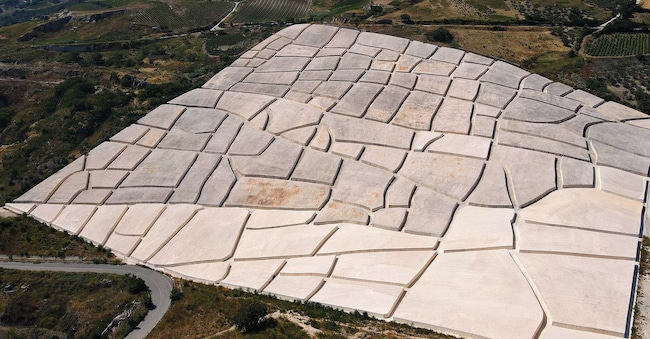
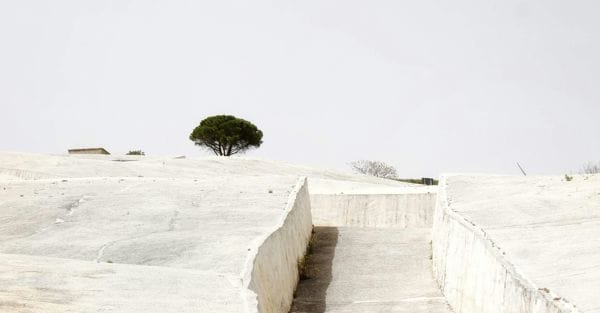
.The slow, rural holiday appeals to travellers and is growing throughout the island from east to west. In the hinterland of Menfi, La Segreta opened in 2024, the country house of the Planeta family, producers of excellent oil and wine that are exported all over the world. Ten rooms of a monk-like simplicity in which to isolate oneself from everything, with the comfort of a swimming pool and the home cooking of Angelo Pumilia, chef also of the nearby Foresteria immersed in a garden of aromas and of the Insula beach club soon to follow. Slow life also prevails here, but the location is strategic for exploring one of the island's most undiscovered corners, from the archaeological excavations of Selinunte to the contemporary surrealism of Alberto Burri's Cretto, Europe's largest work of land art. This masterpiece is located in the Belice valley that in 1968 a 6.4 earthquake shook, crumbling houses like shortbread biscuits. The foundations remained there, a visceral wound, until 1981, when Ludovico Corrao, an enlightened mayor, opened a competition for a few artists to transform the site into a memorial, in continuity with the museum of contemporary art (Mac) he had created in the new town, 11 kilometres away. Of all of them, Burri's idea to reconstruct with rubble and concrete the three-dimensional map of the village with the chessboard of blocks and the interweaving of streets won. From a distance, the impression is of a gigantic white shroud lying in a landscape of hills. There is no entrance ticket, no caption or fence. More frequented by flocks than by people, it is an extraordinary public heritage that, together with the 400 works of the Mac in the new town, have earned Gibellina the nomination, for 2026, as the first Italian Capital of Contemporary Art, with the allocation of one million euros to be invested in cultural activities and redevelopment.
So close, so exotic
There is no shortage of projects, a new energy is flowing through Sicily, which has not staked everything on seaside resorts, but on its interior enhanced by local businesses with a contemporary vision, by important recognitions such as Agrigento Italian Capital of Culture 2025, by film productions such as 'The Leopard' recently released on Netflix, where the countryside is a crucial element of the narrative: Donnafugata, the Calanchi di Cannizzola, Ciminna have rendered well the atmospheres of Tomasi di Lampedusa's novel and with their charm have ignited curiosity about a destination that is close and yet so exotic.

