
Bezos: 'Artificial intelligence? An industrial bubble, but it can be positive'
Amazon founder at Italian Tech Week in Turin: 'AI is real and will change every industry. We live in a golden age, there is reason to be optimistic"

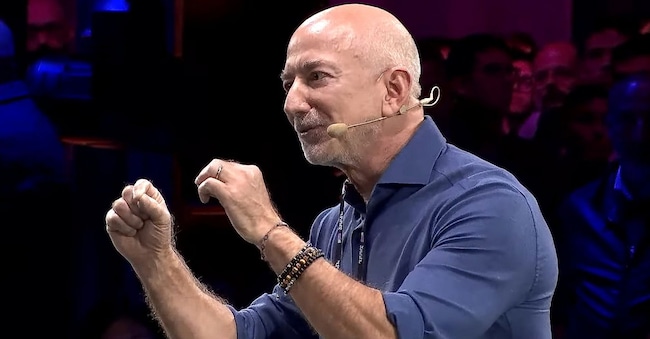
Breakthrough technology with applications in all fields, a challenge to be met and an opportunity to be seized: artificial intelligence is here to stay. But what if it is a bubble, like the internet was 25 years ago? Throwing the rock was Amazon founder Jeff Bezos: 'AI is real and will change every industry. We are living in a golden age, there is reason to be optimistic. There has never been a better time to be an entrepreneur and to launch a start-up,' he said from the stage of Italian Tech Week, at the OGR in Turin. However,' he explained, 'when people get very enthusiastic, every 'experiment' finds funding, making it difficult for investors to distinguish a good idea from a bad one.
The risk
.And thus, the bubble risk is born: 'This AI bubble is a kind of industrial bubble, different from financial ones. Industrial bubbles are not so harmful: they can turn out to be positive, because when the dust settles and we see who the winners are, society benefits from those inventions,' said Bezos, in a dialogue with John Elkann, CEO of Exor, who with the early-stage investment platform Vento organised the tech conference, where more than 15.000 entrepreneurs, investors and innovators, as well as authoritative voices such as the President of the European Commission, Ursula von der Leyen, Microsoft CTO Kevin Scott, Sap CEO Christian Klein and Goldman Sachs number one, David Solomon.
Elkann's caution
.And it was Elkann himself who preached caution: 'The internet bubble has similarities with AI. If we go back 25 years, when the internet was on the rise, no one could have predicted the industrial benefits that would result. My instinct is to be cautious', however 'remaining extremely optimistic that the social consequences and benefits of artificial intelligence are concrete and made to stick', just as it did with the internet. This is why, according to Elkann, 'it is important to distinguish speculative bubbles and their possible consequences from the real long-term context. Because if we look at AI in a similar way to the internet or electricity, we see that it is destined to spread widely'.
Von der Leyen: 'Changing gears in Europe'
.The watchword is therefore optimism, as von der Leyen explained, clarifying that it is however necessary to 'change gear in Europe', to avoid falling behind in a competition that 'is only just beginning'. And we must work to ensure that great talents found in Europe, and in Italy, do not flee elsewhere: 'I want the best Europe to choose Europe. And I want the future of artificial intelligence to be written in Europe,' she said. It is true that there are many obstacles, first and foremost the lack of funding and the slowness with which new technologies spread. But the course can be reversed: 'There is no lack of capital in Europe. European household savings amount to almost EUR 1,400 billion, compared to just over EUR 800 billion in the United States. What is lacking is venture capital and equity,' von der Leyen said, anticipating that 'next week we will present a strategy for applied AI, which is based on a simple but revolutionary principle: AI first'.
Europe, therefore, can meet the AI challenge: 'People say there are too many rules, but those are there everywhere. Europe has all the necessary ingredients to be entrepreneurially dynamic and enormously successful,' Bezos said.


