Open call Italian Pavilion

BHMF to enhance Afro-descendant communities and cultures

For the curatorial collective that started with Black History Month Florence, representing the country means recognising its history of exchanges, shifting borders and mythologies.

by Marilena Pirrelli and Nicola Zanella

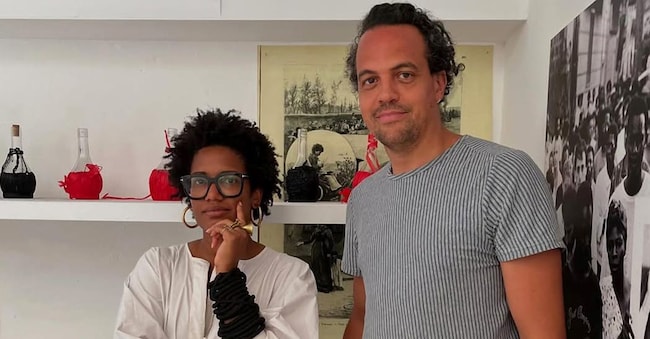
Justin Randolph Thompson e Janine Gaëlle Dieudji. (Credit Bradly Dever Treadaway)

4' min read

4' min read

BHMF (Justin Randolph Thompson and Janine Gaëlle Dieudji) is a curatorial collective formed as part of Black History Month Florence, an initiative founded in 2016. Dieudji is a curator of French/Cameroonian nationality with years of experience in the institutional context, having collaborated with prominent entities such as the Smithsonian National Museum of African Art, MACAAL (Museum of African Contemporary Art Al Maaden), Alserkal Avenue and Festival France Odeon, among others. Justin Randolph Thompson, born in 1979 in Peekskill (NY), is an artist, educator and cultural facilitator, winner of awards such as Italian Council and Creative Capital, and curator of projects including 'On Being Present' for the Uffizi Galleries.

Tell us about yourself, your path and your curatorial vision? Above all, which exhibitions, in terms of impact and importance, can be qualifying of your path?

Loading...

Together we co-founded and co-direct the Florentine research and cultural centre The Recovery Plan. We share the urgency of making complex cultural narratives accessible to a wide audience, with a particular focus on Afrodescendant histories and cultures, often marginalised in the Italian context. Our practice takes the archive as a critical tool and at the same time as an invitation, valuing the multiple forms of knowledge production present in the communities that surround us, and placing the celebration of artistic research at the centre.
Our work is developed predominantly through collaborative processes. In this sense, Sammy Baloji's solo exhibition 'K(C)ONGO: Fragments of Interlaced Dialogues. Subversive Classifications', presented at Palazzo Pitti and curated together with Lucrezia Cippitelli and Chiara Toti, emblematically represents our approach. Among the key exhibitions that reflect our perspective and visual language, as well as our vocation for institutional collaboration, are the numerous exhibitions at the Murate Art District such as 'Memory Effect', 'Repose and Resist' and 'Tremendous Mobility'. On all these occasions, artists from different geographies and generations have dialogued around the archive understood as a living organism in continuous transformation.

Looking back, is there an Italian Pavilion that has particularly impressed or inspired you and what mistakes should not be repeated? And broadening your gaze to international ones?

We are reminded of 'Il Mondo Magico' curated by Cecilia Alemani. It was a pavilion of particular impact. We appreciated its detachment from the national political narrative that tends to follow a canonical understanding of Italy and often leads to didactic or caricatural results. The work was poetic, profound, theatrical and careful in devoting great respect to the spatial management of the artists involved. Nationalism is a slippery slope; it must be approached with care and attention to nuance to avoid replicating clichés.

What does it mean to you to represent Italy in the artistic field? And in general, what are the values and characteristics that represent contemporary Italy?

Representing Italy means acknowledging its history of exchanges, moving borders and constituted mythologies, while at the same time becoming aware of the limits imposed by a historiographical canon founded almost exclusively on the celebration of greatness. Highlighting what has been overlooked in the processes of narrating history and constructing the canon is a necessary attitude for reflecting on the distancing of epistemologies that traverse the dense mesh of archives. In order to anchor contemporary Italy, we need to challenge the archive and the consolidated critical-artistic heritage, which from fixed structures become living, narratively present environments that concern everyone. We need a repositioning of permanence and matter as central elements of the history of monuments and the notion of preservation. To reread is not to erase, but to rework history and our relationship with it; this is fundamental in this moment and in our work.

Being the curator of a national pavilion is a commitment that involves many qualities: organisational skills, fundraising skills, being able to respond to criticism and external pressure. What are your strong points?

We built Black History Month Florence and The Recovery Plan from the ground up, cultivating and curating a community of artists, scholars, students and activists, and connecting with a plurality of cultural institutions in the area. This has meant facilitating processes of historical narrative and fostering a sense of solidarity and collective responsibility. This has been possible thanks to a core group of transnational fellows and professionals deeply embedded in the arts and culture, but also through the involvement of people from other fields, encouraged to develop new visions and trajectories. The community shapes us and supports us in everything.

 By the way of fundraising, the MiC's General Directorate for Contemporary Creativity in 2024 financed the PI with 800,000 euros, the rest was supported by private individuals. Do you already know the Ministry's figures for the next Italian Pavilion? For the presentation of the project you are already required to have the endorsement of potential sponsors, how is it going? Tell us...

Fundraising in the Italian cultural sector constantly presents challenges, particularly for bottom-up initiatives and the cultural sector in general. But through collective efforts and public-private partnerships, there is the capacity to transform the economy of a system that too often relies on a few voices. As a Florentine reality operating in dialogue with a vast national and international network, we have always found a way to build an incisive vision capable of meaningfully celebrating all the actors involved and, at the same time, of recalling the continuity of commitment that our sector urgently needs.

Copyright reserved ©
Loading...

Brand connect

Loading...

Newsletter

Notizie e approfondimenti sugli avvenimenti politici, economici e finanziari.

Iscriviti